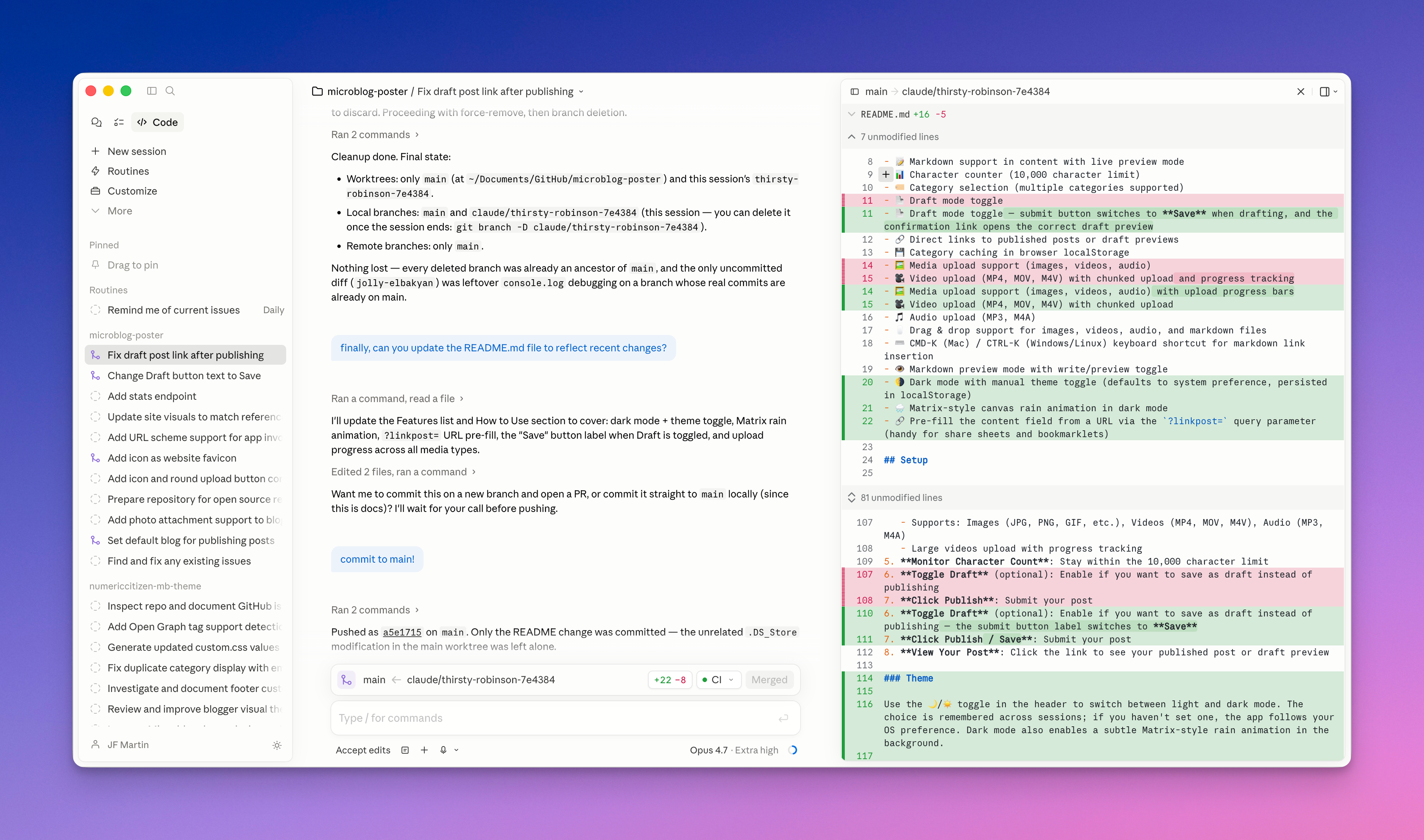
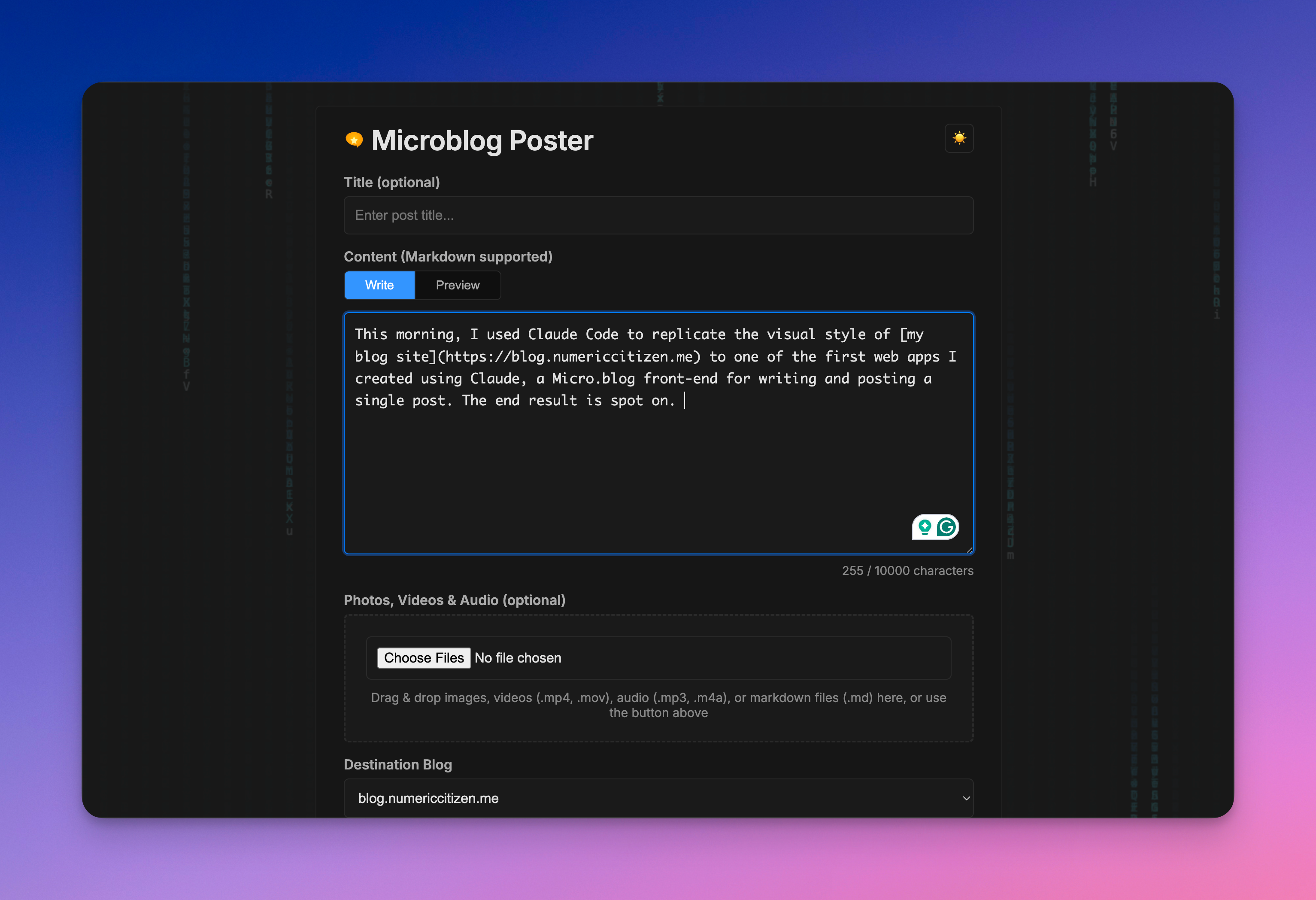
“Please, add a map of all the places I visited based on photo metadata”. “Add animation across the site to make it more dynamic, nothing too fancy”. “Please, add support for progressive web app and make sure to set the favicon with the provided image”. “Add support for swipe gestures (ledt and right) while glancing at individual image”. “Add a counter of how many images are stored in each album”.

Are you getting it?

This is simple web app development in 2026 built using Claude Code, Vercel, Next.js and Tailwind CSS. 🤯

Building A Dedicated Photo-Sharing Website in Claude Code

Thinking about the upcoming trip to Egypt, I realized I still didn’t have a good solution for sharing photos and comments beyond the usual social networks. Drawing on my experience from the past few weeks deploying web applications on Vercel, I decided to try the same by building a website for sharing and viewing photos. The additional complexity here is that the viewing portion is separate from the photo upload section. Therefore, I need to protect this feature with a password. Additionally, image storage must be optimized to minimize costs and provide a pleasant, flexible viewing experience. I’m using Vercel-only blog storage and Redis for metadata store.

In less than 2 hours, I built a fully functional application with Claude Code and Vercel. Impressive.

I completed implementing automated backups of all my n8n workflows to GitHub and documenting their triggering times in a compact format using Claude AI. The backup workflow is based on a template found in the n8n community.

This is how I glance at my Micro.blog timeline recently, using my n8n automation and my personal Discord server. The summary structure varies from one edition to another, likely due to the unpredictability of LLM on top of content variations. When something catches my interest, I go directly to the timeline or my timeline RSS feed to pick it up. I get these summaries every three hours. It’s fun.

Anthropic on Cowork:

“That said, there are still things to be aware of before you give Claude control. By default, the main thing to know is that Claude can take potentially destructive actions (such as deleting local files) if it’s instructed to. Since there’s always some chance that Claude might misinterpret your instructions, you should give Claude very clear guidance around things like this.”

and

“You should also be aware of the risk of “prompt injections”: attempts by attackers to alter Claude’s plans through content it might encounter on the internet. We’ve built sophisticated defenses against prompt injections, but agent safety—that is, the task of securing Claude’s real-world actions—is still an active area of development in the industry. "

A world of possibilities awaits you. 🫣

On Apple’s Deal with Google

Back in November, Google announced Private AI Compute, positioning themselves to offer something like Apple’s Private Cloud Compute. It might be something that OpenAI wasn’t willing to do or didn’t see a fit in their business mission. By offering Private AI Compute, Google might have secured the business with Apple. Anyway, it’s becoming impressive how Google is taking back the lead in AI. Lastly, maybe we will see Google Gemini being added to this week’s next beta of iOS 26.3 to go side-by-side with ChatGPT?

I just discovered that Raindrop.io offers many integrations, including n8n! I might need to reconsider my bookmarking strategies, yet again. I’m currently using Anybox. 🤔 I’m exploring ways to move the data around. If you made a similar move, I’ll be more than happy to learn about your experience. For now, I’ll prompt ChatGPT for strategies.

This diagram tries to illustrate the how modern AI, Claude AI in particular, compares to traditional computing paradigm. Models more or less are processors, Agents are more or less the operating system and Applications are more or less Skills. It’s interesting, but I’m wary about agents because they open up too many pandora boxes.

I made two important changes this morning for my automation-related operating environment:

  1. Using DigitalOcean monitoring, I created two resources alerts (CPU > 50% for 5 min, Disk usage > 70% for 5 min). Alerts will make me look into n8n automation misbehaviours.
  2. I switched my AI nodes to use Claude AI Haiku 4.5 instead of Sonnet 4.5 to reduce costs for comparable results. I don’t think my summarization tasks needs more powerful LLM.