I’m trying something new this year for my year-in-review blog post. Using all my monthly post digests stored in Craft1, I’m using ChatGPT to look at those digests, take into account last year’s year-in-review article, plus this year’s document personal milestones to suggest ideas. This is now possible because Craft now supports MCP. Using the best ChatGPT models, I get a lot of material to consider but somehow I feel this is really overwhelming. I should be more directive like limiting the number of possible scenarios, their length, etc. I’m still exploring this workflow.


  1. I subscribe to my own blog post digest newsletter for archival purposed. ↩︎

Rant on. I’m judging on facts and acts, not with what someone says. Some people might defend web openness et al, but sharing on x.com in 2025 because it’s the place most people go is not an act of openness. It’s an act of contribution toward fascism. Stop pretending, people, don’t be lazy, stop taking shortcuts and leave x.com once and for all. Rant off.

Algorithms, Platforms, and the Personal Web Space

The piece) from Disassociated about being “freed from personal websites” thanks to algorithms and timelines really resonated with me. I’ve long believed that platforms are killing the web; they are not the web.

I recently asked my son if he had ever considered having his own personal website—a blog, having a place outside the usual platforms. His immediate response was, “But what about discoverability?” Why I think that everything comes down to that: It’s always about beating the algorithms (hello SEO) so that we are “discovered”. I always believed about my own existence without the need of any algorithm. Same with my wife: she knows about my websites but rarely visit them. She’s always talking about discoverability too, thinking that there is no future if I’m not one those platforms. She couldn’t be more wrong. And yet… Platforms have obscured the open web, plain and simple.

This led me to a question that keeps circling in my mind: if we go back 50 years, how accurately did newspapers reflect reality? And how different is our situation today? Yes, the speed and reach of information are radically different now, but consider people who read only one newspaper—like my father did when I was young. Weren’t they also shaped, if not manipulated, by that publication’s editorial line?

Disclaimer: I feel my feelings are well reflected in those few words… it’s complicated.

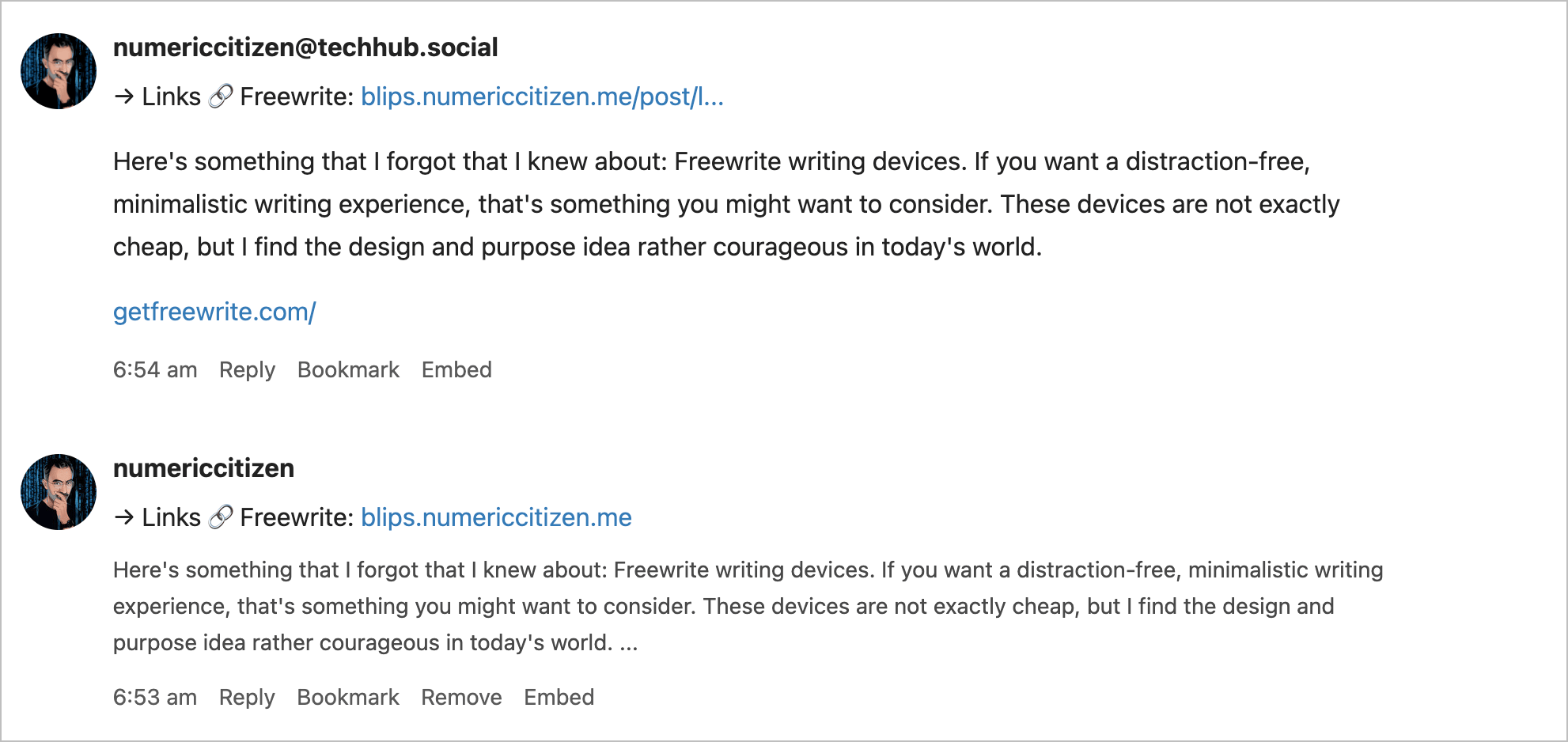
When blogging from Scribbles.page, this is how the blog post will appear on my timeline (because I use Micro.blog’s RSS feed reading capabilities, which is really cool). The first occurence of the post is the cross-posting result from Micro.blog to my Mastodon account (yes, I subscribe to my own Mastodon account). I see the full post including the shared link. The second occurence is the RSS feed article as grabbed by Micro.blog and reposted on my timeline; if you follow me on Micro.blog, this is what you will see. The post is truncated and the link is missing. I think there is room for improvement here. cc @manton

The latest edition of the Ephemeral Scrapbook newsletter is out (Craft-based version). In case you didn’t know: this is a free newsletter available to a mailbox near you (to go out later today). Pas editions can be found here (Both, Craft versions & Web versions).

Here’s another edition (Craft edition) of the world-famous Ephemeral Scrapbook newsletter. It’s also published as a free newsletter on Ghost. Maintaining this newsletter is quite fun and forces me to explore more than I would if I weren’t authoring it. My publishing cadence is also quite consistent. I wish more people knew about it and would subscribe… but hey, that’s the life of any blogger.

I began my writing project for the Apple Journal review. For this project, I will try a different approach1. I started experimenting with the Perplexity Comet browser to survey past reviews. I use genAI to create quick summaries of previous articles. I save text highlights in Inoreader for the most interesting past reviews. I use Craft to compile all my knowledge and copy-paste the genAI summaries. However, I’m unsure where this will lead.


  1. Dare I say ‘modern approach’? ↩︎