Today is a reminder that the internet is probably the worst place to have a debate. You would think that Mastodon or Bluesky or Thread are better than X, Y and Z? Nope. Same. Arguing the contrary is shortsighted. Even arguing in a text message conversation is not a good idea.
Thought of the day: read-later services or applications are a consequence of facing or having too much content available and a lack of time for consuming that content in a timely matter. ☝🏻
The usefulness of ChatGPT for me is as a replacement for using Google when I have to learn something new (eg an API). Formerly, I would have Googled, and then visited a bunch of results, and learnt a little on each page until I had built up an answer for myself.
I see ChatGPT as a Google mashup. It takes those Google results, and mixes them up to give me a more direct answer to my question. Previously, my own brain would have to do that mashup.
I do exactly the same but for a subject that I don’t really know. I’m curious to know if Google’s traffic is affected by this change of behaviour.
Om Malik on Threads capabilities in regards to sharing and consuming photo content: Threads, Twitter, & Social Photos
The design is particularly conducive to viewing photos. The white space, the way the photos are rendered, and the styling of photo collections enhance the overall presentation. The vibe on Threads is the polar opposite. Even John Gruber, a long-time critic of Facebook, has been vocal in his appreciation of this new product from the same company. It’s surprising to see him overlooking the poor privacy-related track record of the Facebook family.
and
Still, Threads offers photos and photographers a second chance to find a home beyond a dying Instagram.
I deeply respect Mr. Malik😒, but there is zero chance that fancy web design will erase Meta’s business practices and business model. I refuse to consider Threads as an alternative to Instagram. It’s a matter of time before Threads becomes another Instagram-type platform. Just wait for it. Now, excuse me, I have some photos to post on Glass and Pixelfed. Thank you. 😜
Has putting Apple silicon in the iPad set unrealistic expectations?
The Mac feels too much like a computer that has felt too overwhelming and the iPad is like the smartphone they have already been using.
At some point in the more or less distant future, the iPad form factor will take over. Just like cars took over trucks a long time ago. Just like most people use a smartphone as their main computer or as their only computer, the iPad will eventually be regarded as “a real computer”, the only computer, if people are willing to add something on top of their iPhone. One day.
In a world where we all struggle with how much we use our devices (let’s be real, we mean our phones), I think it’s kinda nice to have some places that just give up and tell us, “my dude, you’ve read it all, go do something else.” Source: Let the internet run out
I relate to this thought so much. Sometimes, enough is just… enough.
“At age 20, we worry about what others think of us. At age 40, we don’t care what they think of us. At age 60, we discover they haven’t been thinking of us at all.” — Ann Landers
★ Holy Hell, Trump Did Use Twitter Direct Messages, There Were ‘Many’ of Them, and the Special Counsel Now Has Them
https://daringfireball.net/2023/08/holy_hell_trump_did_use_dmsReader: mastodon.social daringfireball.net
The situation with Trump and his extensive use of Twitter and how Twitter responded to the search warrant/court order confirms that leaving Twitter was one of my best decision in a long time. Twitter’s actions to protect Trump are disgusting (telling him that there is a search warrant targeting his use of the platform). I cannot, in good faith, be on such platforms.
Apple Should Introduce FlightPlay™
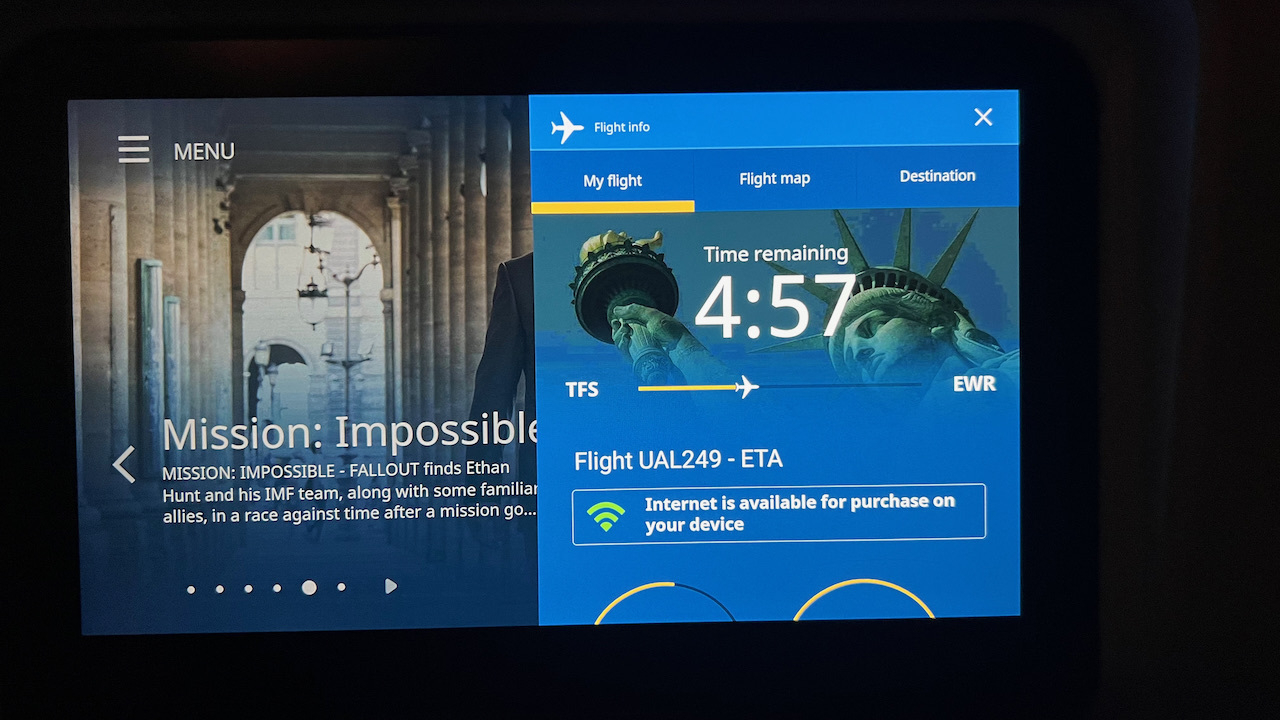
Recently, while on a flight with United from Tenerife to Newark, I played with the infotainment screen in front of me. These infotainment systems really improved in recent years. Screens are bigger, speed is much faster, and interaction has improved quite a bit. Some of these systems look like iPad-in-the-seat, literally. It occurred to me that Apple while offering CarPlay, could try to find a way to create a version for flight infotainment systems. Let’s call it FlightPlay because Flighty is already used, and AirPlay, too!
I want each plane to offer a complete set of flight data, ready to be consumed by my iPad or iPhone while in flight via a local wifi network. The iPhone or the iPad would then turn into a special StandBy mode where data would be visually presented dynamically, allowing for great interactions with the user. Modern devices have so much powerful CPU, the interaction would be much more fluid and enjoyable. The data provided would be based on a standard model and would provide speed, altitude, current destination, path, atmosphere metrics (temp, headwind speed, etc.), and so much more. The airplane company could directly provide TV shows, music, etc., to our devices. The same would be for games. But Apple could also allow consumption of locally stored content from the device itself. I can imagine Apple’s designers working on a great graphical dashboard.
Is anybody at Apple reading this? What are you waiting for?