Looking behind the scene. (#blogging #Hugo #html #git #github)
It all started with the idea of tweaking my micro.blog visual theme. I don’t like it, but this is the best that I could find from the included themes. After reading for a while and seeing people writing about their blogger workflow, I found out that Micro.blog is using Hugo, a static website generator. Then I started to learn about Hugo by searching for introduction videos on YouTube. Then, I learned about Hugo themes and how they are constructed, and at the center of how a website is displayed. Since static websites need a place to be stored, GIT and Github came into the picture. So, I started to read about GIT and Github. Git and Hugo both can be installed on my Mac mini to locally create content and generate a microblog from that. It a great experimentation place to learn and dig a bit deeper. Github is also a place to find new Hugo-based visual themes. Then I learned that I can import one of those themes on my machine so can change the visual appearance of my local Hugo microblog. Then, came the idea of publishing this content on the web, on Github, for free. To close the loop, services are available to take Github content and generate a static website, again using Hugo, behind a domain name of my choice. Then came the question: why do I need Microblog then? I could own the whole widget! It’s not that simple.

All this because I’m not satisfied with my current Micro.blog visual appearance. The next step is to dig within Micro.blog custom templates and see how I can update them. I’ll have to refresh my memory about HTML and learn a bit of CSS. The latter seems a bit an arid subject. Oh well.

Dear Micro.blog, where do you plan to go next? (#microblogging #microblog)

Thought of the day for @manton and @jean: there is something that could be improved regarding micro.blog: opening up the evolution and improvement roadmap of the platform. I do appreciate when a service do put out their roadmaps so the community get a better look at where things will be going in the future. Mailbrew, Plausible and Craft are very vocal about their future plans, you just have to find the place where they talk about it.

So, where is Micro.blog heading? In particular, how do you plan to expand on themes support and customizability? Why the web editor doesn’t allow support for Grammarly? Do you plan an opt-in option to see how many followers a user have? Those are just a few questions that I have regarding Micro.blog future plans. Thanks in advance.

Hey @jack! Let’s start a discussion.😊 I’m looking at your sites, your work and the tools and services you use. I’m very curious about how it all fit together. I’m curious about this Hugo thing, Github as a storage service and content editors and how they all talk to each other. Maybe others would be interested to discuss their options and workflow too. Chime in!

Let’s start like this: I started to look closely at Hugo and now I do have a better idea of this engine. What is less clear is this. Suppose I’m running an instance of Hugo on my M1-based Mac mini. Where does Github fit? Why I would use it?

Writing, like so many creative acts, is hard. Sitting there, staring, mad at yourself, mad at the material because it doesn’t seem good enough and you don’t seem good enough. (Ryan Holiday, Ego Is the Enemy)

I know this feeling really really well.

Giving without asking in return (#bloggerlife #blogging #writing)

Greg Morris recently on his blog about trying hard as a blogger to make something out of all this:

“I asked, I’m giving, and I am still blogging — now more than ever.”

Strangely, pure coincidence I guess, I wrote this last week-end “The journey is the Reward” in which I said:

“It doesn’t really matter if nobody comes and reads my stuff here or there. What matters is the process and the thinking that took place behind my writing. It’s all the small moments where I had to pause, think, read, learn and write. It’s about feeling creative. Alive. The rest is just another tiny drop in the numeric ocean. A few will taste it, and most won’t. That’s the life of a blogger and a writer in a sea of abundance. So, I’ll keep doing it, no matter what.”

The journey is really the reward for me.

Desktop vs Laptop vs Mobile vs Tablet (#blog #bloggerlife #analytics)

Here is something absolutely fascinating and surprising to me. According to my main blog’s visitors statistics, thanks to my recent switch to Plausible, over the last thirty days, the distribution of devices type used to visit my blog puts the tablet far behind the desktop, the laptop and the smartphone. One would think the tablet form factor to be much more popular.

The iPad is massively popular. I’m still in love with this form factor after all these years. These numbers doesn’t jive.

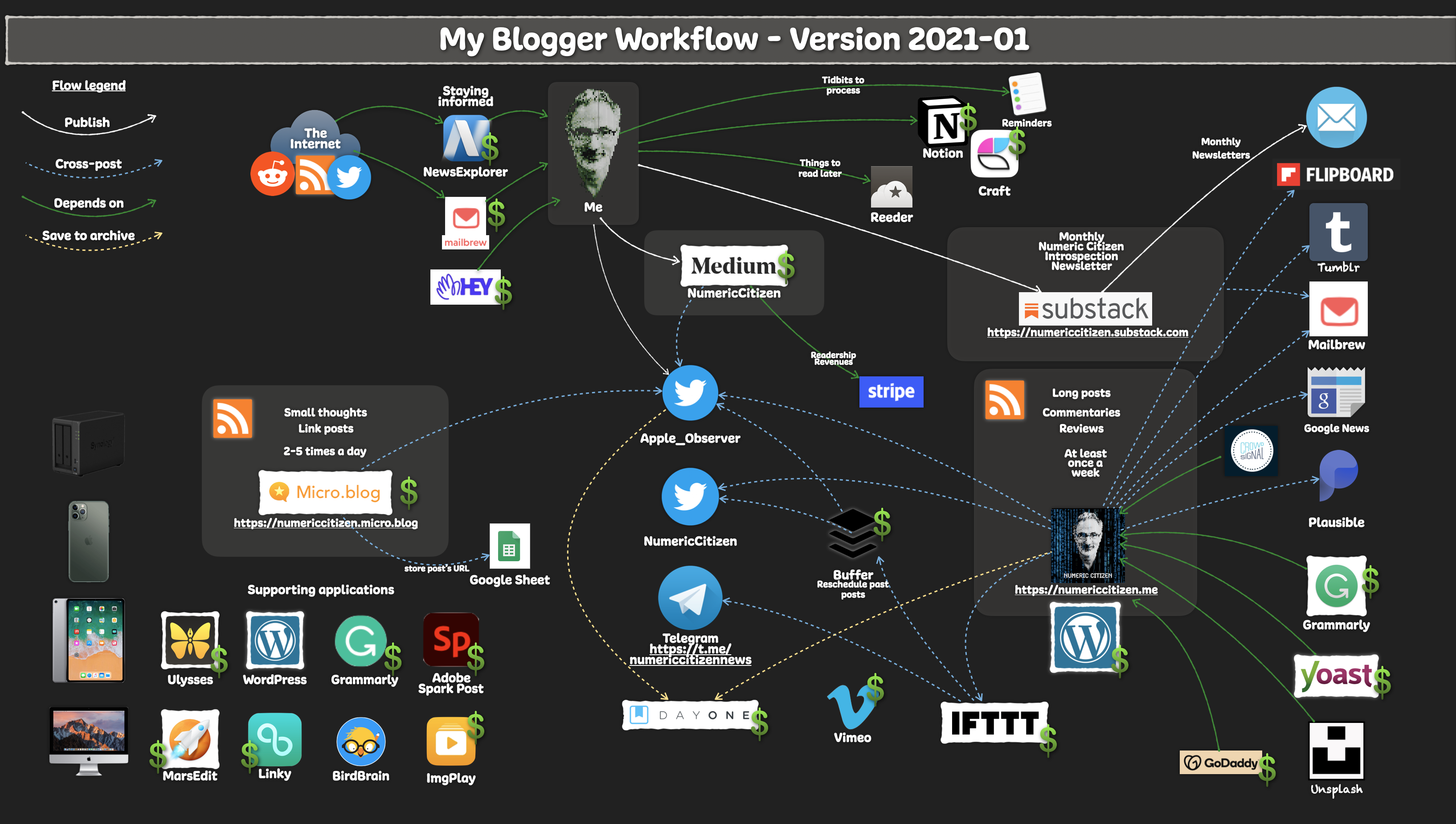
Our secret? Optimizing workflows (#blogger #writer #tools)

I like to see other people talk about their own writing or blogging workflows. Here’s an interesting tidbit from Greg Morris about using Apple’s Shortcut to publish to WordPress:

“Shortcuts is a really robust way to publish to WordPress and not have to use the WordPress app or third-party app.”

Apple’s Shortcuts are also an important part of my blogger workflow. Since I’m using Ulysses, which supports publishing directly to WordPress, I don’t need a shortcut for that. But for many other small things, it is a valuable tool in my arsenal. Shortcuts are an interesting technology within the iOS and iPadOS ecosystem.

Being robbed, again (#stealing #robbing)

A yellow square with an angry face painted on it is placed against a red brick wall on a concrete surface.

Someone stoled my most recent article. I hate when this happens. I guess my article was good enough for this guy to bother.

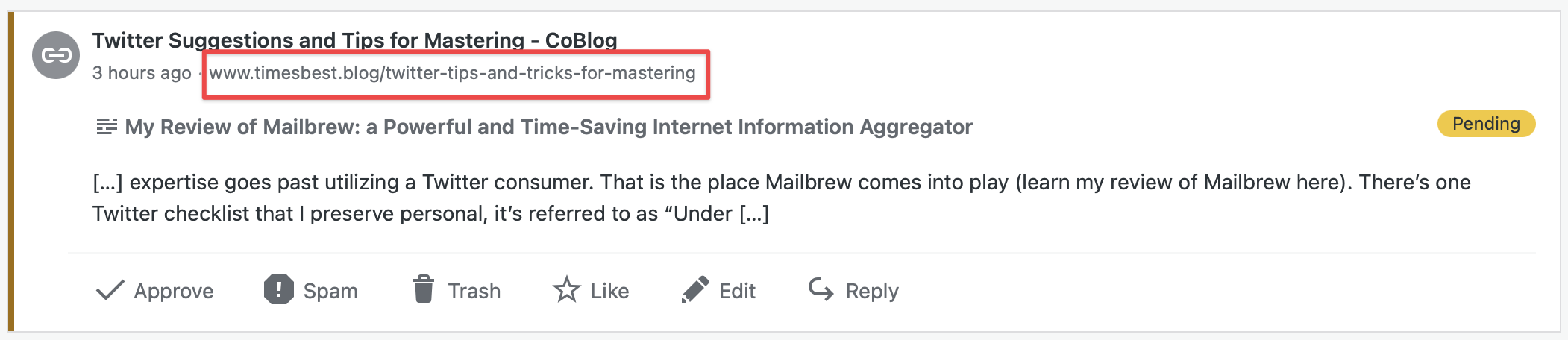
This morning, I got a pingback on WordPress for an article being published elsewhere as shown below.

A screenshot of a comment on a blog post promoting an article about mastering Twitter, including options to approve, mark as spam, trash, edit, like, and reply.

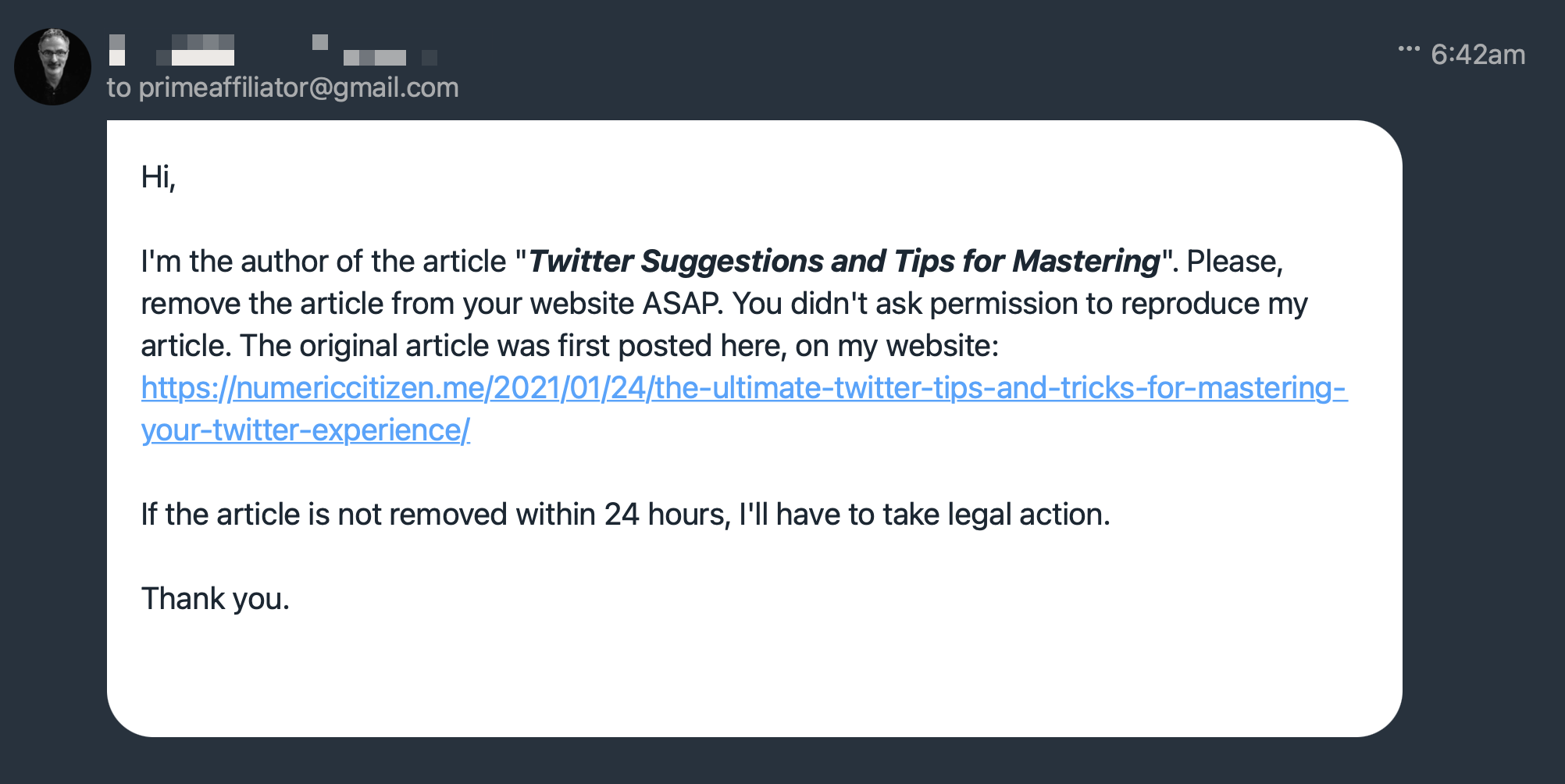
Someone copied my latest article “The Ultimate Twitter Tips and Tricks for Mastering Your Twitter Experience”. By doing so, he forgot to remove one of the URL pointing back to another previously published article, “My Review of Mailbrew: a Powerful and Time-Saving Internet Information Aggregator”, I was notified via a pingback. I paid a visit to the “publisher” and sure enough, 90% of my article was reproduced. The guy removed the screenshots but left the captions (weird). The title was modified too. The conclusion was removed. Here is what I wrote to the “published”:

I also posted the same thing on the comment section but comments being moderate, I don’t think the guy will republish them. I will see what happens. This is the second time this happens to me.

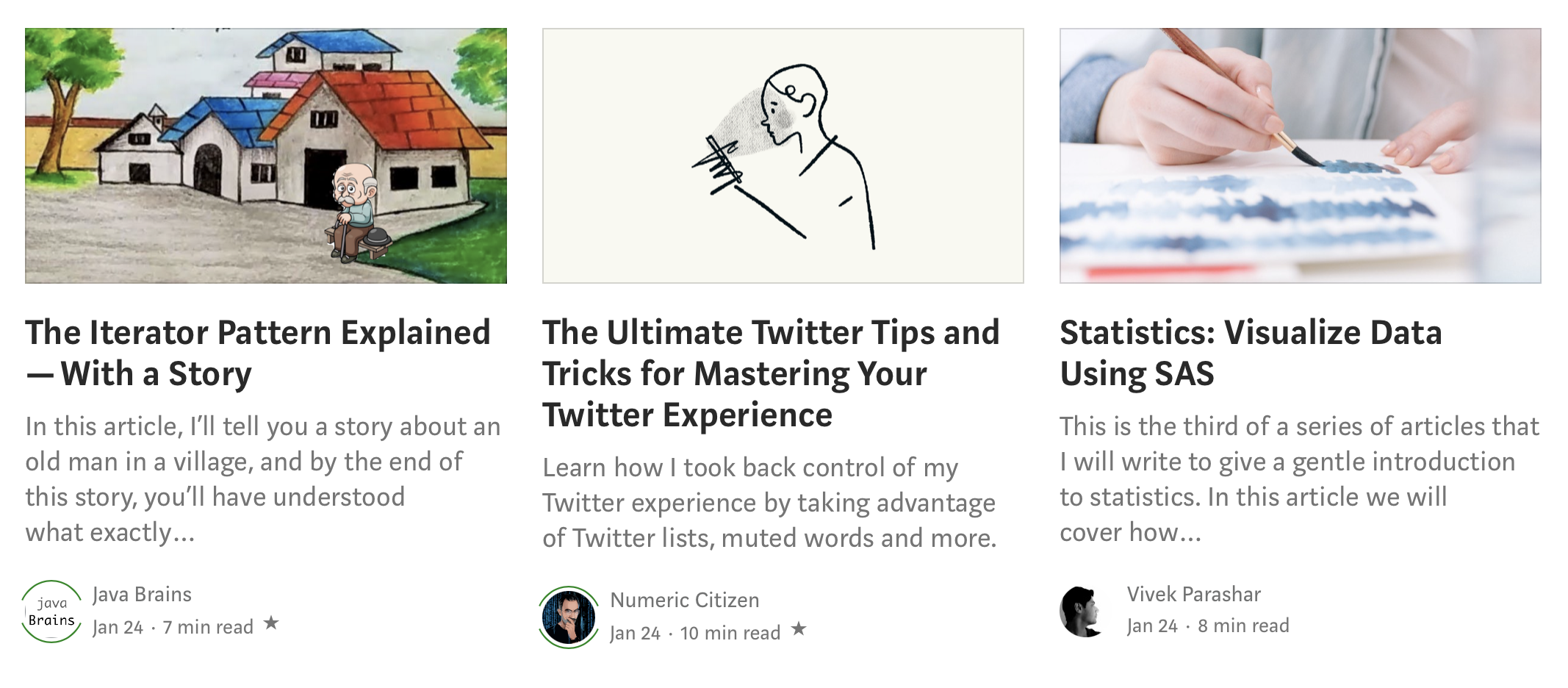
Meanwhile, The Startup magazine on Medium accepted my article submission. More than 750K followers can see it from the magazine homepage. 😃

That one was hard (#blogging #writing #article)

A person is intently looking at and interacting with a smartphone.

I just published one of my most difficult to write article in a long time. It is about transforming your Twitter experience to make it more focused, enjoyable, tailored to your personal interests. I’ve been working on it for the last few months. Along the way of writing this long piece, my Twitter experience was profoundly changed. I’m pretty happy with the end results. If you’re on Twitter, consider giving a look to this guide. Hope you’ll like it.

“The Ultimate Twitter Tips and Tricks for Mastering Your Twitter Experience”

Dear bloggers, let’s not forget about the link posts (#blogging #writing)

In “A Love Letter to the Link Post”, CJ Chilvers lament the lost of link posts from the blogosphere. Link posts marked the debut of so many websites raison d’être back in the nineties:

“At that time, they weren’t even called blogs. You’d simply update the front page of your website every day with a few interesting links you discovered since the day before.”

I love link posts. I follow many bloggers just to have a peek at their discoveries and comments about them. A big portion of my monthly Numeric Citizen Introspection newsletter is built around sharing a curated content of links that I find interesting. They generally fit within the boundaries of my deep interests. Link posts within newsletters = 🥰

In summary := Link posts > comments on a social network.