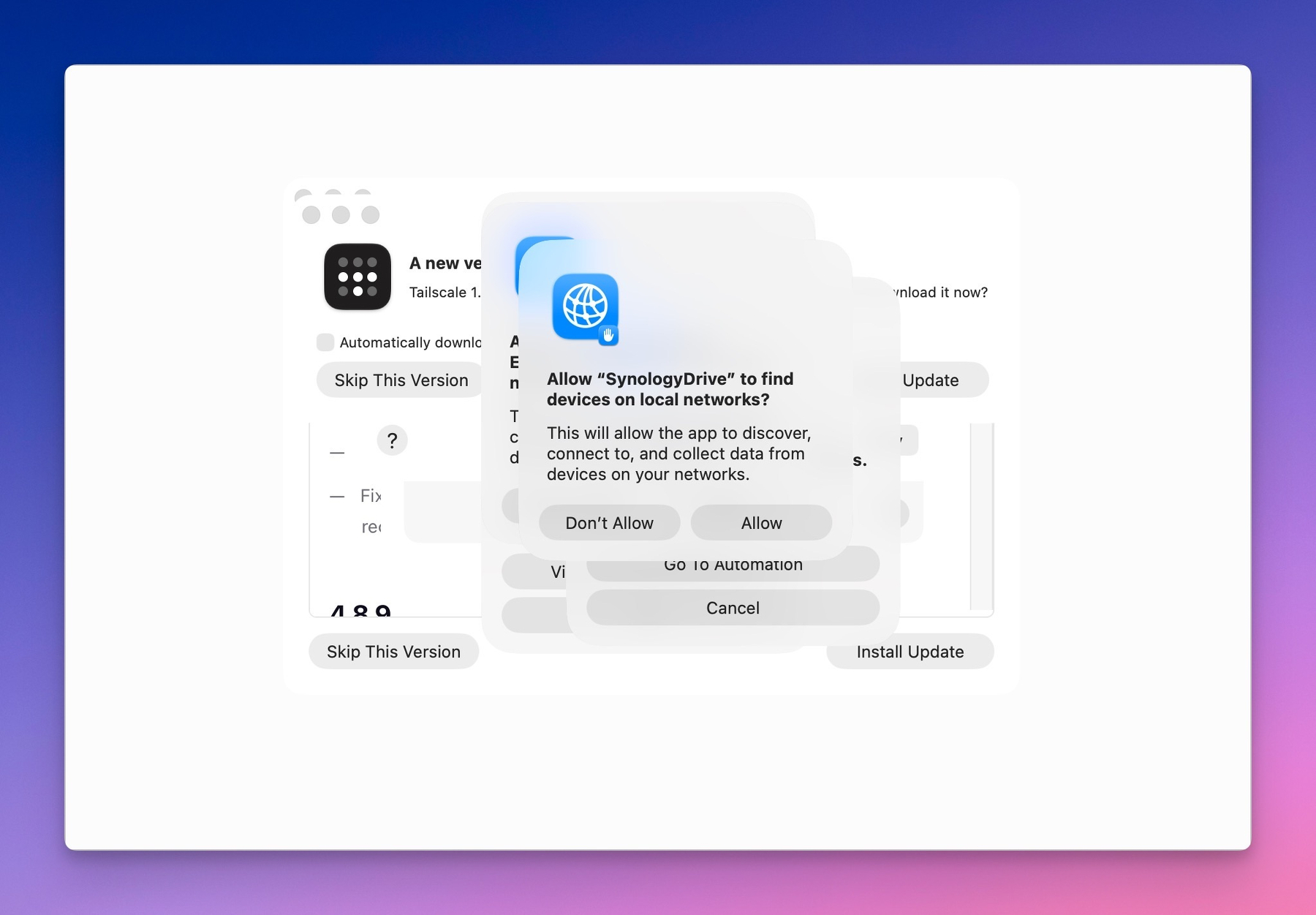
The digital toxicity

No One’s Happy recent blog post suggesting not to use native apps:

“Most native apps collect far more data than their website equivalents ever could. They request permissions to hardware, sensors, and background processes that browsers deliberately restrict. The third-party software embedded in these apps frequently transmits your location, device identifiers, and behavioral data to third parties before you even see a consent prompt. This data is in tandem bought, sold, and aggregated by brokers. It has been used to out individuals, track immigrants, and enable prosecution over reproductive healthcare.”

While this is true, refusing to use native apps is surprising advice. One might think the App Store submission process that every developer is subject to prevents bad actors, but it doesn’t. Coupled with the developer’s ordeal with the App Store review process, some developers are suggesting focusing development efforts on web applications instead. And finally, vibe coding might be another factor driving a move toward web application development. Yet the web is a jungle where user tracking is a standard “feature” that mines the browsing experience with bloated web pages that sell you ads and lead you to forced engagement.

Any lessons from EchoFeed's closure?

What can I learn from the demise of EchoFeed? Earlier this year, when I heard about this service, I looked into it to see if it could be useful. It wasn’t, thanks to Micro.blog’s ability to cross-post to Bluesky, Mastodon and more. Plus, at first it looked like an experiment more than anything else. I didn’t know EchoFeed’s long-term goals. I was on the breaks.

I’m wary of one-person services like EchoFeed. Another example is FeedPress. I like this service a lot, but I think there is only one person behind it, and it’s owned by a parent company which I know nothing about. It’s not entirely clear from this post what their mission is. What happens if this guy decides, or the parent company says, it’s no longer viable? Moving off EchoFeed might be a pain for people who need cross-posting capabilities. I highly doubt these people are willing to move to Buffer.

The same could be said about moving off FeedPress. It would be a pain in the ass to reconfigure all my feeds. The same torment applies to Micro.blog itself (or Scribbles.page, for that matter!). What is the future of Micro.blog if something bad happens to its founder? What is the continuity plan? Micro.blog has done everything it can to enable data portability and ownership, but moving things around, even if you own most parts, is not as easy as it sounds. In today’s world, nothing is permanent, and planning for this is mandatory.

Manton Reece writing about the demise of a Mastodon instance

I had missed that mastodon.cloud is shutting down. While its active user base has been shrinking, it still has a lot of total users and millions of posts. There’s still no way to migrate posts between Mastodon servers. (Mastodon posts → Micro.blog and some other fediverse servers works.)

POSSE principle is often talked about when referring to one of Micro.blog’s strengths, but being able to own your content and import content from other places are also important distinctive features of Micro.blog.

Since my bookmarking app now features links to Bluesky, I’ve observed that my Bluesky timeline is heavily political, which I dislike. I’m unsure how to unfollow people or lists. I wish there was a way to simply reset the timeline and start fresh for a better experience.

About my curiosity for FreshRSS

I saw people mention FreshRSS on my timeline today and I was curious about it. Why? Because self-hosting an RSS reader service might mean that I could drop Inoreader… so, I started reading the documentation. If there was a single-click install droplet on DigitalOcean, that would be enticing, provided that FreshRSS offers a great set of APIs. The UI is meh, though, but using the engine with a nice client like NNW might be a possibility. I didn’t go further in my exploration so far… but now I want to look at other self-hosting solutions, too. Suggestions?

WTF Substack? What are you for?

I’m unsure who Substack writers aim to reach. In my view, Substack might be the most anti-reader platform I’ve ever seen, even more so than Medium, which is in itself very telling. Today, I wanted to read an article on Substack after following a link in an email from my inbox, but my app wasn’t installed on my iPhone. After reinstalling it, I tried to open the link again, but it didn’t work. I had to log back in, apparently, which I did. The next step? Reading the article? Not quite—now it asks for topics of interest, then requests access to my Contacts. I stopped there, killed and removed the app from my phone and never read that article. Instead, I’m here to vent my frustration.

Ship it when it's ready

MacRumors’s article “Anthropic’s New Claude Opus 5 Nearly Matches Flagship Fable 5 at Half the Cost”:

Anthropic has released Claude Opus 5, an upgraded AI model that delivers near-Fable 5 performance at half the cost and is optimized for everyday use. The new model shows significant improvements over its predecessor (Opus 4.8) across multiple benchmarks including coding, problem-solving, and visual outputs, while maintaining the same pricing structure. Opus 5 is now available as the default model on Claude Max and the strongest option on Claude Pro, with an optional faster mode available at double the cost.

It’s fascinating to watch AI companies release their new offerings. It’s all over the place if you compare that to the way Apple releases their flagship products like the iPhone. “Ship it as soon as it’s ready” seems to be the way to go.

Anthropic: you can do better

From the DF Archive: ‘Electron and the Decline of Native Apps’:

The ironic frustration with Anthropic’s Claude app being an Electron turd is that Claude and especially Claude Code are so capable of helping to create good native Mac apps. It’s one thing for a big company or organization with cross-platform aspirations but no institutional Mac expertise, like Notion or Slack or Discord, to choose Electron to create their Mac client. It’s another when it’s a company like Anthropic, whose only product’s single most impressive ability is generating programming code, including high-quality AppKit and SwiftUI code for the Mac. To return to my hammering-screws-into-the-walls metaphor from yesterday, it’s as though the building into which Anthropic decided to hammer all the screws is a renowned screwdriver factory.

Bingo.