Numeric Citizen Blog Posts Monthly Digest
Numeric Citizen Blog
Keep dreaming
This morning, I received a renewal notice for a domain I registered during my transition from my previous job to my current one. At the time, I wasn’t sure if I would start my own consulting firm, so I registered the domain but then changed jobs. Despite that, I decided to renew the domain just in case. I like to think that one day I’ll be my own boss. It cost me about ten bucks a year, which is really cheap for dreaming.
2026-08-02 ∞What's up with Anthropic?
I’m not sure what is going on at Anthropic these days, but updates to Claude Desktop have stopped. Normally, I would get an update every few days; the last update was July 24th. Something might be going on. I wouldn’t mind if AI companies took a pause and started thinking about the consequences of putting their products in the hands of millions, you know, being conscious about what you do? Alas, that’s not going to happen.
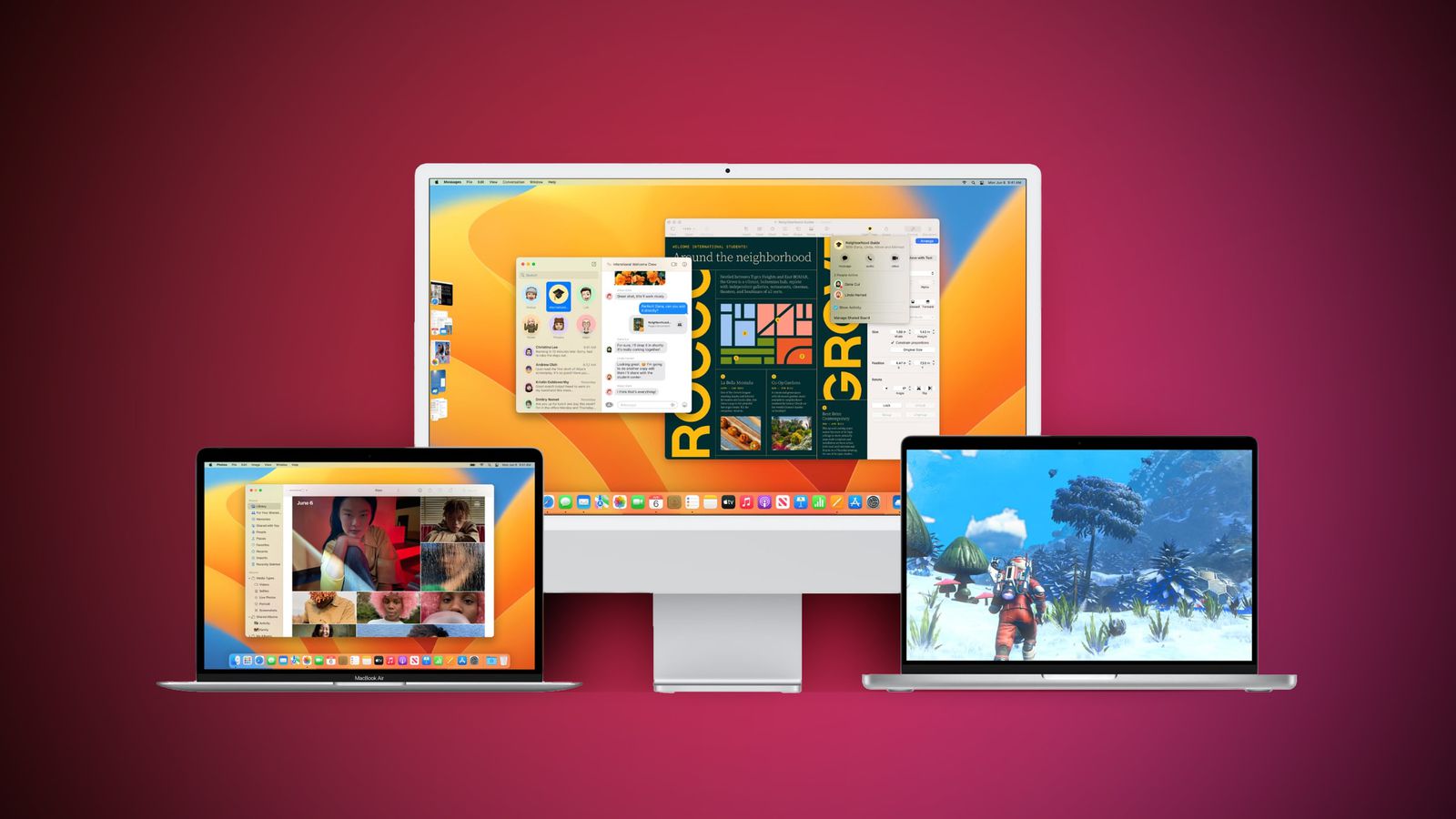
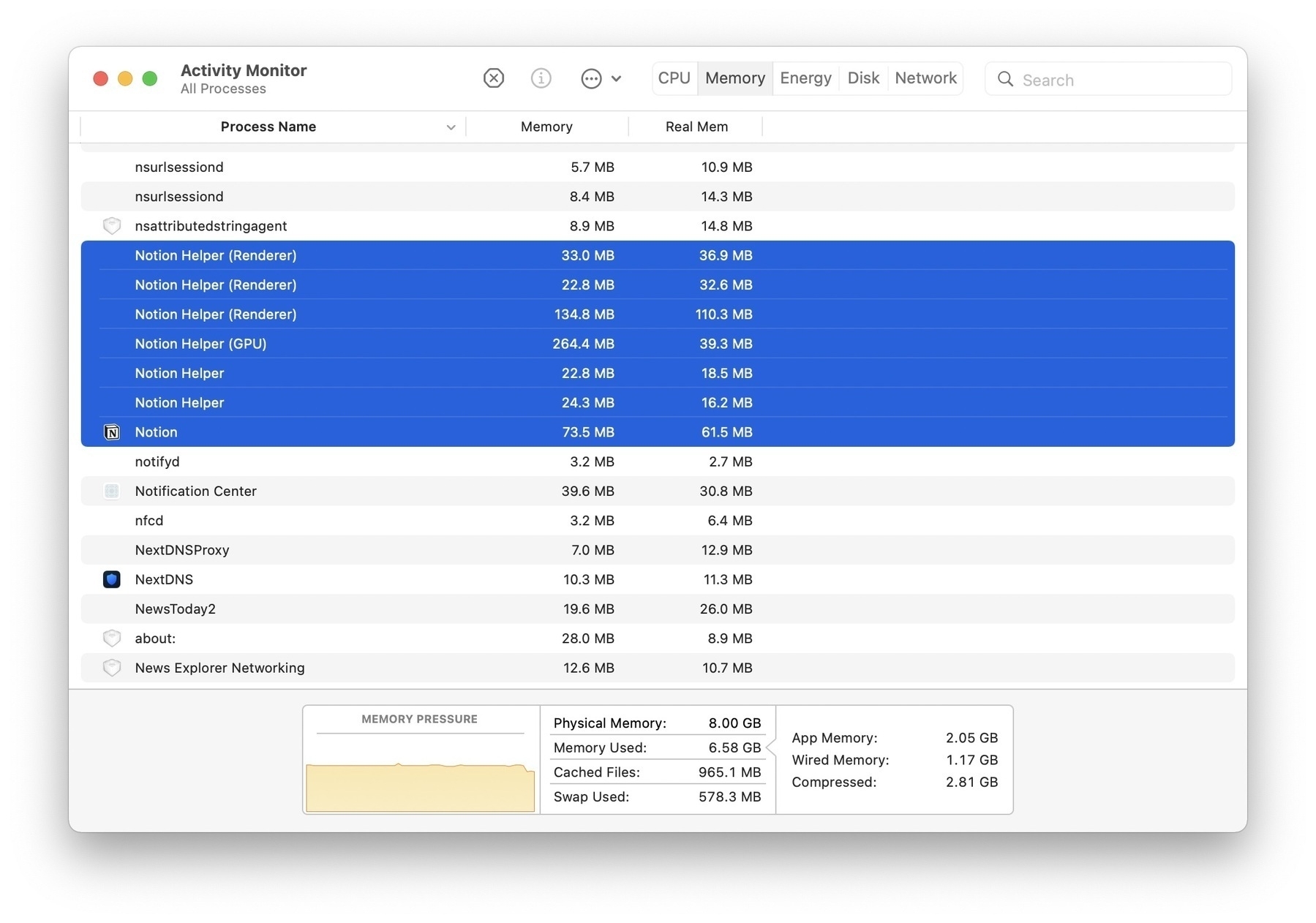
2026-08-02 ∞If my non-scientific calculations are to be believed, this week marks the weekly release of Apple’s OS 27 betas. In my case, Beta 4 was a bit of a step back compared to Beta 2 and Beta 3.
 2026-08-02 ∞
In the TV series “Silo” there is a woman who seems to be responsible for retrieving and refurbishing old computer equipment or various devices. It makes me think that with the current situation, where electronic device prices are soaring, the periods of price drops for a computer or smartphone are over. One day, society might see the latest-generation devices become inaccessible to the general public, who will then have to settle for rebuilt or refurbished devices.
 2026-08-02 ∞
 Are we in a world war yet?
In “The War That Could Swallow the World”, David French writes:
“I’ve often wondered what it was like to be alive in the summer of 1914, much less in 1938 and 1939. When did people start to realize that the world was on the brink of catastrophe? Speak up too soon or too frequently, and you look ridiculous — like the Chicken Little of World War. Speak up too late, and you live (if you live) with bitter regret.”
I often ask myself similar questions. When does it feel like it? Are we calling a world war after-the-fact? Does it matter in the end? This blog used to have a blog post category named “UkraineWar”. It will be renamed “Conflicts” which I think feels closer to what I perceive from today’s world.
2026-08-02 ∞Too many products?
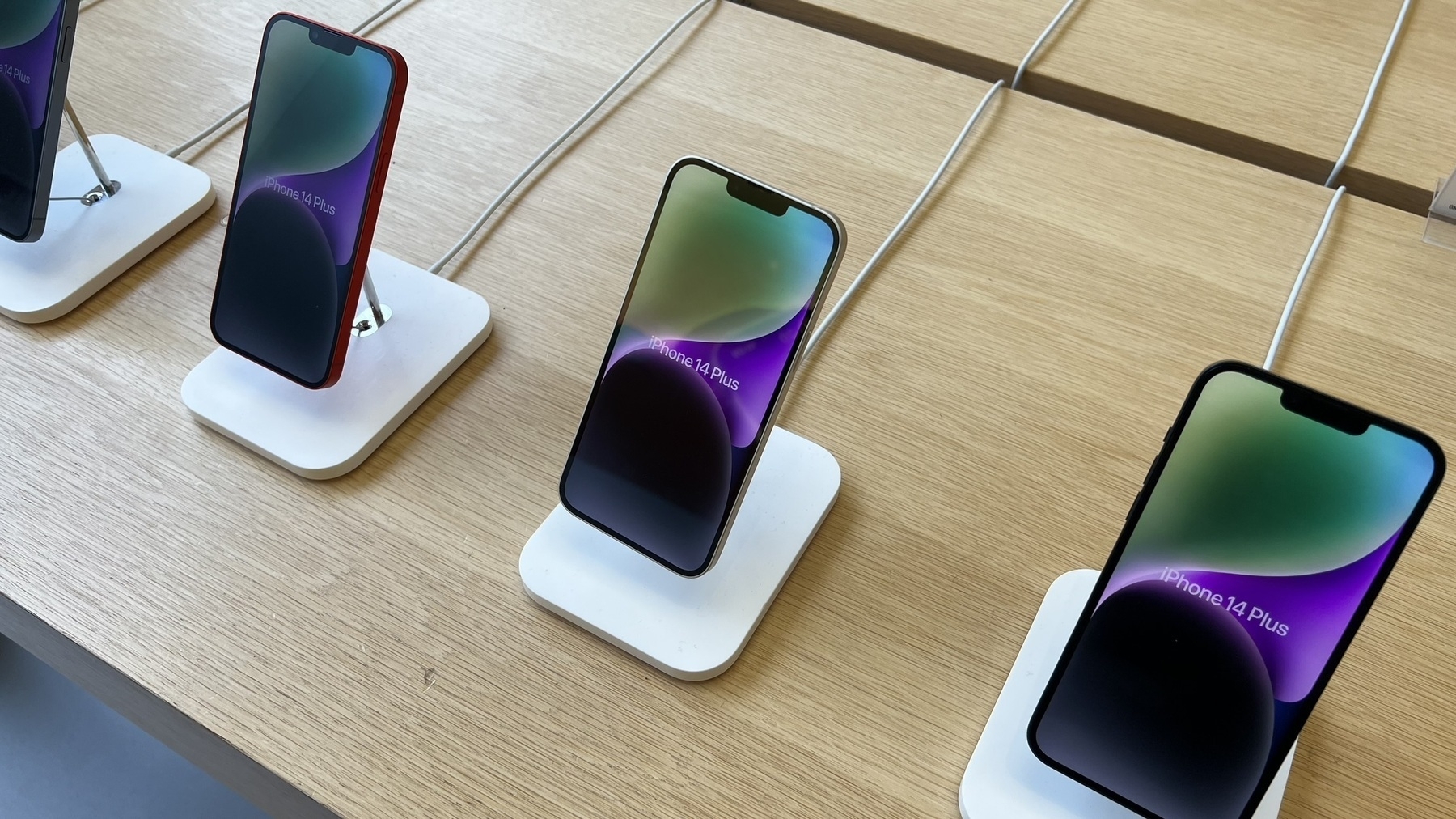
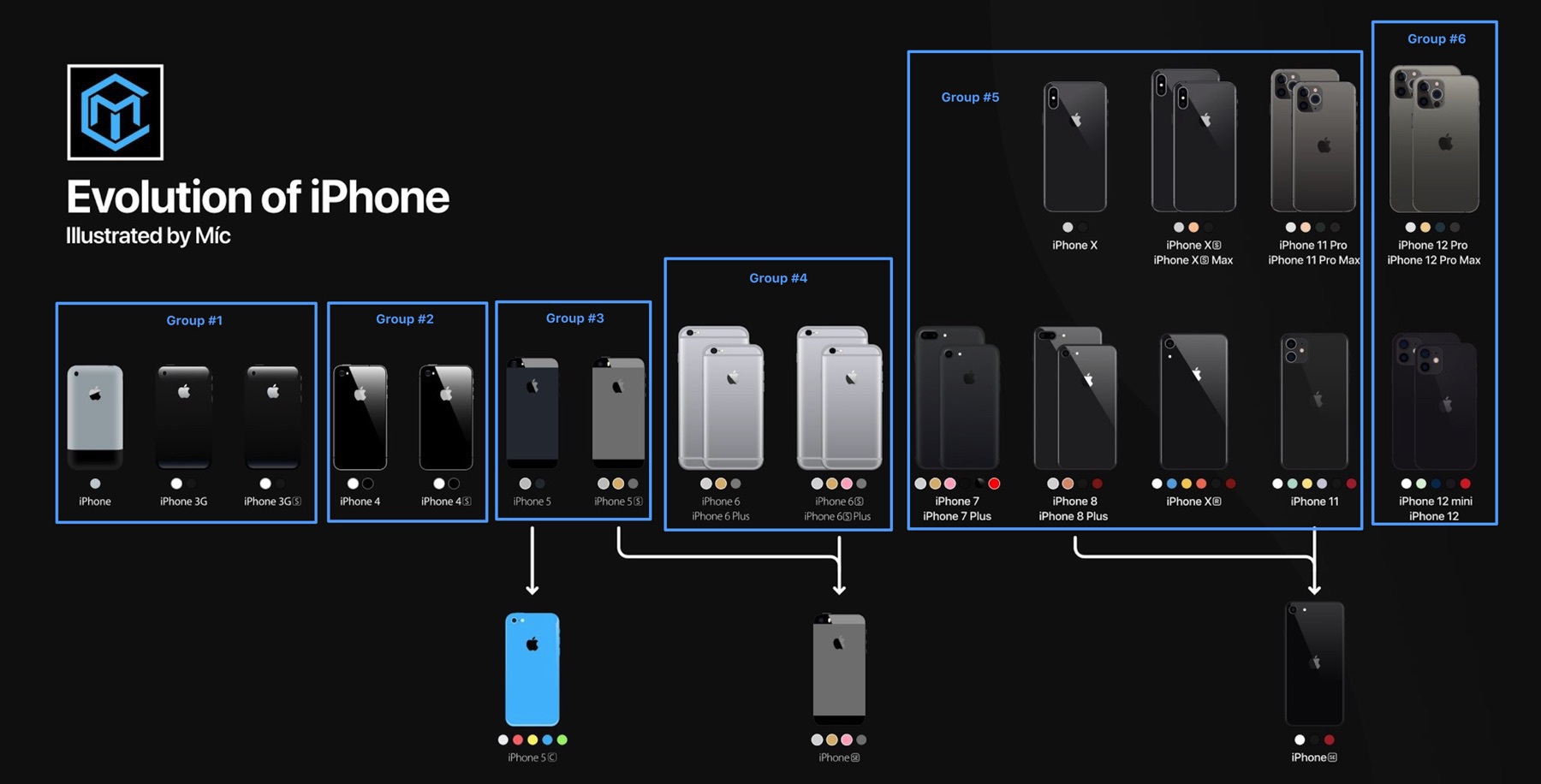
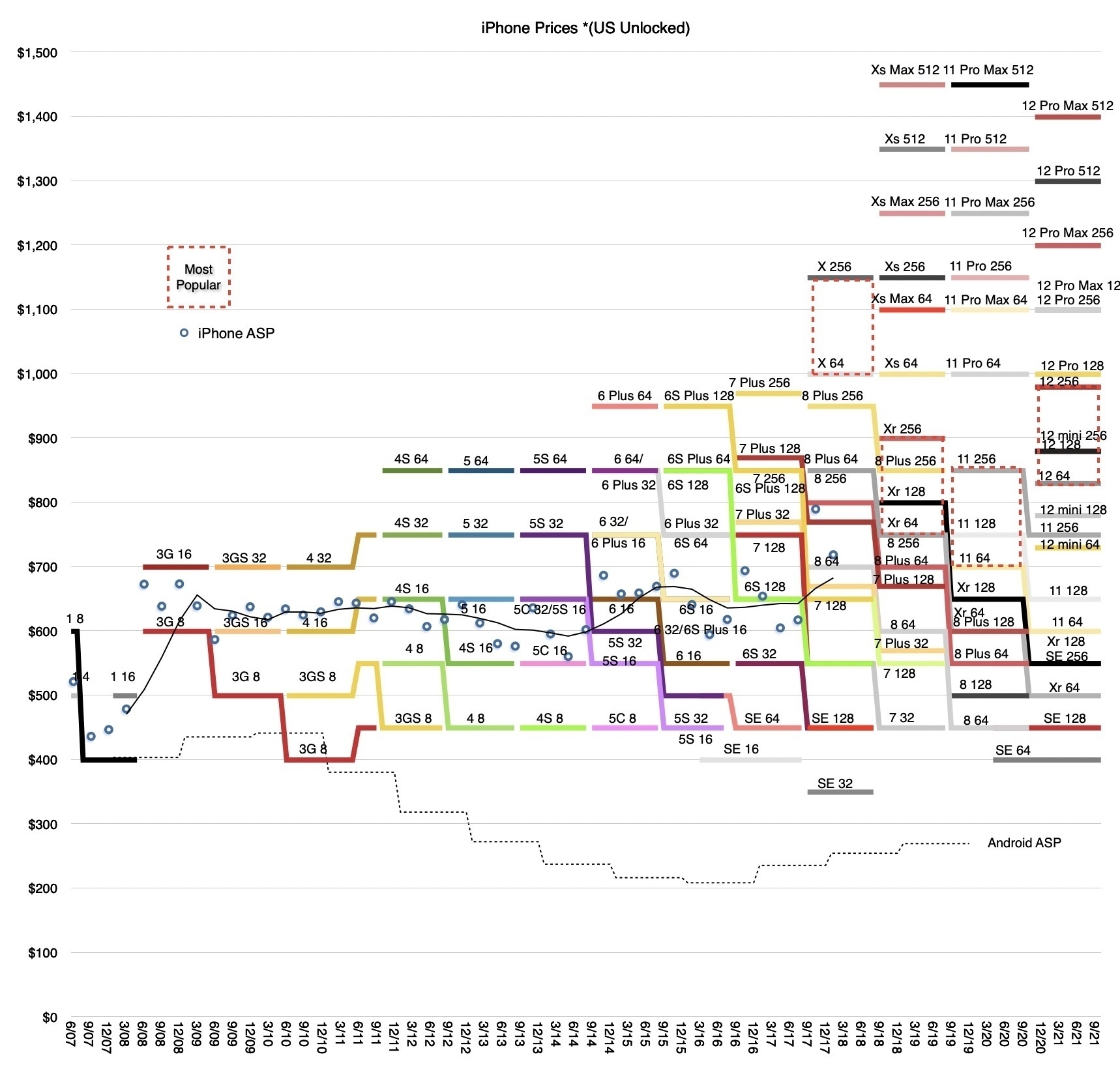
Today, while preparing the next edition of my newsletter, I wondered whether managing numerous product lines, with a multitude of variants and configurations, might be harming Apple, especially in the current context of supply chain difficulties. I feel that Apple’s strategy is no longer in tune with the times.
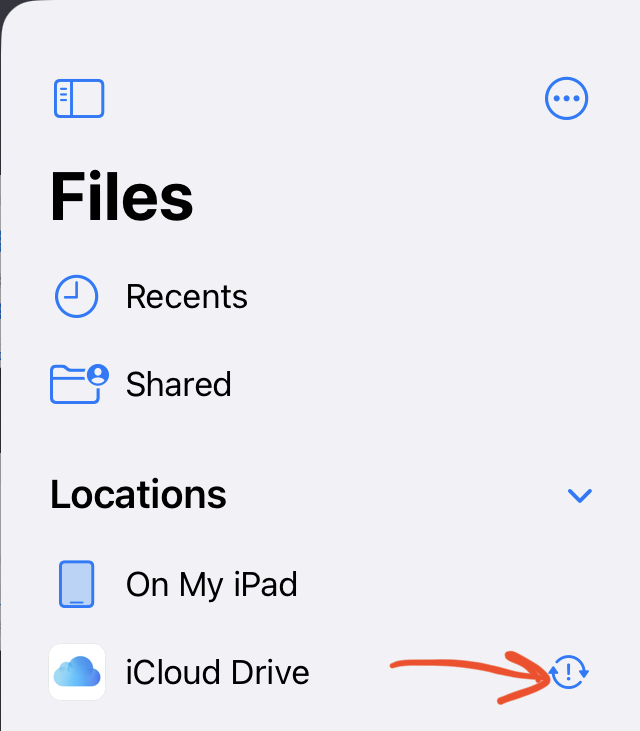
2026-08-02 ∞Apple’s iCloud File Sharing Left Ex-Employees With Access to Secret Documents:
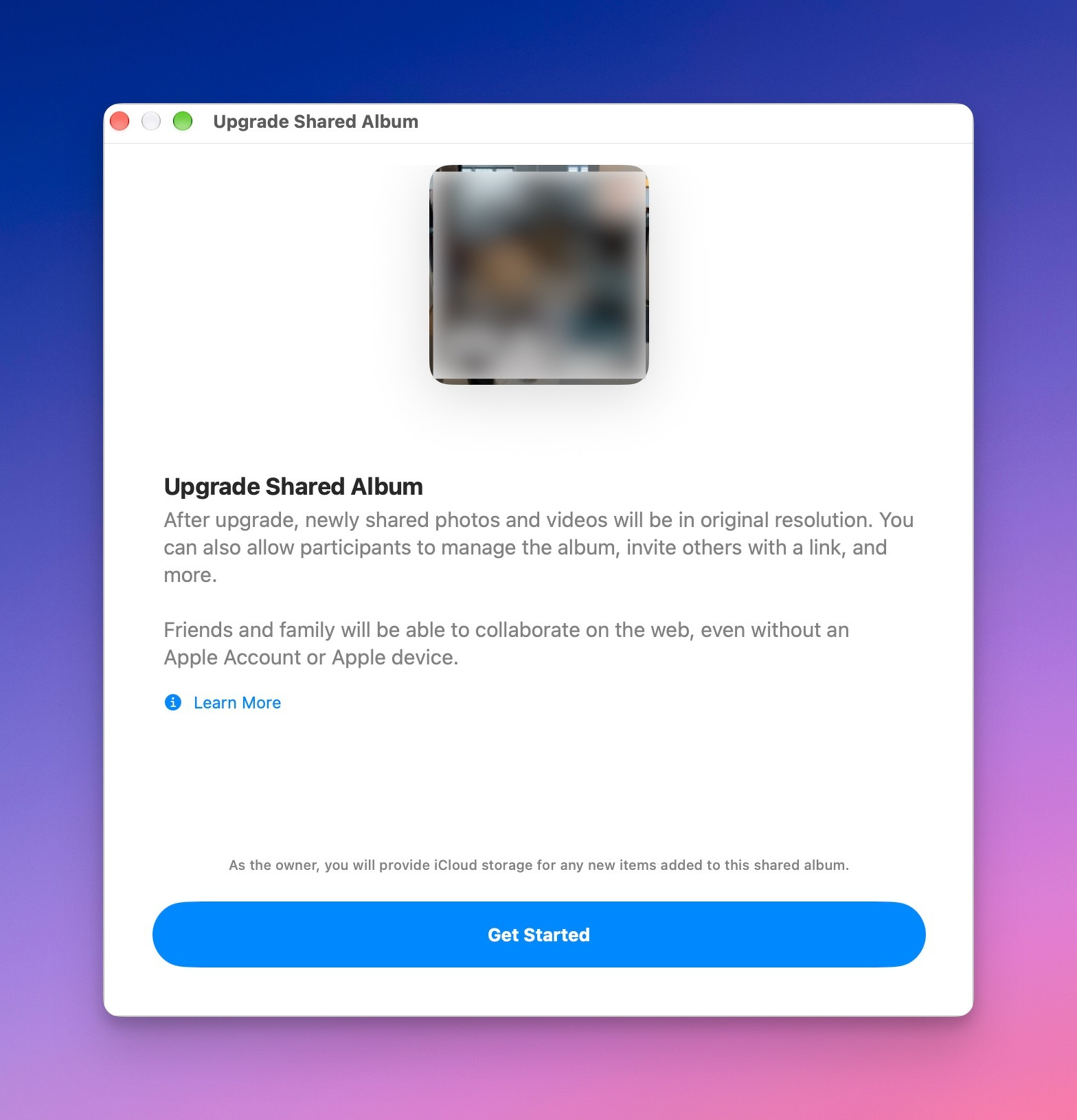
The former employees said many Apple files they had been shared on over their careers at the company—including planning documents for product launch events—continued to sync to their personal devices through the iCloud storage service after they left Apple. In some cases, they even received notifications about fresh updates to the documents. Some former employees said they were petrified to delete the files for fear that doing so would attract Apple’s attention.
Wow! I work in the banking system and such document life cycle management would be considered lousy at best. I think it’s time for Apple to make iCloud a little bit more business-friendly. The story on the iPhone is better as corporate-controlled apps are using their own partition which can be wiped independantly from the personal partition. But on iCloud? It doesn’t seem to be the case.
2026-08-03 ∞About my curiosity for FreshRSS
I saw people mention FreshRSS on my timeline today and I was curious about it. Why? Because self-hosting an RSS reader service might mean that I could drop Inoreader… so, I started reading the documentation. If there was a single-click install droplet on DigitalOcean, that would be enticing, provided that FreshRSS offers a great set of APIs. The UI is meh, though, but using the engine with a nice client like NNW might be a possibility. I didn’t go further in my exploration so far… but now I want to look at other self-hosting solutions, too. Suggestions?
2026-08-03 ∞Since my bookmarking app now features links to Bluesky, I’ve observed that my Bluesky timeline is heavily political, which I dislike. I’m unsure how to unfollow people or lists. I wish there was a way to simply reset the timeline and start fresh for a better experience.
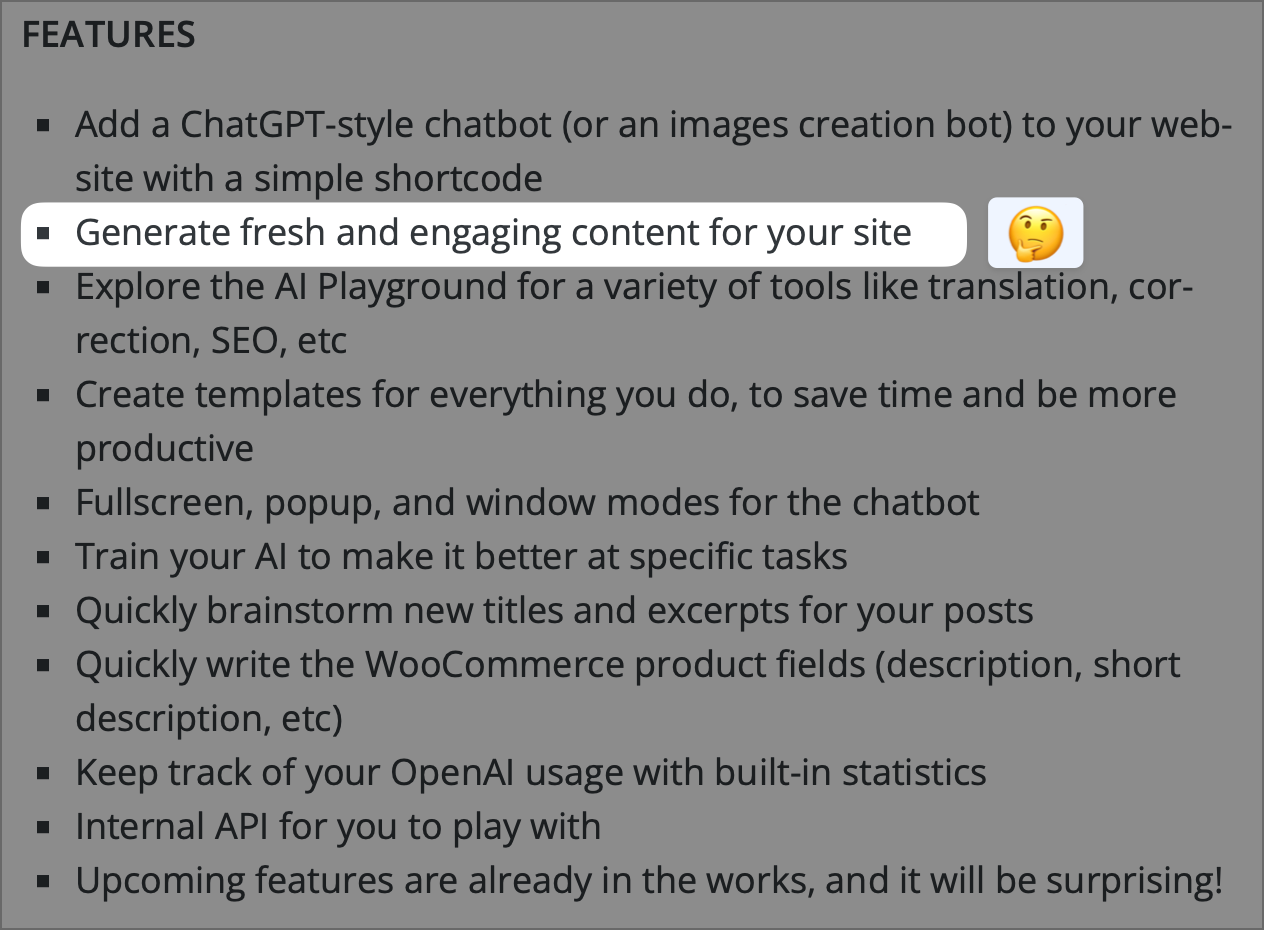
2026-08-03 ∞AI everywhere in YouTube Studio
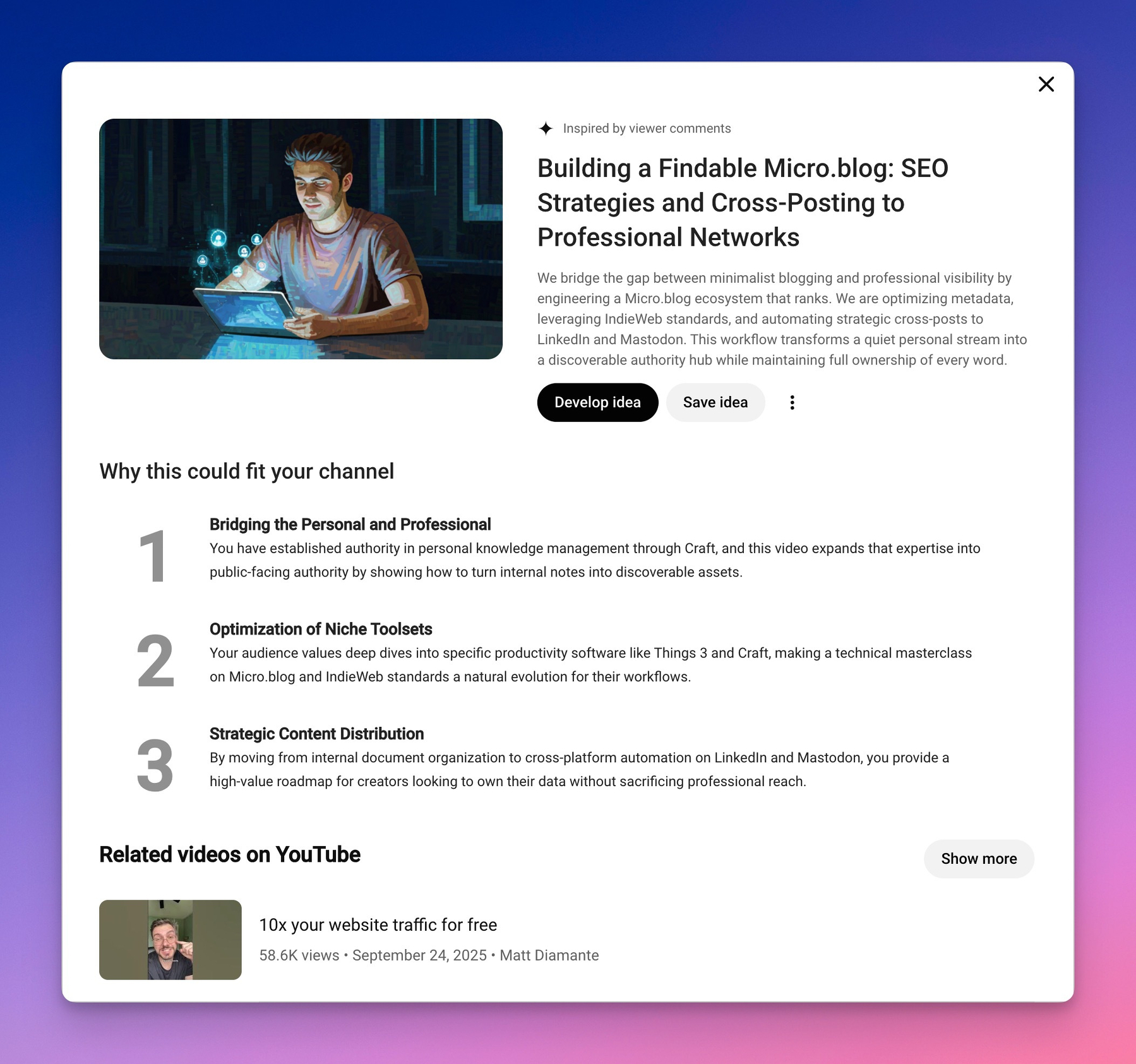
I’m returning from a short visit to YouTube Studio to find out that Google is now offering AI-based ideas to inspire the creation of new videos. I selected that one because it relates to Micro.blog. Very low quality. Here’s an excerpt:
“Most Micro.blog sites are digital ghosts, invisible to the search engines and professional networks that matter. We are going to fix that by engineering a high-authority ecosystem that ranks on the first page while keeping you in total control. Stop shouting into a void and start building a discoverable hub.”
This couldn’t be further from the truth.
 2026-08-06 ∞
Manton Reece writing about the demise of a Mastodon instance
I had missed that mastodon.cloud is shutting down. While its active user base has been shrinking, it still has a lot of total users and millions of posts. There’s still no way to migrate posts between Mastodon servers. (Mastodon posts → Micro.blog and some other fediverse servers works.)
POSSE principle is often talked about when referring to one of Micro.blog’s strengths, but being able to own your content and import content from other places are also important distinctive features of Micro.blog.
2026-08-06 ∞Trusting AI companies
One quick question for the Anthropic, OpenAI, and Meta IT guys: is it that hard to configure a sandbox to block outbound traffic to the Internet? I know really good guys who could help you with this. Or, if you don’t want to hire a human to do it, just ask your fuckin models how to do it. Until then, how can we trust you?
2026-08-06 ∞Any lessons from EchoFeed's closure?
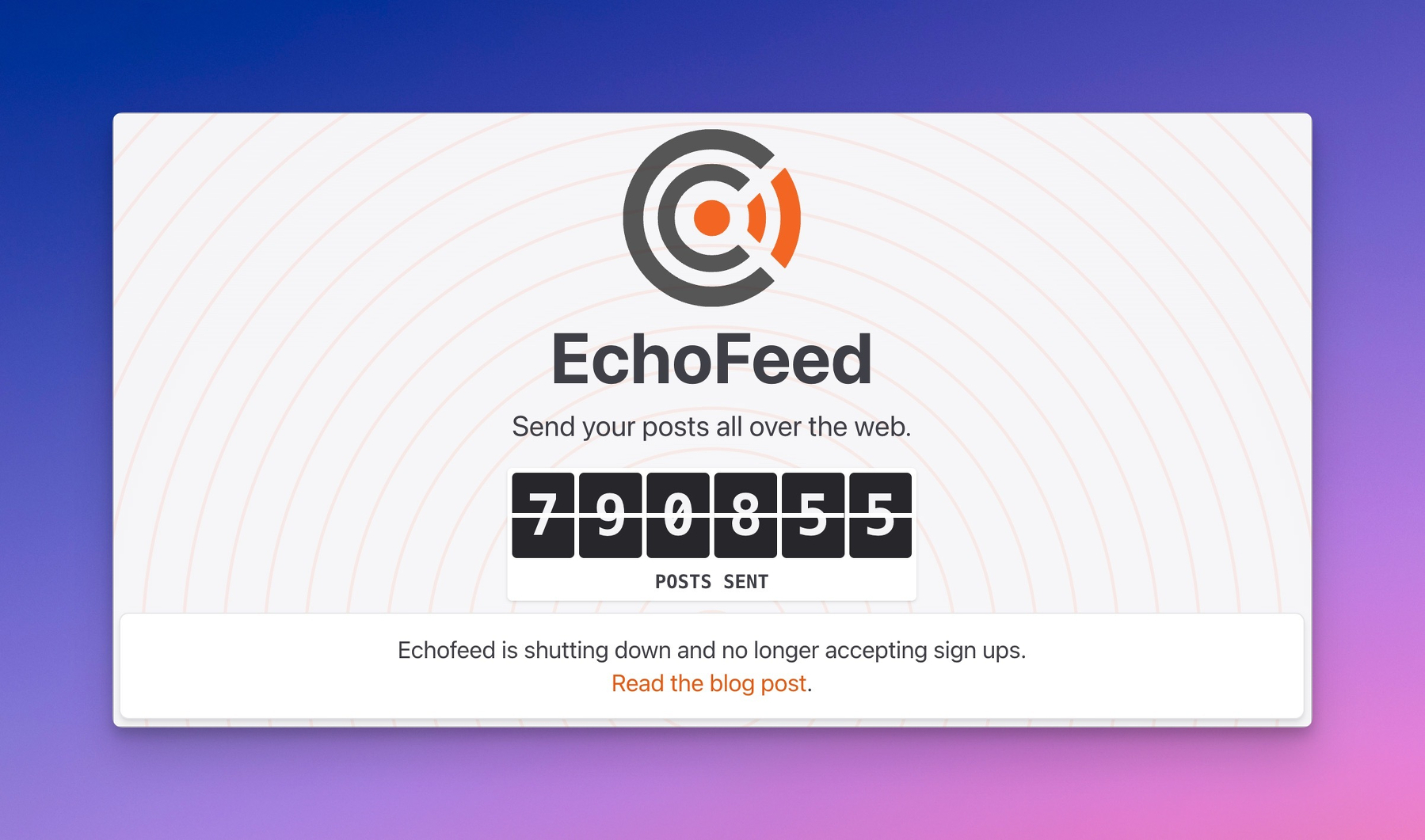
What can I learn from the demise of EchoFeed? Earlier this year, when I heard about this service, I looked into it to see if it could be useful. It wasn’t, thanks to Micro.blog’s ability to cross-post to Bluesky, Mastodon and more. Plus, at first it looked like an experiment more than anything else. I didn’t know EchoFeed’s long-term goals. I was on the breaks.
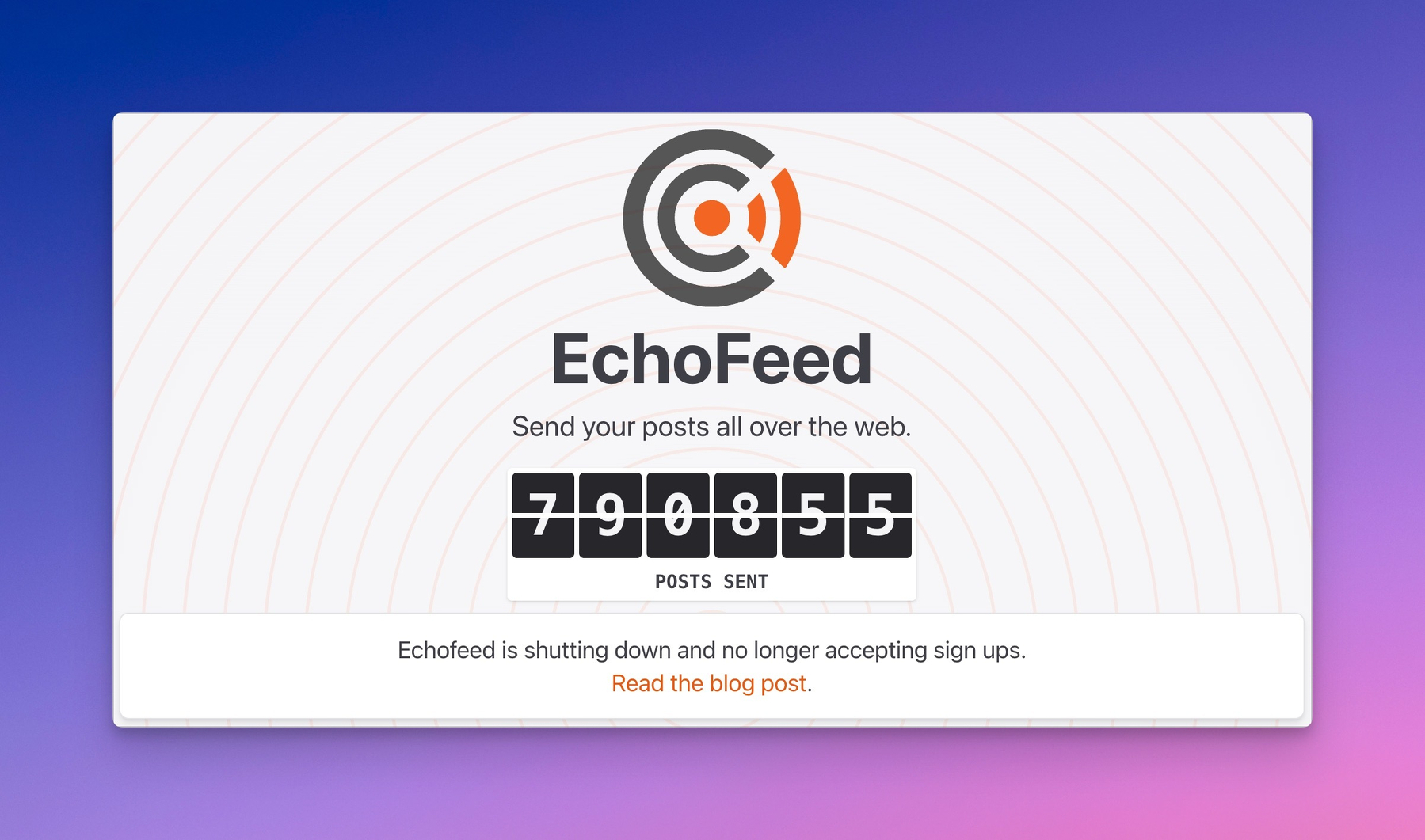
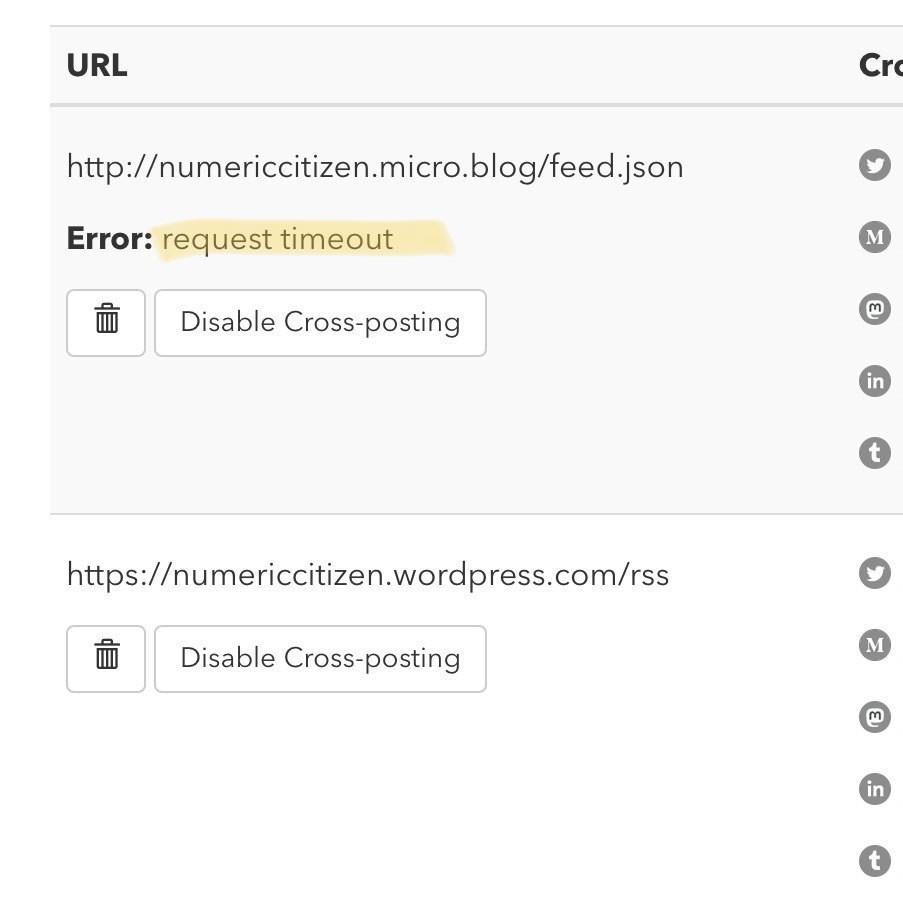
I’m wary of one-person services like EchoFeed. Another example is FeedPress. I like this service a lot, but I think there is only one person behind it, and it’s owned by a parent company which I know nothing about. It’s not entirely clear from this post what their mission is. What happens if this guy decides, or the parent company says, it’s no longer viable? Moving off EchoFeed might be a pain for people who need cross-posting capabilities. I highly doubt these people are willing to move to Buffer.
The same could be said about moving off FeedPress. It would be a pain in the ass to reconfigure all my feeds. The same torment applies to Micro.blog itself (or Scribbles.page, for that matter!). What is the future of Micro.blog if something bad happens to its founder? What is the continuity plan? Micro.blog has done everything it can to enable data portability and ownership, but moving things around, even if you own most parts, is not as easy as it sounds. In today’s world, nothing is permanent, and planning for this is mandatory.
2026-08-06 ∞MyMind MCP
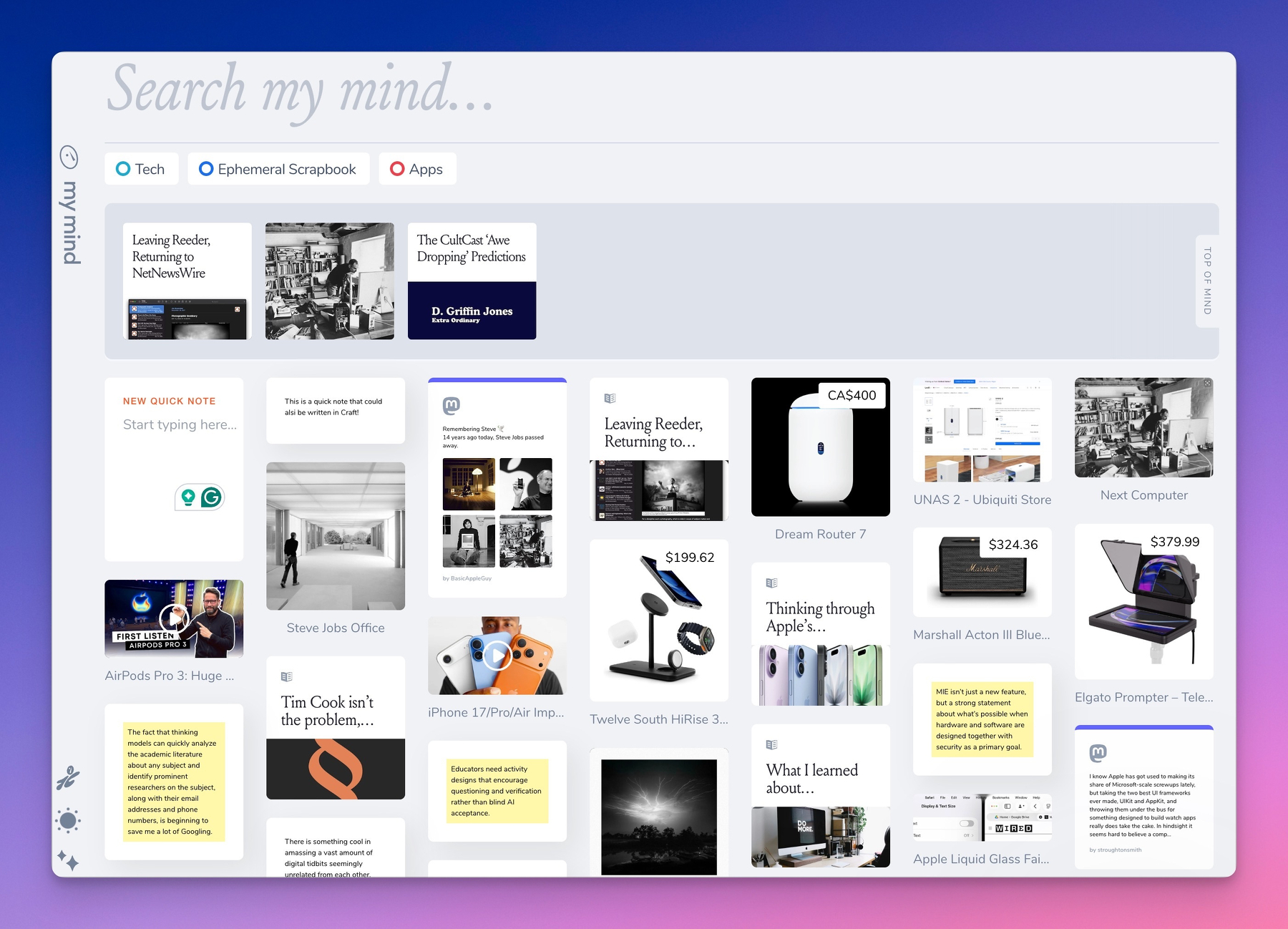
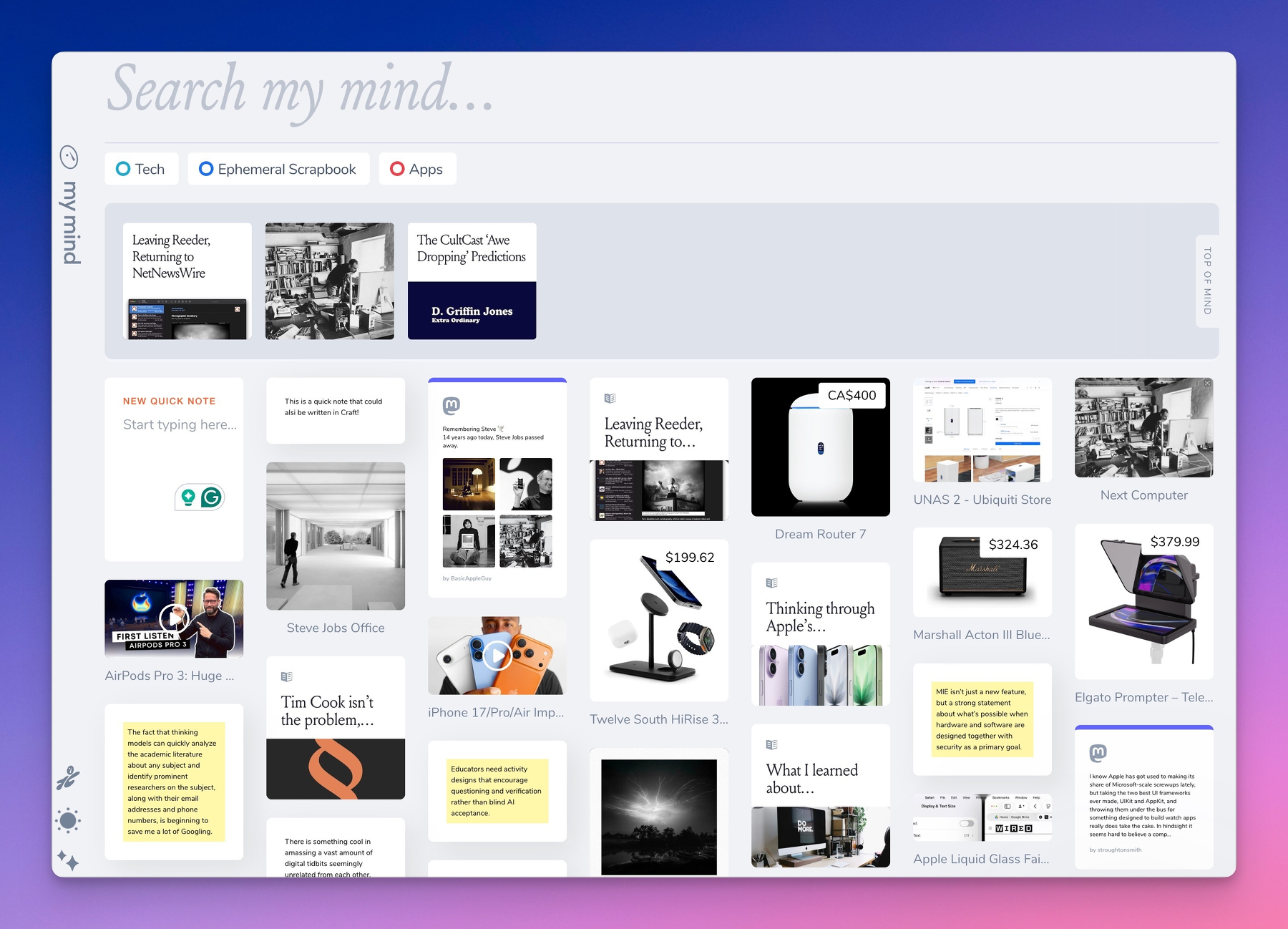
MyMind now offers an MCP endpoint for use with Claude. I can imagine that for those who store a lot in MyMind, it could be really useful. I tested MyMind and liked a few things about it. It’s like Pinterest but without the AI and ads crap. I connect to my MyMind account from time to time just to see how the service is evolving, and it does, but I eventually found it was redundant with what I already use: Craft, which also supports MCP and API endpoints.
 2026-08-07 ∞
 The new and uncharted way for me to get advices
I’ve been working as a technical project manager on a major migration project at my job. It’s a new role for me, which has increased the demand for my soft skills. While I’m technically inclined, it’s not necessarily my strongest area, but I manage well enough. Yesterday, a team member privately mentioned that my project management style sometimes borders on micromanagement. Though it’s hard to hear, I responded positively and thanked him for the feedback. Our discussion lasted some time, helping me understand his perspective. The issue is that my technical expertise often leads me to ask detailed questions, which might seem like I don’t trust my team members’ abilities. However, that’s not the case. This feedback prompted deep reflection and self-assessment.
As an experiment and out of curiosity, I provided the context to Claude AI and sought advice. Overall, the experience was very insightful. My issue isn’t unique and is likely common and well-documented in management literature. After this session with Claude AI, I felt uplifted and more prepared to confront today’s challenges. It’s not easy, and the project may be full of pitfalls and surprises, but I believe it will help me grow.
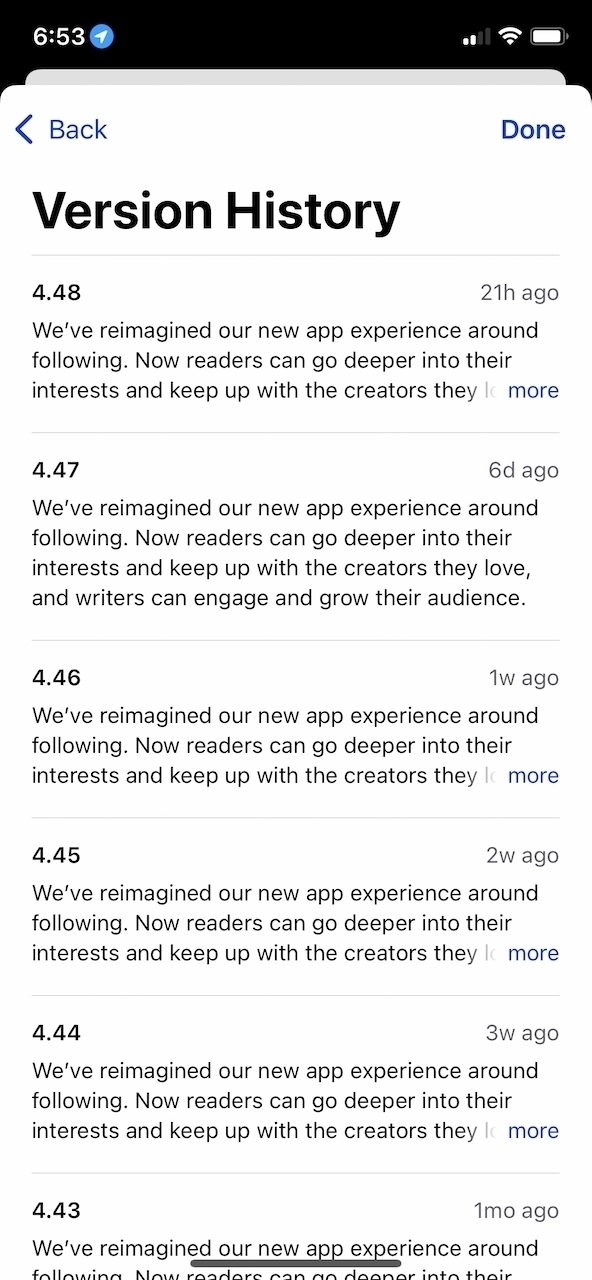
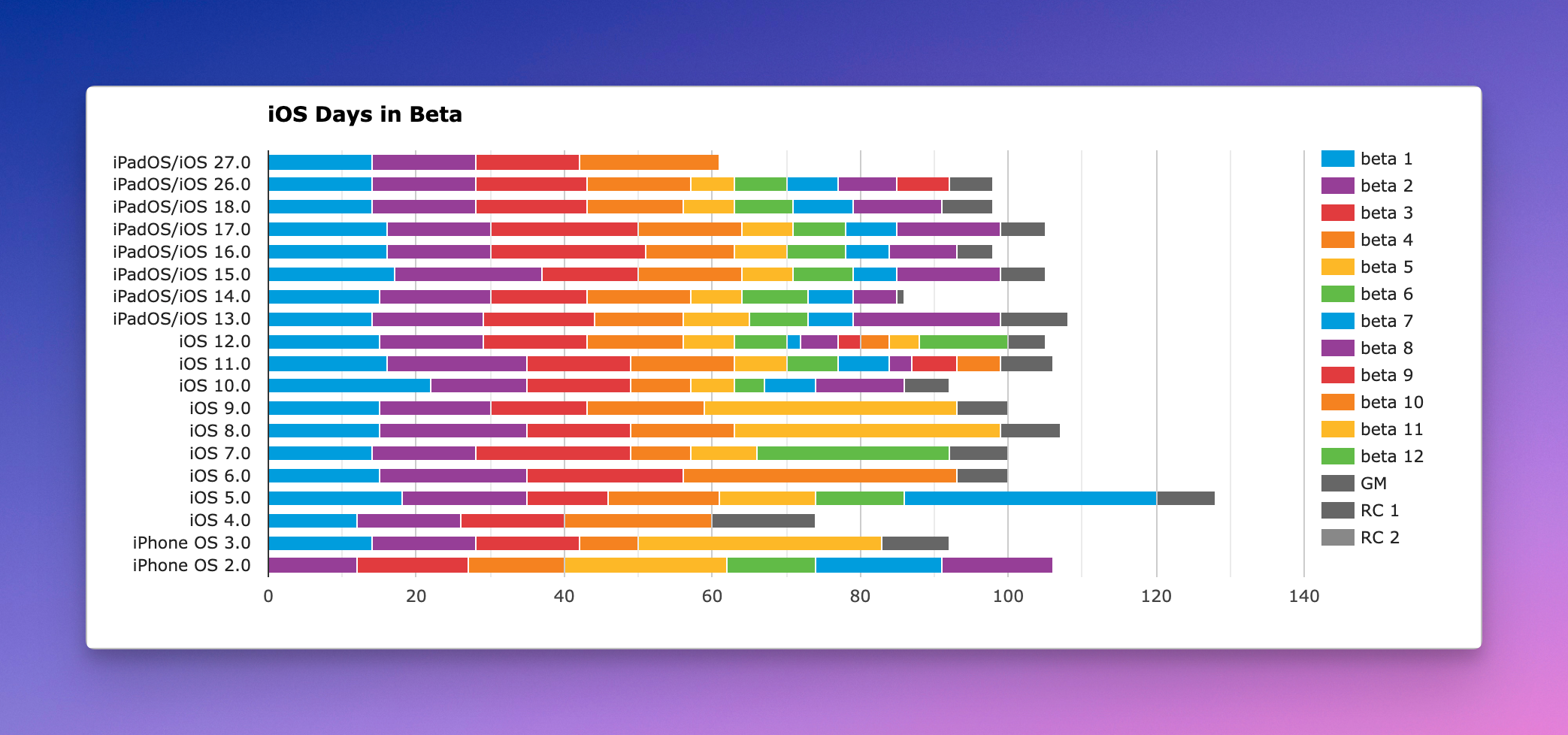
2026-08-07 ∞I wish there were a beta 5 for Apple OS27 this week, but alas, no; we’ll have to wait until early next week, I guess. According to this iOS Version History chart, iOS 27 beta 4 stands at 19 days, the second-longest beta 4 period for a .0 release since iOS 6.0 beta 4, which lasted 37 days. I don’t know if this is a good sign. Maybe I shouldn’t try to read too much into this.
 2026-08-07 ∞
 Happy ignorant here
I wanted to open a link pointing to a post on x.com. Clicked on it. After a few seconds, X website opened but right after the App Store launched to the download the app for reading content on X. I went back to the website, dismissing the App Store. Clicking to play the shared media again launched the App Store. I went back to watch the video. What an awful experience.
I wondered if installing the X app would make the experience more tolerable. The login / signin screen scared the shit out of me when I started remembering all the bad things about social networks, Musk, etc. but then I started thinking that even if things like the dark web is bad, some people still need to visit this place for investigation. Was I investigating this morning when opening up X? I certainly was looking to understand something.
Having to create a new X account, then being exposed to ads, tracking, etc. killed my desire to understand. It’s ok not to understand everything. I’m a happier ignorant.
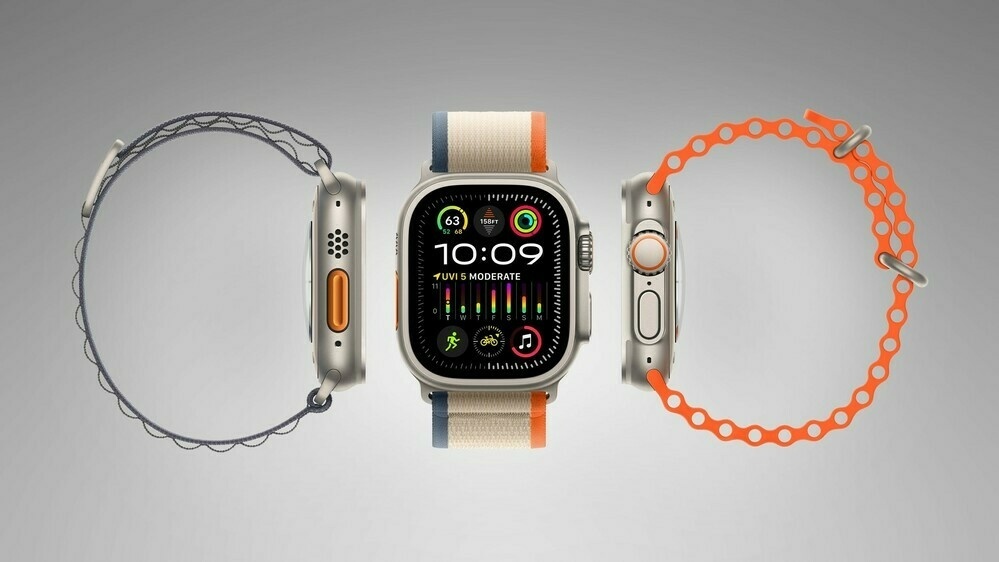
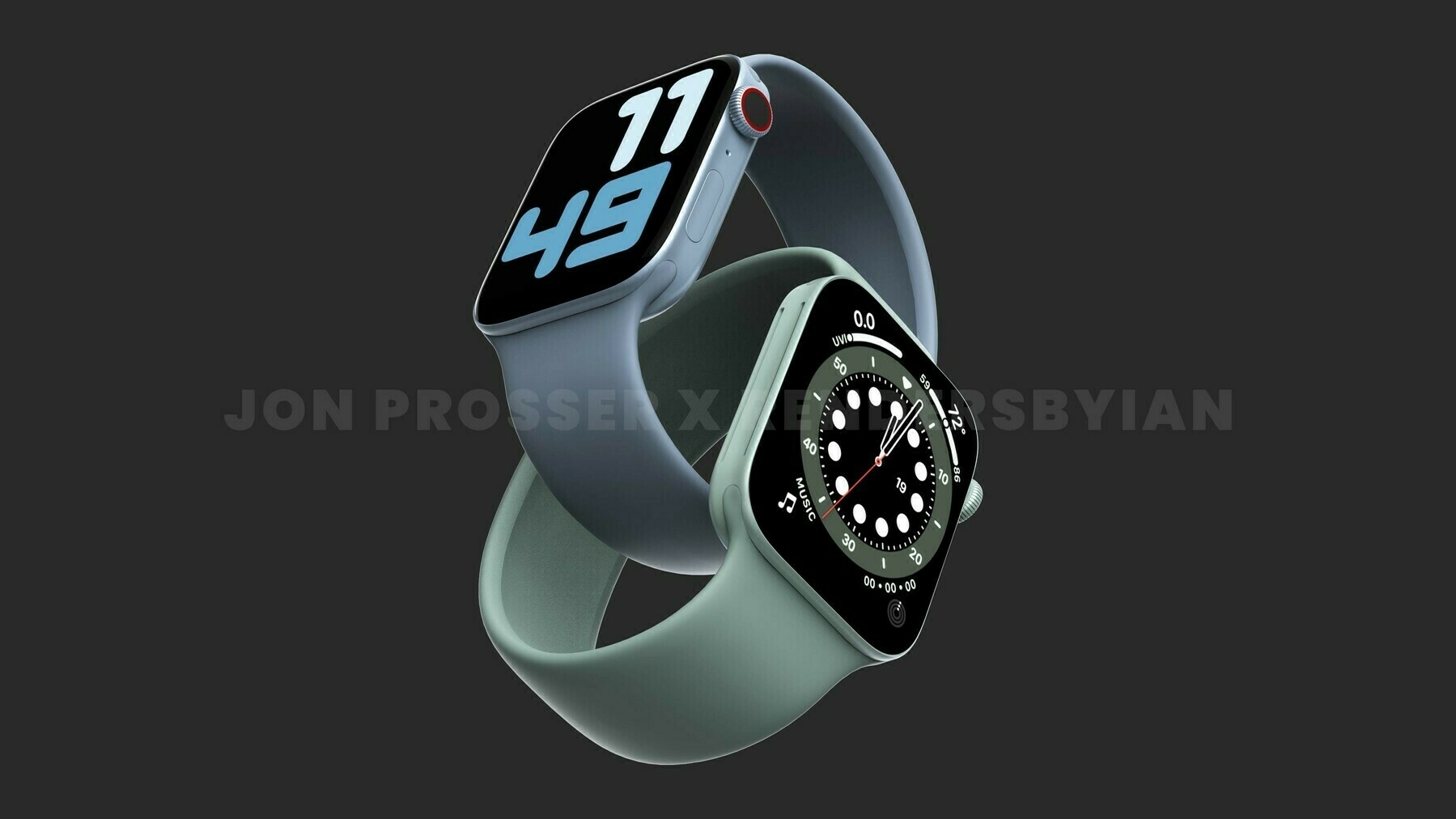
2026-08-09 ∞MacRumors reporting about Mark Gurman latest Apple rumors Apple Watch Rethink Could See Debut of Round Model, Screenless Fitness Tracker, and More:
The company is apparently taking the resurgence of fitness bands without screens and smart rings seriously. As a result, the company is considering new Apple Watch-style devices with no display…
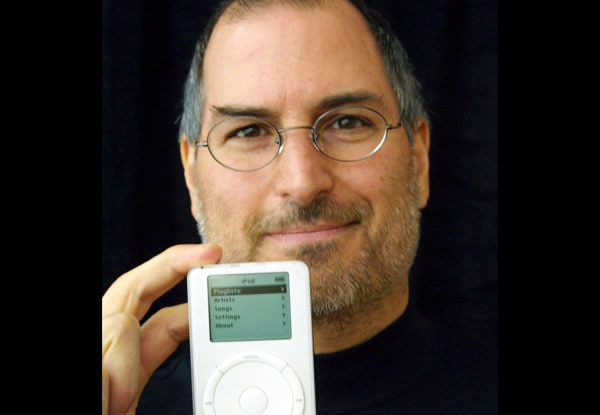
Do you remember the iPod Shuffle? I would seriously consider a fitness band if it meant more powerful sensors integration.
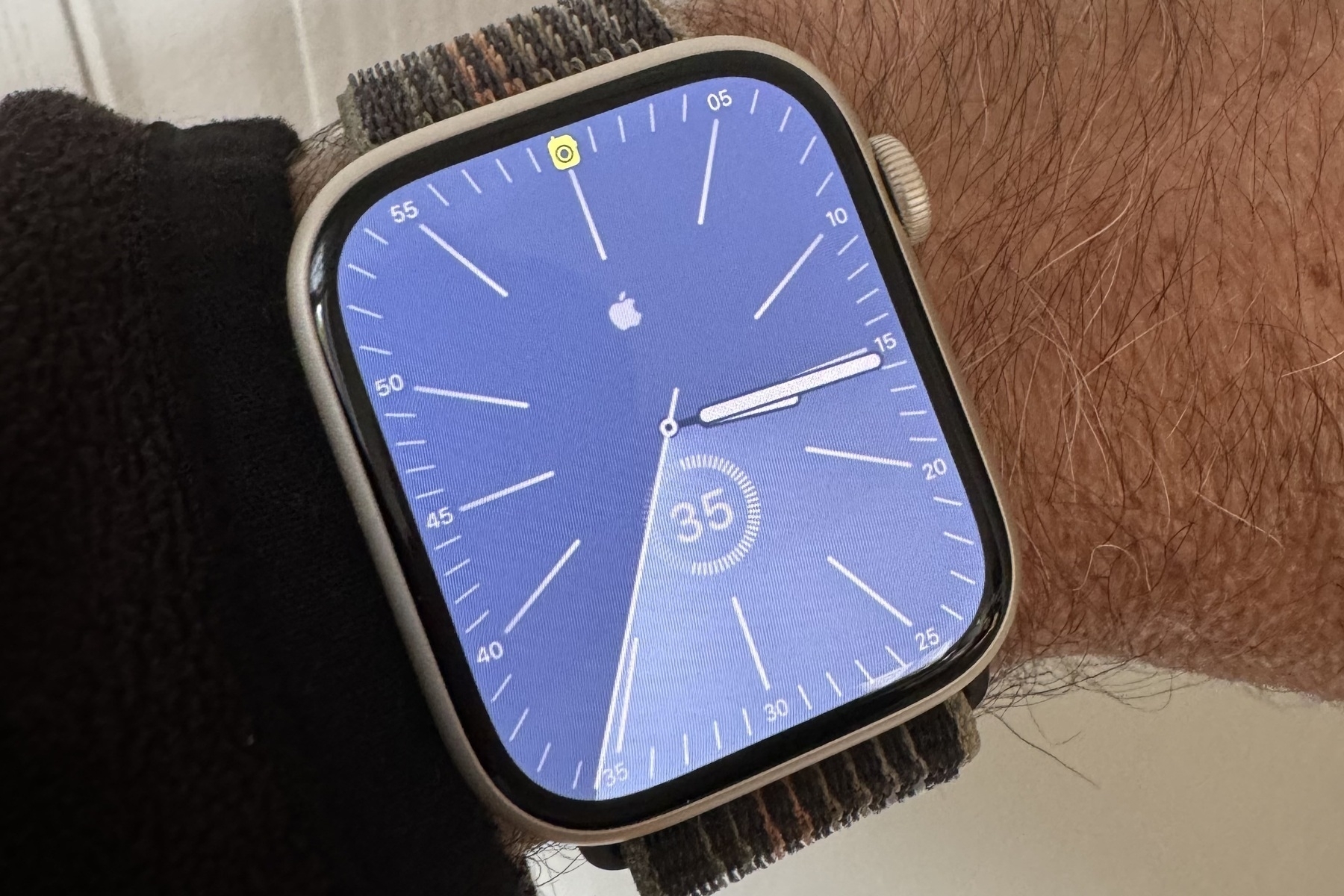
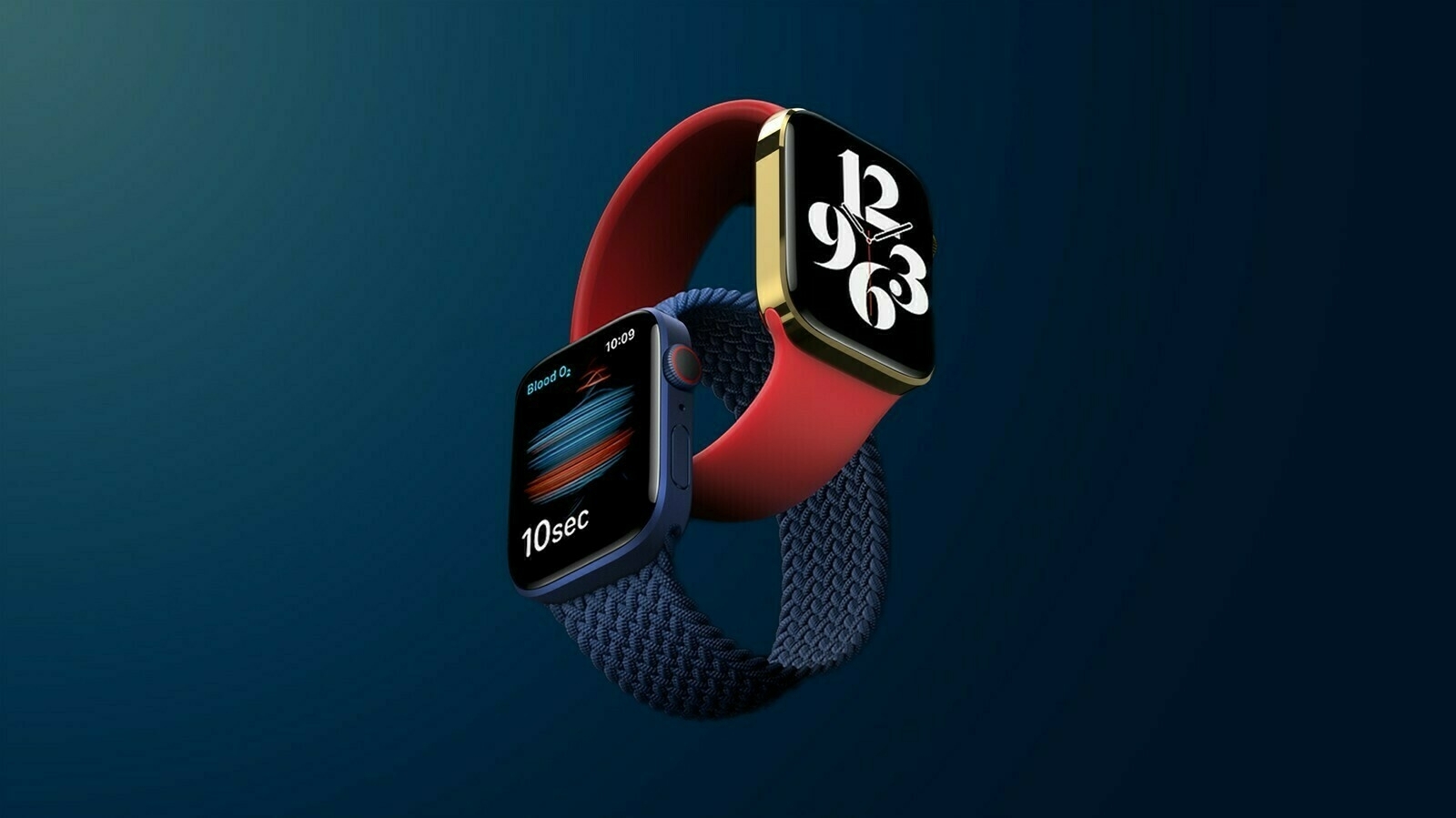
2026-08-09 ∞Ceramic Case Could Return With Apple Watch Series 12:
The white ceramic finish, made from a compressed zirconia and alumina powder polished with a diamond slurry, was marketed as being four times as hard as stainless steel.
Long lasting materials for a durable Apple Watch should be coupled with ever lasting battery life and a user-replaceable battery, otherwise it makes no sense to me.
2026-08-09 ∞The digital toxicity
No One’s Happy recent blog post suggesting not to use native apps:
“Most native apps collect far more data than their website equivalents ever could. They request permissions to hardware, sensors, and background processes that browsers deliberately restrict. The third-party software embedded in these apps frequently transmits your location, device identifiers, and behavioral data to third parties before you even see a consent prompt. This data is in tandem bought, sold, and aggregated by brokers. It has been used to out individuals, track immigrants, and enable prosecution over reproductive healthcare.”
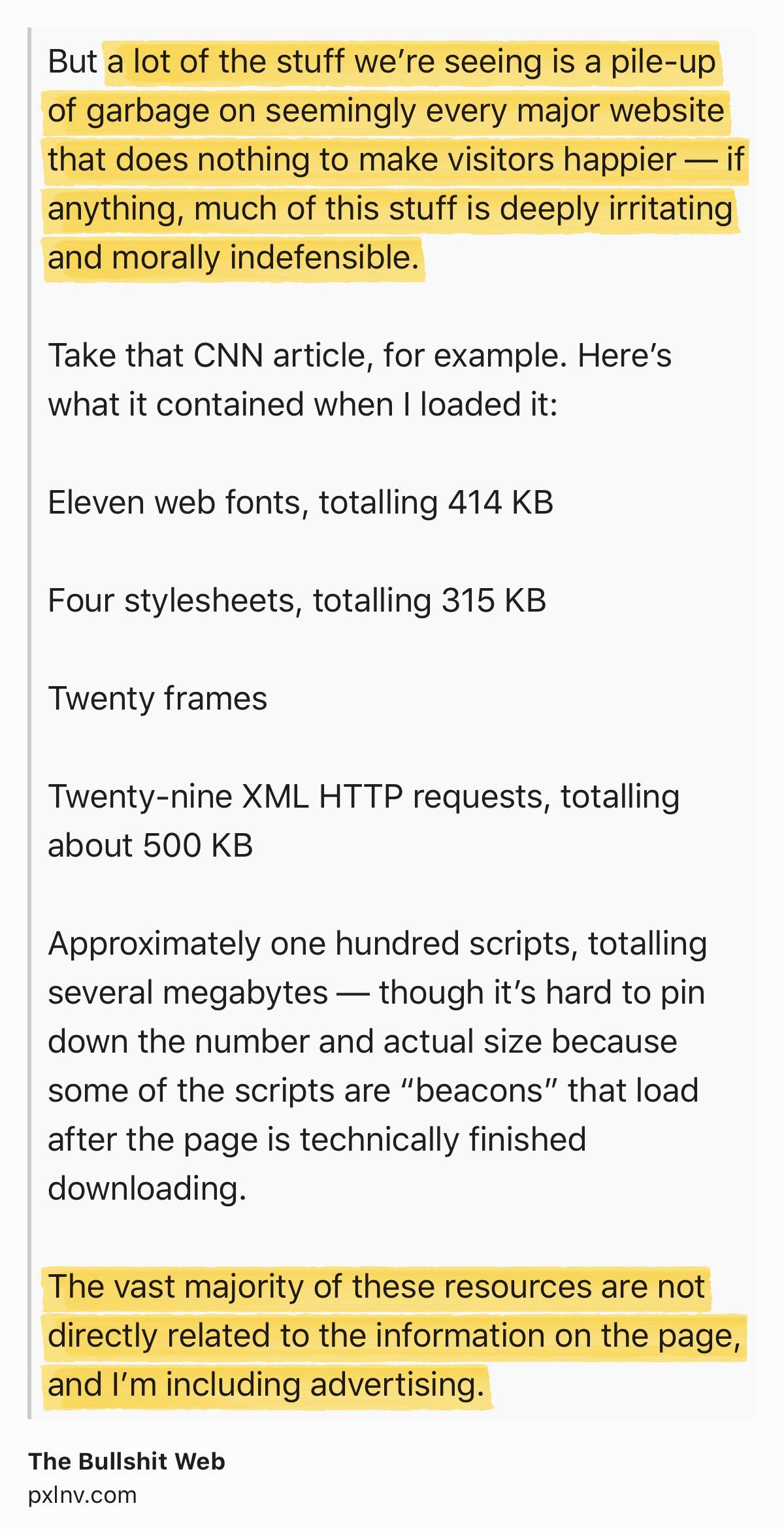
While this is true, refusing to use native apps is surprising advice. One might think the App Store submission process that every developer is subject to prevents bad actors, but it doesn’t. Coupled with the developer’s ordeal with the App Store review process, some developers are suggesting focusing development efforts on web applications instead. And finally, vibe coding might be another factor driving a move toward web application development. Yet the web is a jungle where user tracking is a standard “feature” that mines the browsing experience with bloated web pages that sell you ads and lead you to forced engagement.
2026-08-10 ∞Oh Quick Reads ♥️
I’m currently testing Quick Reads by @mattbirchler, and I must say that I’m impressed. From the onboarding experience to the actual product use, it’s a joy to use. The read-aloud voices are top-notch. I have small and bigger plans for this relatively new service, and I’m really looking forward to making this happen.
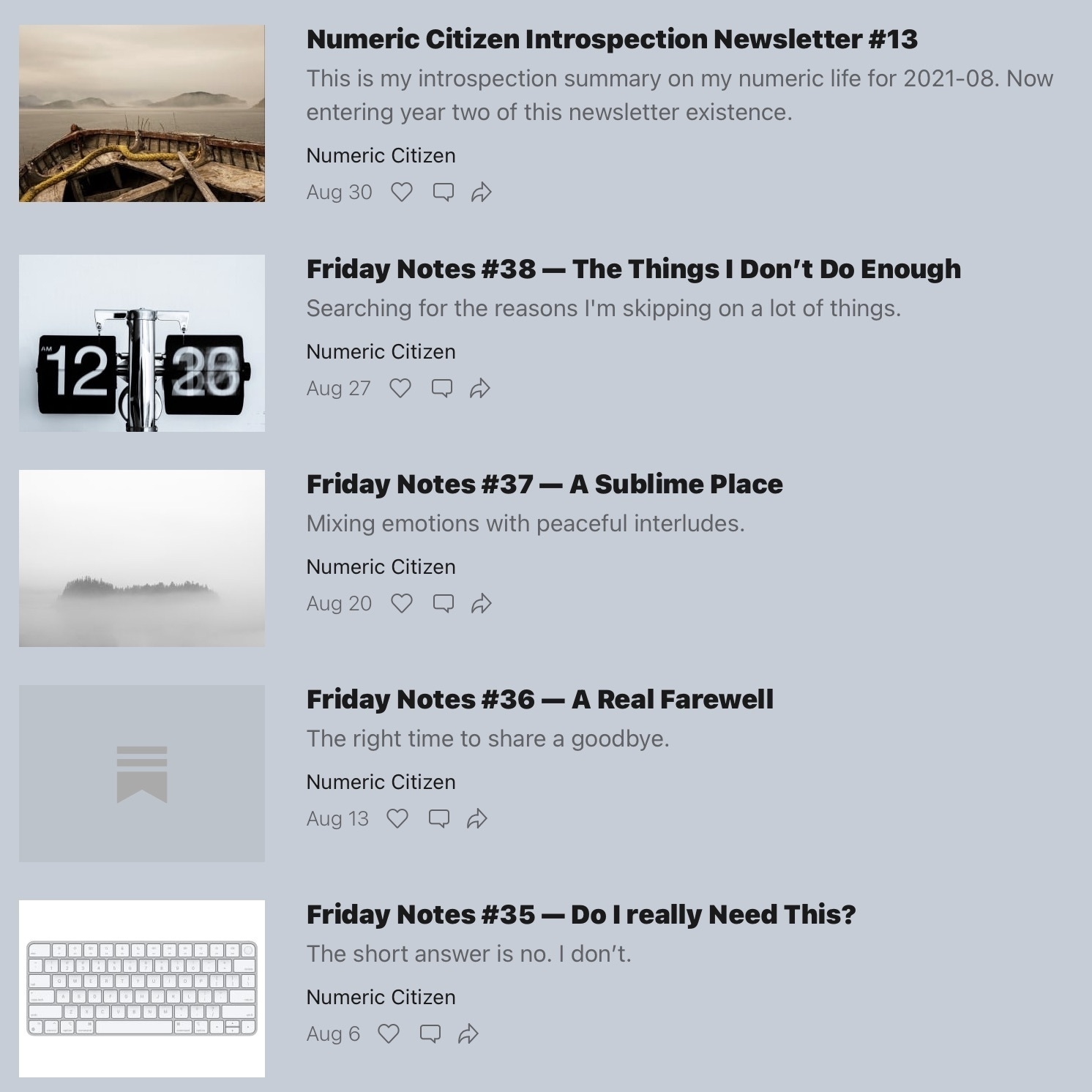
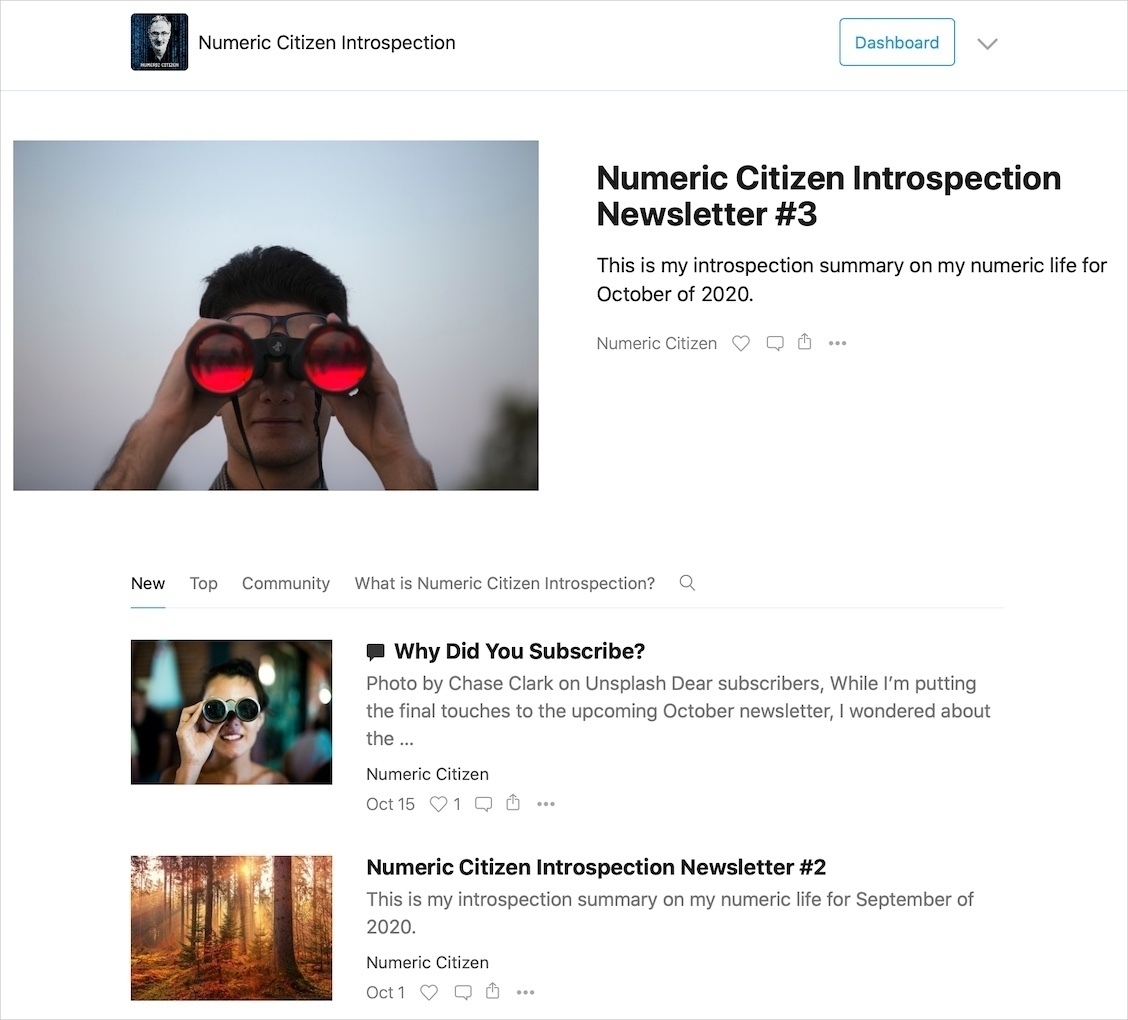
2026-08-10 ∞It’s fun to go back in time and look at content I’ve previously published. Here’s an example: a Create Summary newsletter issue published two years ago. I still have a newsletter; the name is different, the content format is similar but more mature, and the motivation to put it together regularly is the same.
2026-08-15 ∞Adding an MCP endpoint is...
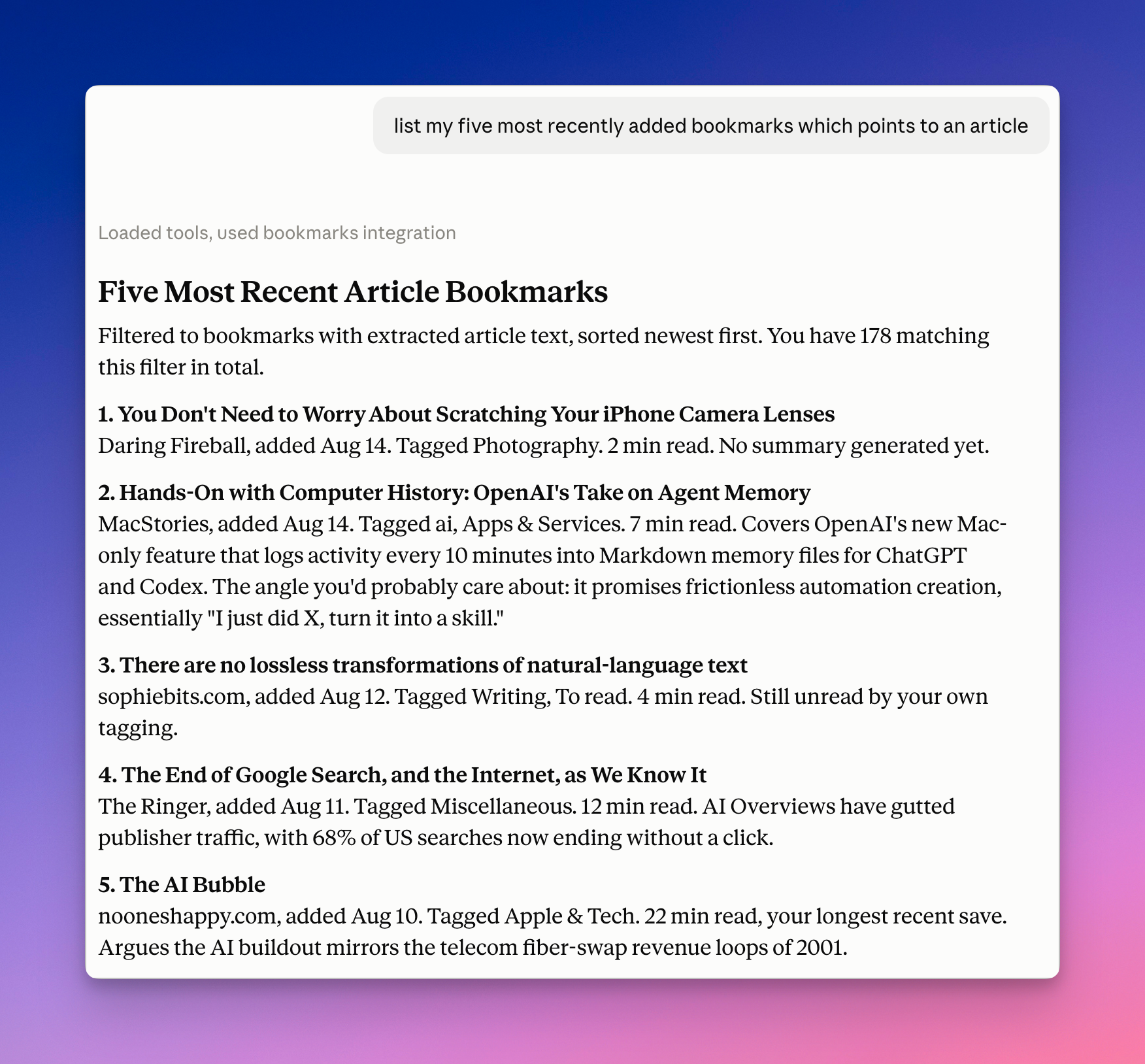
My bookmarking web app is now mature, but one thing was missing: an MCP endpoint. I wasn’t sure whether I could add that feature while running on Vercel. Well, after less than an hour, Claude Code helped me get my MCP endpoint running smoothly and responding to all sorts of prompts! I was expecting a much more challenging journey. 😅
 2026-08-15 ∞
This morning, I spent some time revisiting my RSS feeds and blogroll, and I was sad to delete the RSS feed pointing to Om Malik’s website. Such a loss. 😔
2026-08-16 ∞Incogni value proposition and contradictory policy
For the second time in as many days, I’ve seen paid promotion from Incogni (one in a YouTube video and on the 9to5Mac website). According to the Incogni website:
Incogni is a personal data removal service that automatically removes your information from data broker websites, significantly reducing your digital footprint. Anyone can get instant access to personal data online—Incogni makes sure it stays private.
I was curious and headed to their website, where you can enter your email address to test the service. The problem is that, according to their ToS and privacy policy, they collect email addresses this way so they can bug you with promotions and all that. I find this against their value proposition and it weakens their credibility. People willing to pay for such a service are probably protective of their email address, and yet, this is the first thing Incogni collects. If they offered a way to test the service, albeit in a limited way, while saying they don’t collect email addresses to perform these tests, it would be quite another matter, and I would be more willing to test and maybe even subscribe! But no. Bummer. I’ll pass.
2026-08-16 ∞Vibe coding, Glaze, Lovable, etc. are these the consequence of a disconnect with traditional developers as well as with traditional digital distribution conduits? 🤔
2026-08-16 ∞The journey should be the only reward
My sister, who discovered water painting late in life, is part of a group of artists who share the same passion for art and painting in general. She is really good. She has taken many art courses since COVID. Now, she’s part of a Facebook Group, and when she mentioned it, I suggested creating a website for her to showcase her work, separate from platforms like Meta. She inquired about discoverability. What can I say to her? Is discoverability always tied to rewards? Are likes part of a validation process? Can we be on the web without seeking discoverability or rewards (likes, reblogs, etc.)?
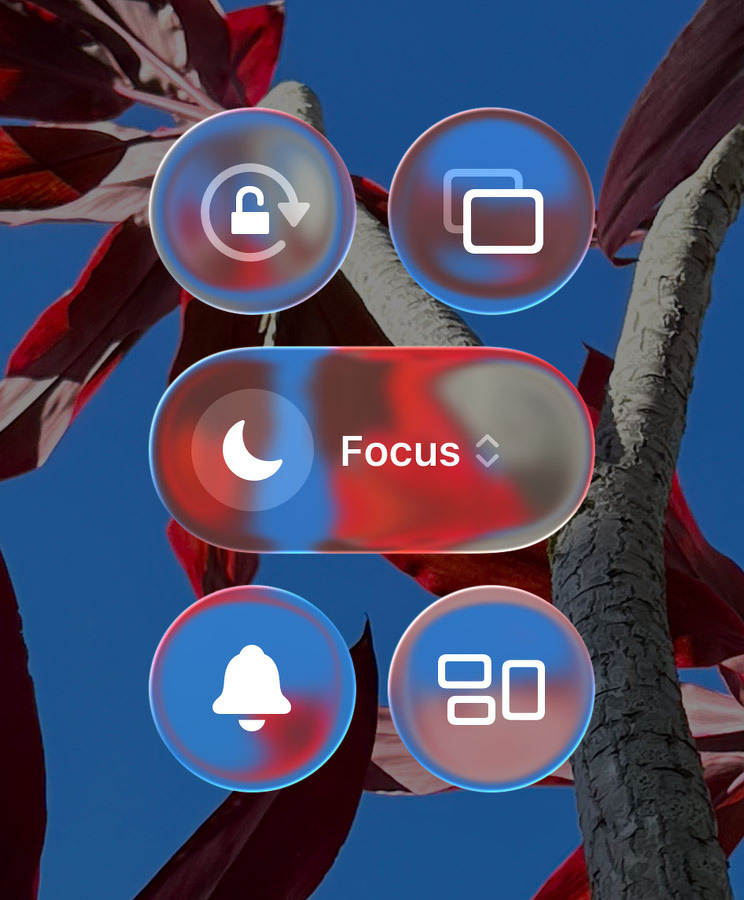
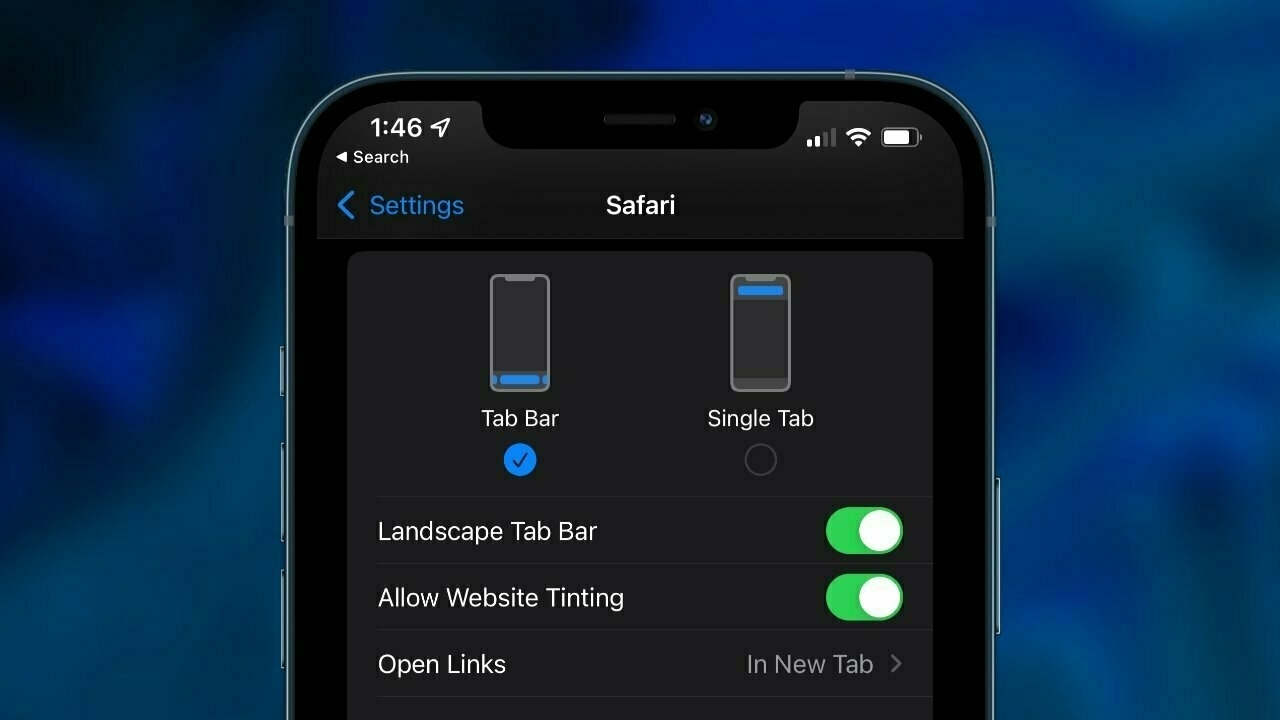
2026-08-16 ∞The new traffic light controls in macOS 27 beta 6 are 👌🏻
To me, Apple is slowly but surely correcting course here.
 2026-08-17 ∞
Gruber, in his most recent article about Anthropic’s strategy for encoding fingerprints in generated text:
“English Is the Finest Language, and Thus, Perhaps, More Fingerprintable”
Give me a break. The finest language is French, the language of diplomacy. Period.
2026-08-17 ∞What is morally acceptable?
Yesterday I had a long and tricky discussion with some of my colleagues about the war in Ukraine. It was tricky because one of my colleagues suggested to consider Russian side before judging that it is not ok to invade Ukraine. While he wasn’t fully up-to-date with what is going on in this war as I am, he kept pressuring me to think that Ukraine might have done bad things in the past to justify Russian invasion. I find this point of view morally hard to hold and justify. Even if it is about joining NATO or not and the effects on Russian political posture and geopolitical posture, I cannot accept any justification.
2026-08-20 ∞Real followers, please stand up!
In followers rot, Matt forgot to cover followers that are trying to get your attention and hoping that you will visit their profile and get hooked to them by starting to follow you and like everything you post online. They are active but don’t really care about the content. I have a few of those on Bluesky and Mastodon (and a lot on Twitter, too).
2026-08-20 ∞The untrustworthy partner
Well, we failed to conclude a deal with the Trump administration. A last minute change from the US smashed the only little bit of trust we had. Is it surprising? Just look at Trump’s behavior since is his in the office, this should be enough to stay away from him and his bunch of bandits to conclude that we cannot trust him, we cannot trust this administration and we cannot trust the US. The US is un untrustworthy partner.
Now, my hope is that we start talking the same language as they use with us and act accordingly. No return of American alcohol, block dairy products from entering Canada, put tariffs on energy we export, etc. Make them pay the price. Make the Trump administration look bad right before the midterms. Standing up isn’t a free ride and I’m willing to pay the price. I support Carney. 🇨🇦💪🏻👊🏻
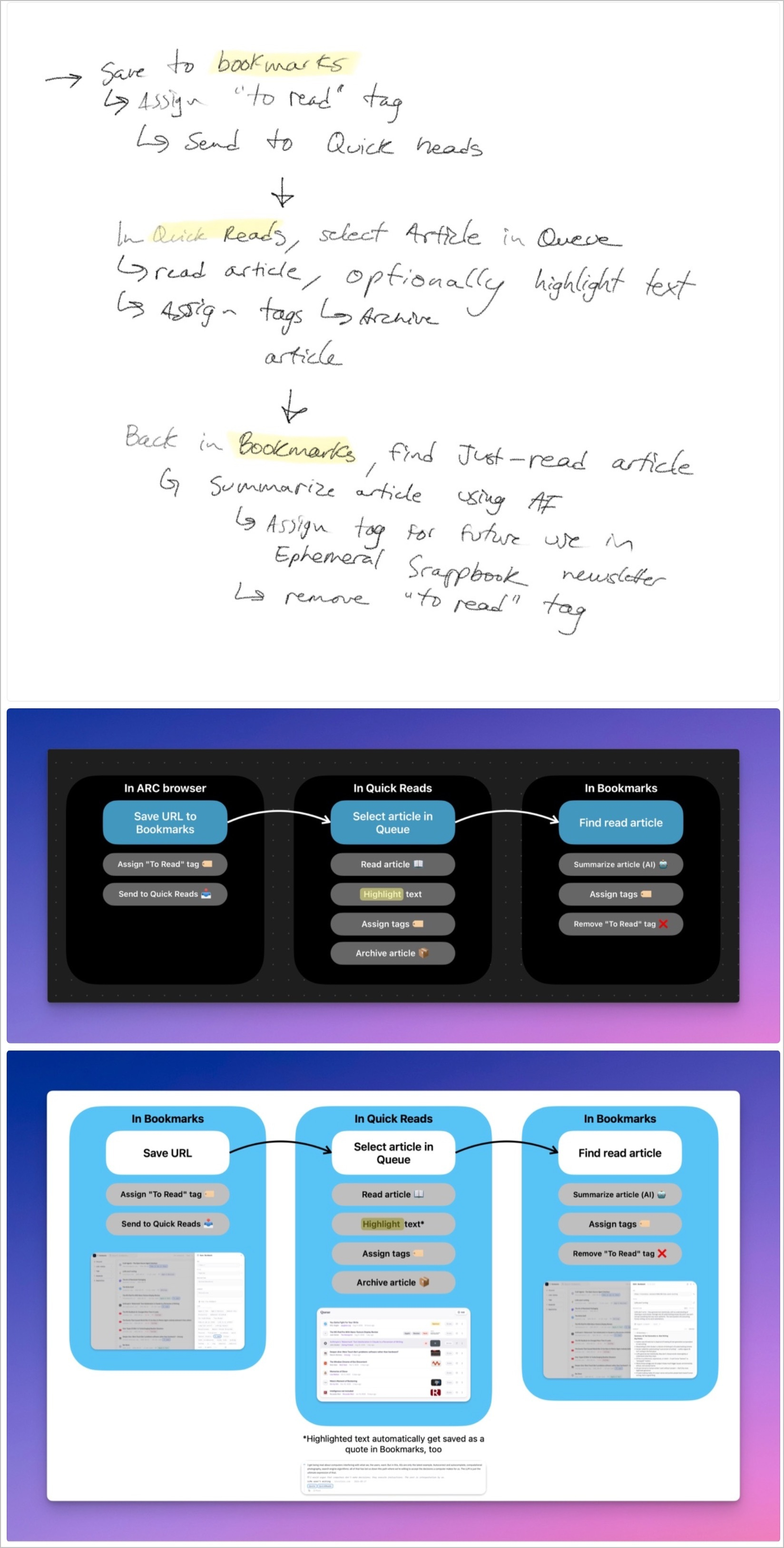
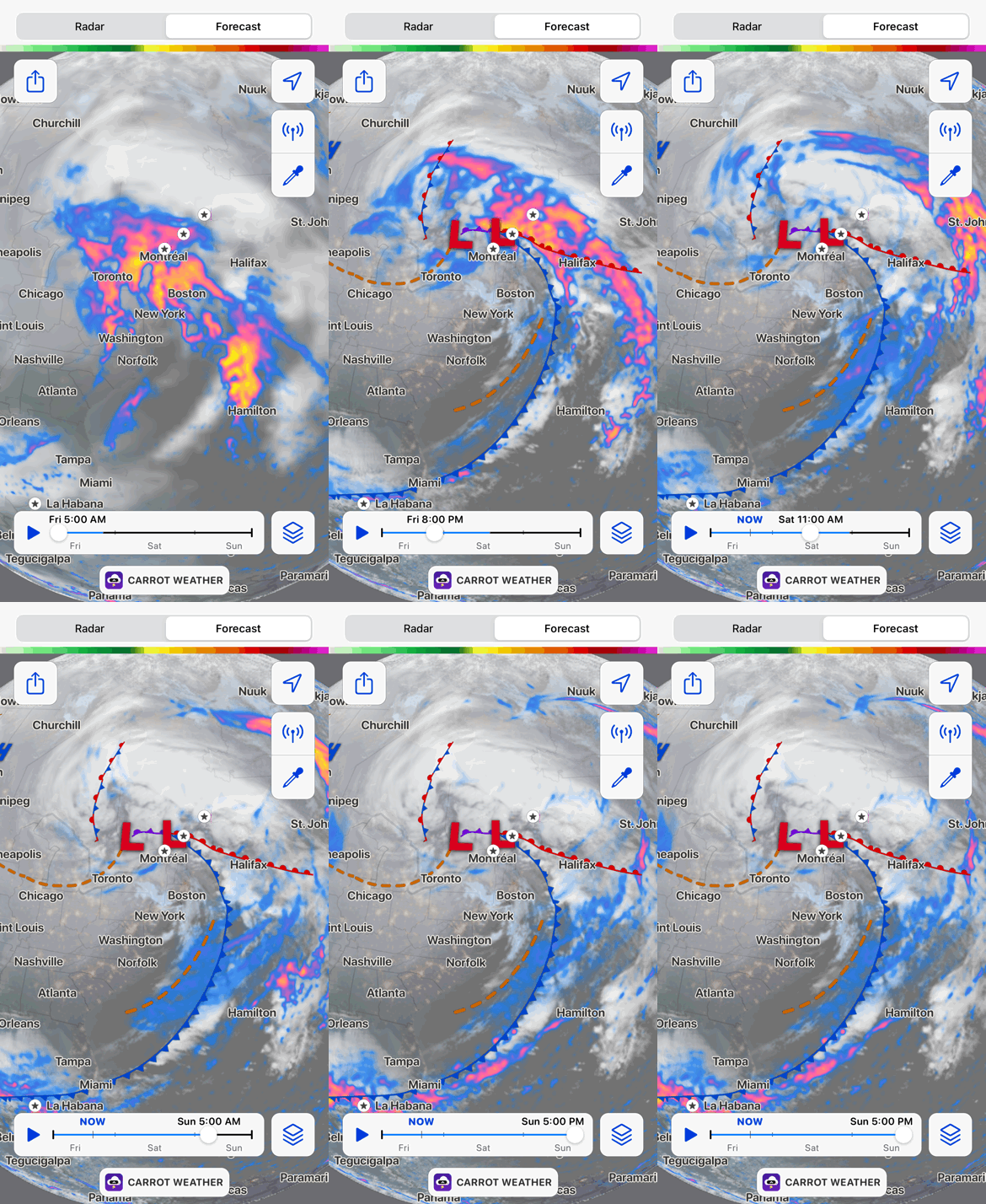
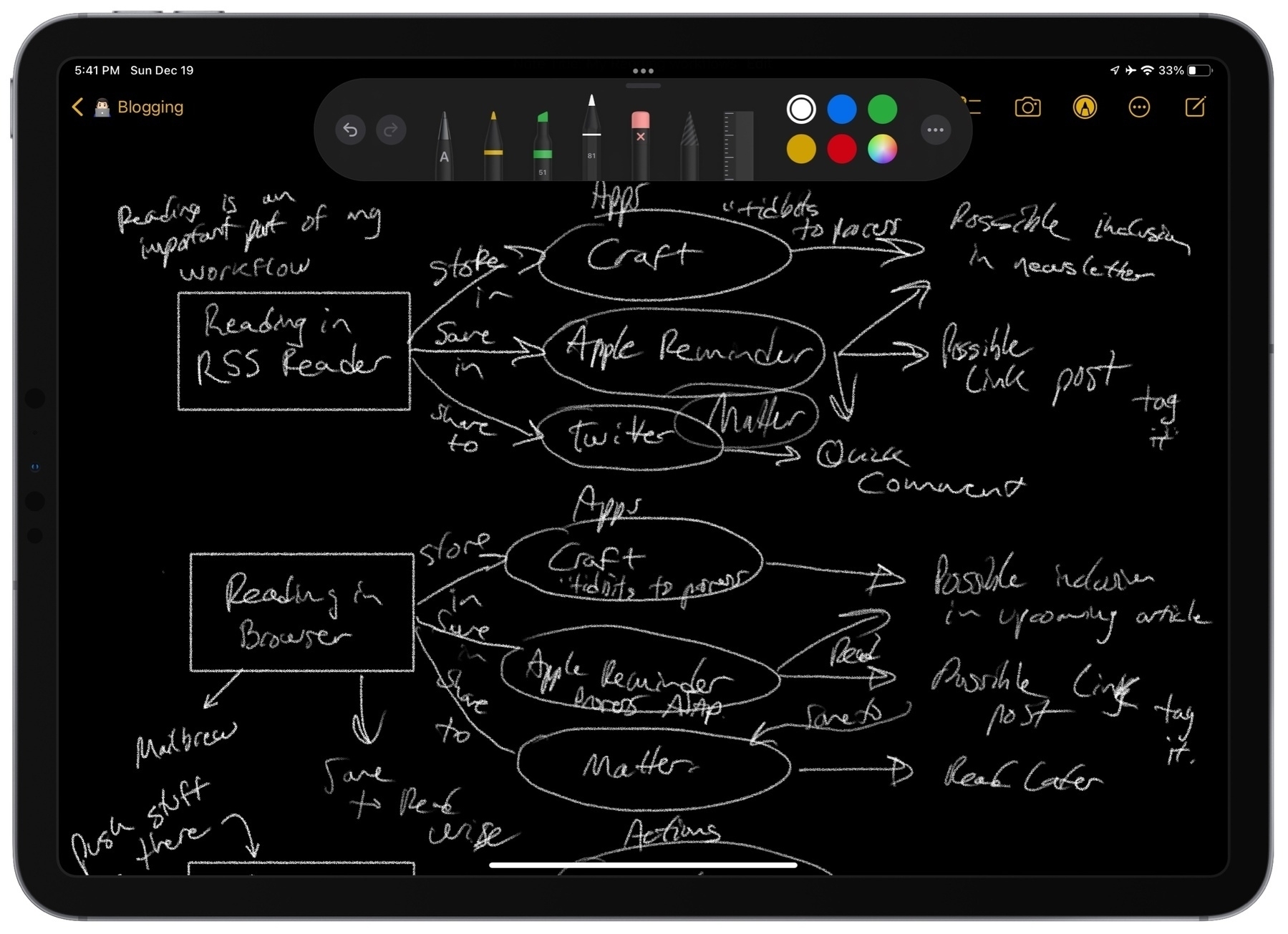
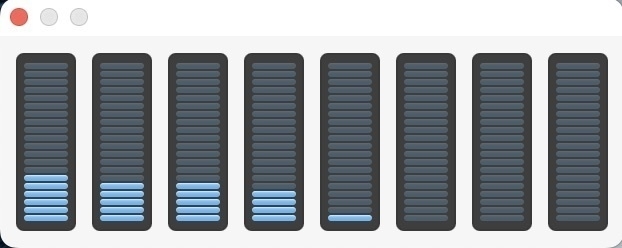
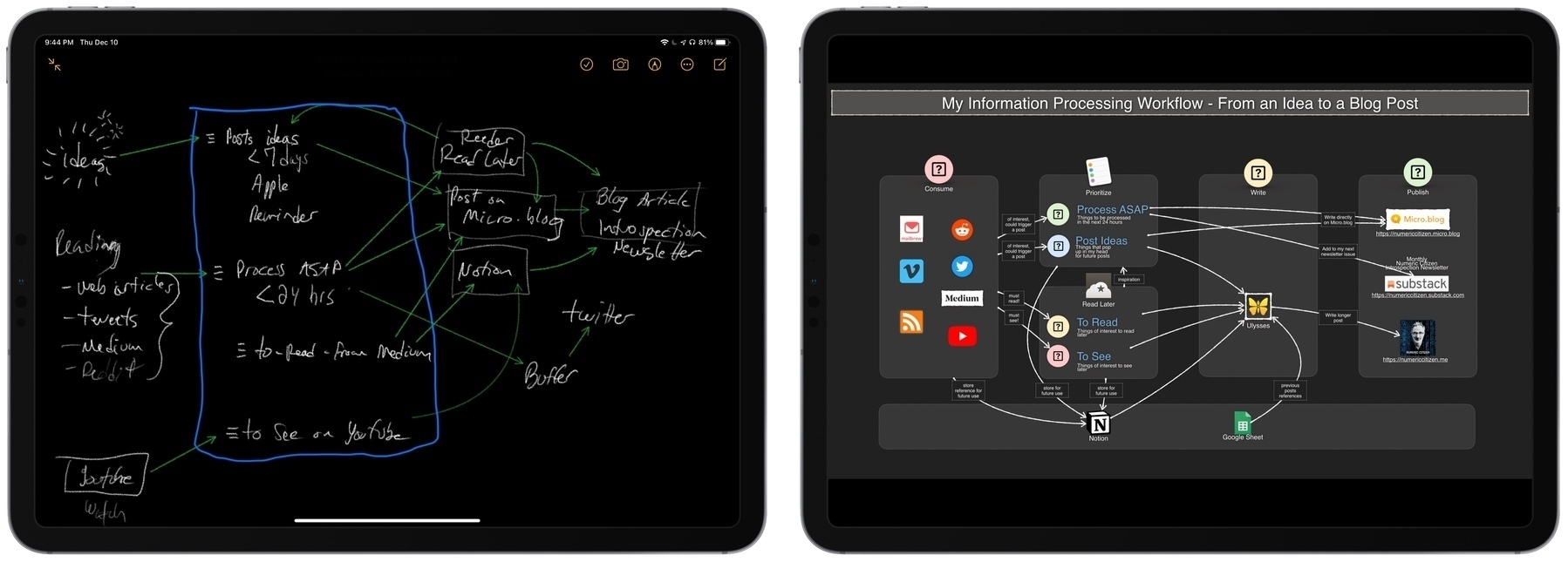
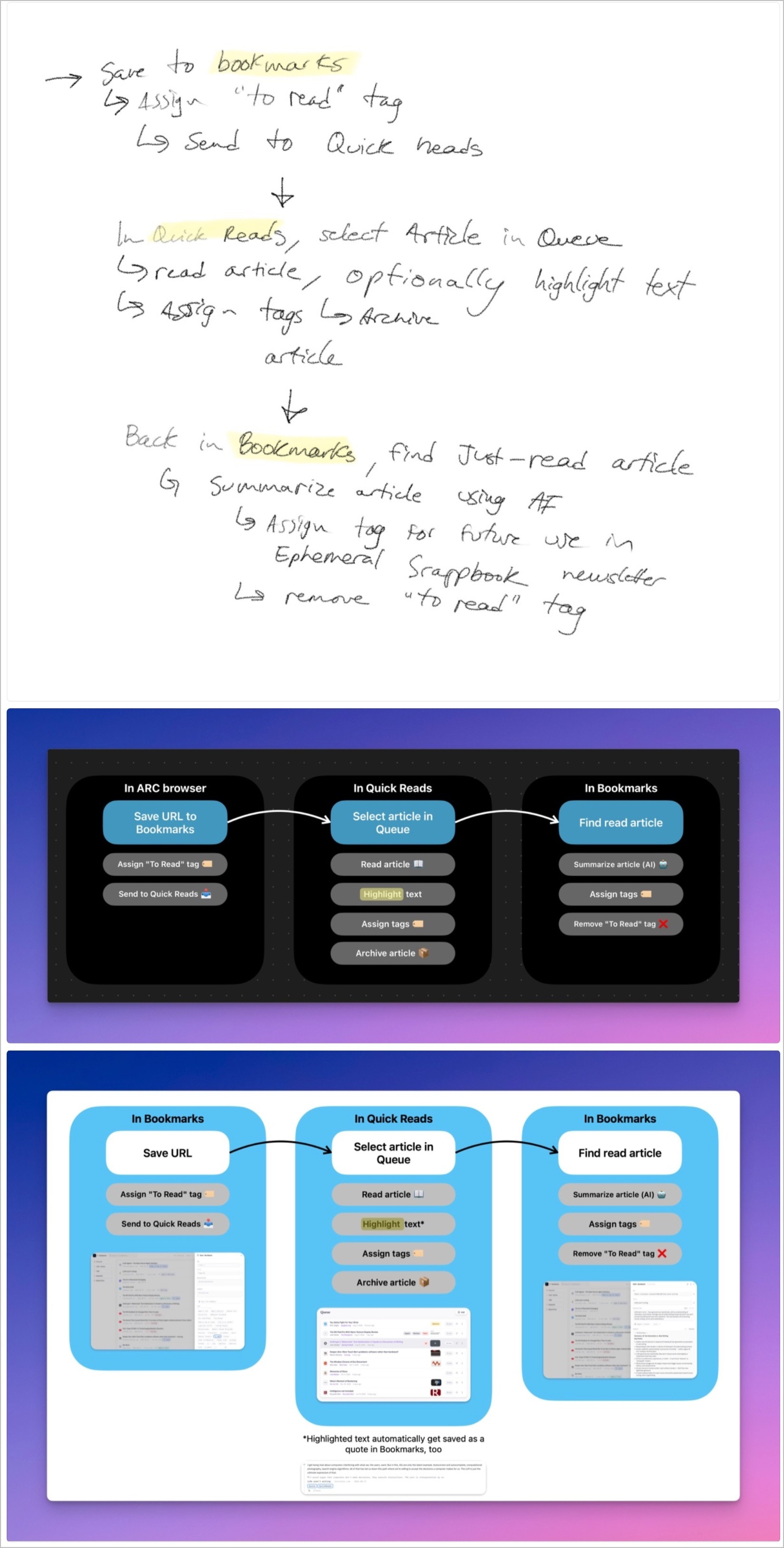
2026-08-22 ∞I’m putting the final touches to an upcoming review of Quick Reads, built by @mattbirchler. Below is a work-in-progress diagram, from jotted notes to the final version. Much more detail tomorrow.
 2026-08-22 ∞
 Striving with X
Federico Viticci is sharing an explanation about why MacStories resumed posting on X:
We want to be absolutely clear about something: returning to X does not represent a change in our values, what MacStories or we stand for, or an endorsement of Elon Musk. We abhor Musk’s politics, his rhetoric, his careless disregard for others, and the direction he has taken X. But we also disagree that participating on X means we have aligned ourselves with any of Musk’s views or actions. We reject Musk’s worldview and will continue to treat people with the kindness and respect they deserve wherever they are on the Internet.
That’s not enough. MacStories is contributing to the bad internet, the siloed internet. They are feeding the machine. I stopped reading MacStories long ago because it became something else I don’t really care about. Here’s another reason to stay away. MacStories is giving people more reasons to return to X, too. Sad that in today’s world you cannot stand by yourself and only depend on toxic platforms to thrive. Too bad, because the original MacStories was really great.
2026-08-22 ∞Mark Carney on the U.S. Under Trump: ‘Sometimes, Its Signature Is Written in Pencil’:
Carney is rising to the moment and showing the rest of the world how to deal with the Trump administration. Trump is erratic, emotionally unstable, ignorant, and dishonest. Carney is consistent, steadfast, knowledgeable, and honest. The only correct way to deal with a con man is to cut him off and call him out for what he is.
Gruber, now you’re talking! For once, I fully agree. I’m proud of Carney; I’m proud to be Canadian. I’m proud to stand up.
2026-08-22 ∞Is the iPad still valuable for me?
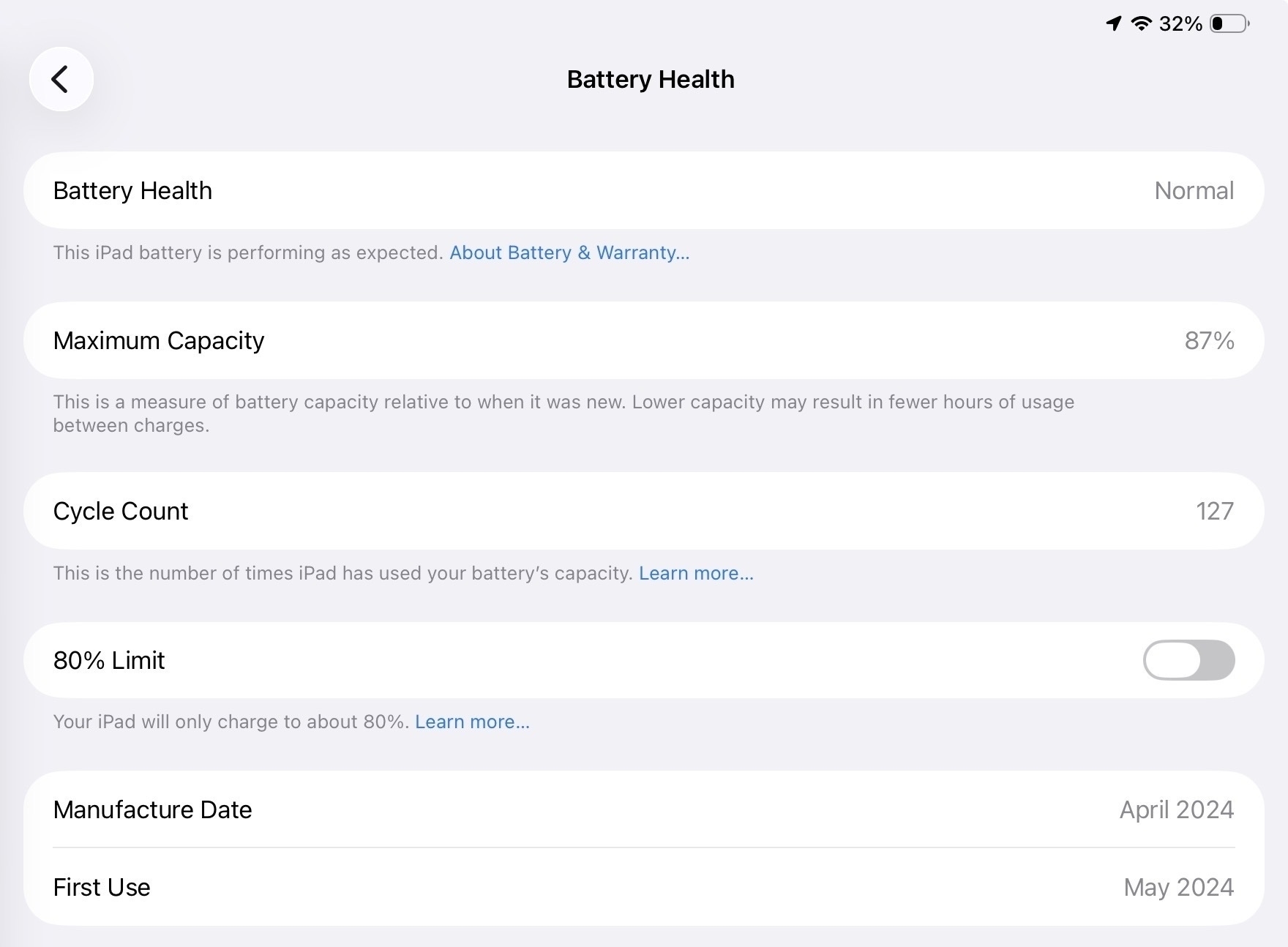
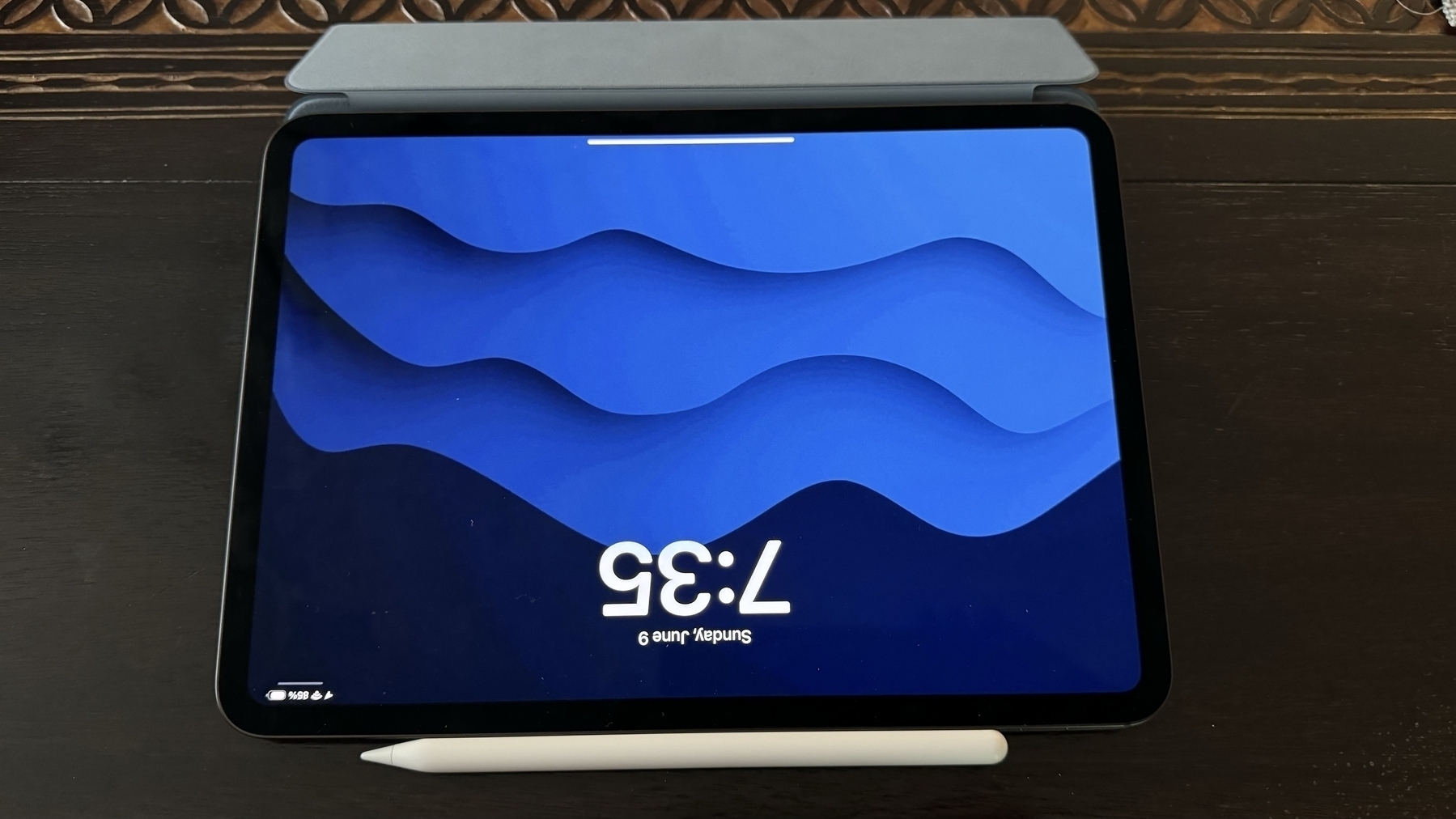
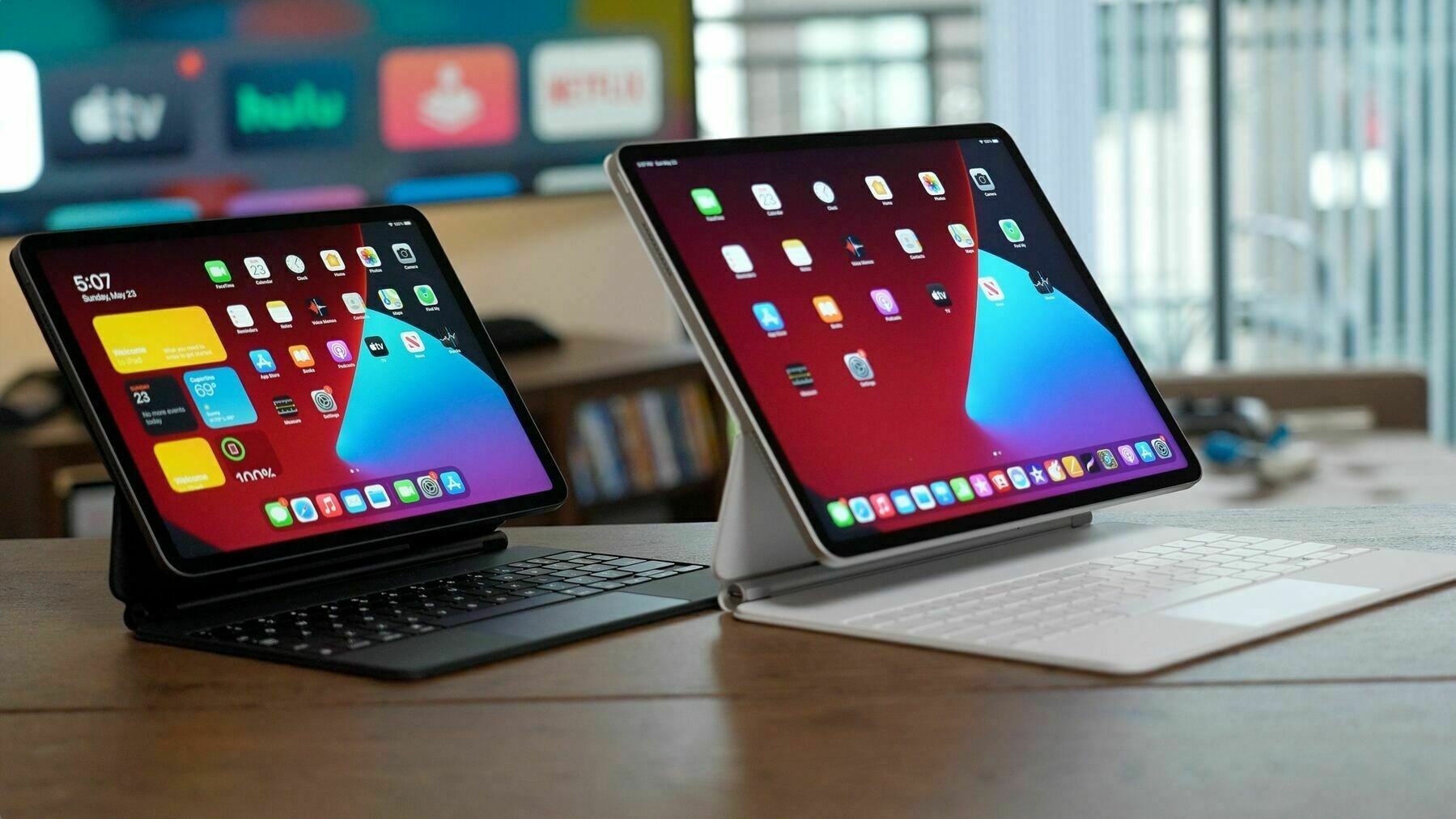
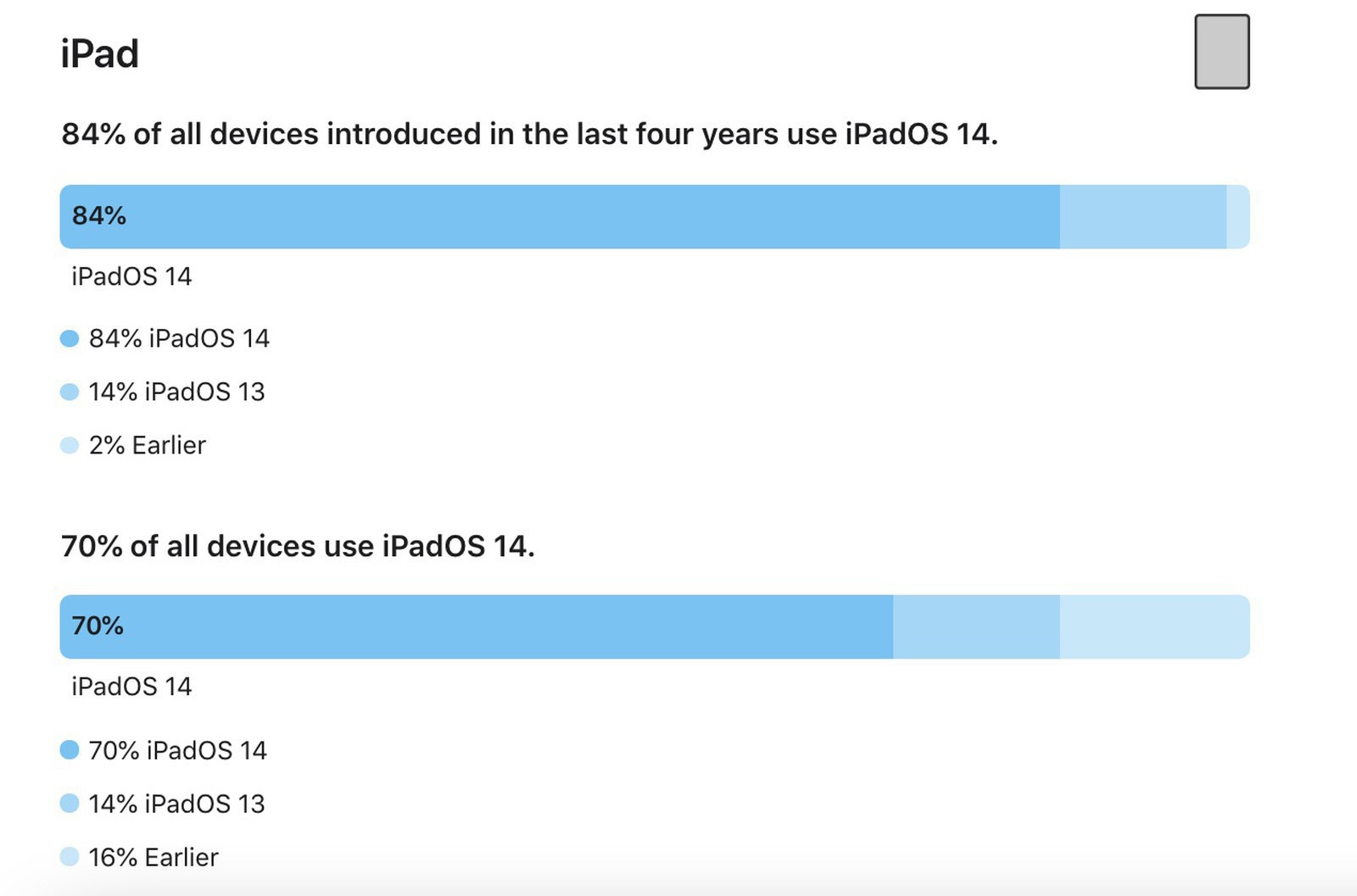
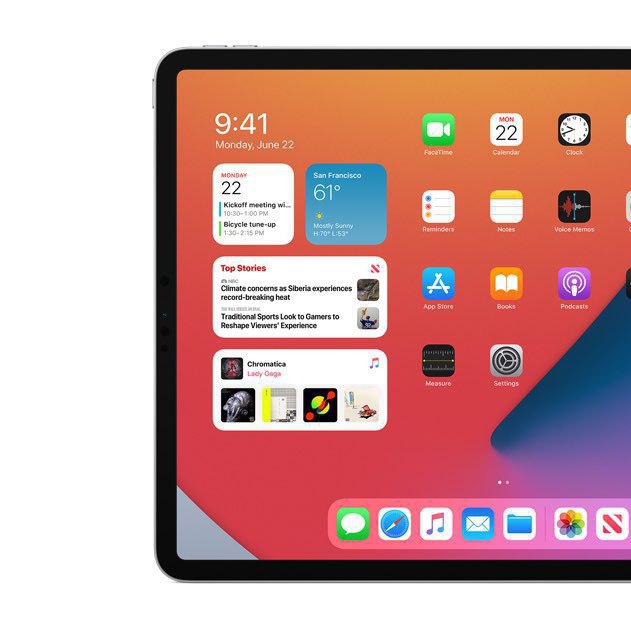
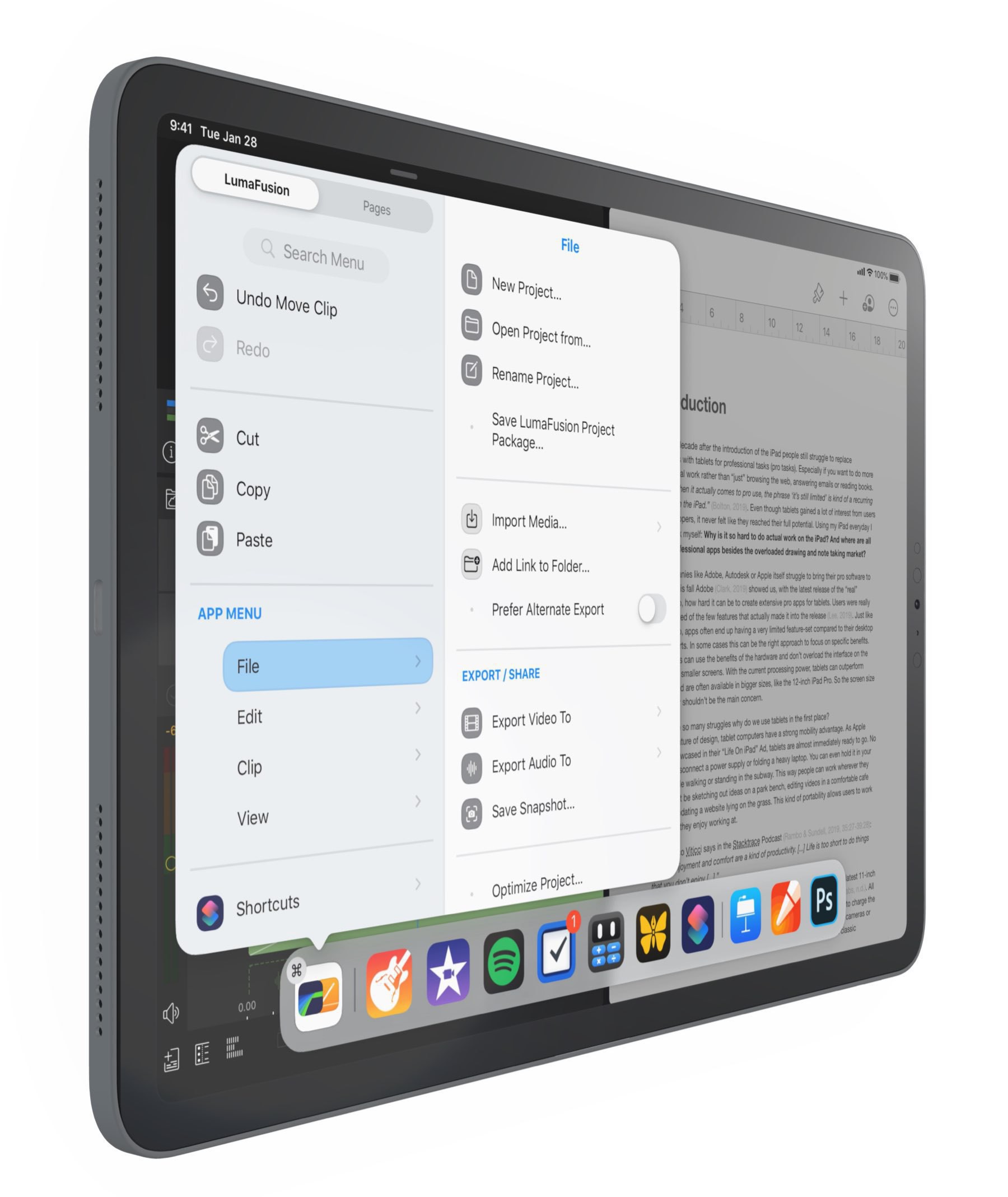
This morning I had a short discussion with my wife about how she could upgrade her aging 2018 iPad Pro, a device that is not supported by iPadOS 27. I suggested taking my 2024 M4 iPad Pro instead of buying a new one. She was dubious about the suggestion even if I don’t use my iPad often and instead voiced her desire to go with the latest iPad Pro which is not a cheap option. She still think that this upgrade circus comes down to programmed obsolescence. 🤷🏻♂️ I was ready to get rid of my iPad, can you imagine?
2026-08-23 ∞Being manipulated
This morning, I visited Reddit to answer a question about Craft. When I noticed five notifications, I clicked the bell icon. Two of them were about engagement stimulation, which I felt was manipulative and deceptive. I dislike being tricked this way. LinkedIn is also good at this. And Meta, the master of them all. Major platforms will likely face legal challenges in the future because their product design promotes toxic engagement tactics that manipulate users for growth. Om Malik won’t be around to see this unfold, sadly.
 2026-08-24 ∞
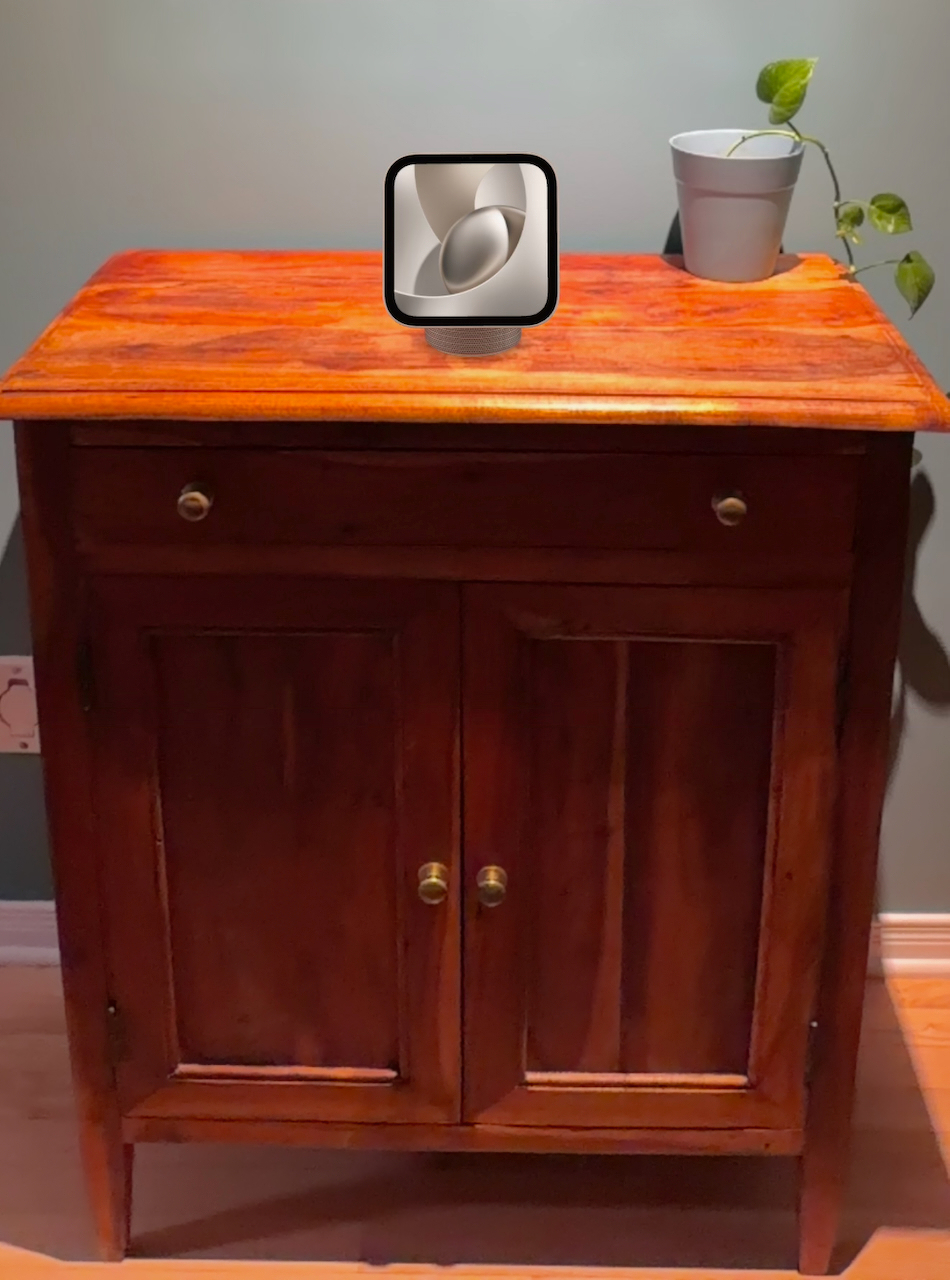
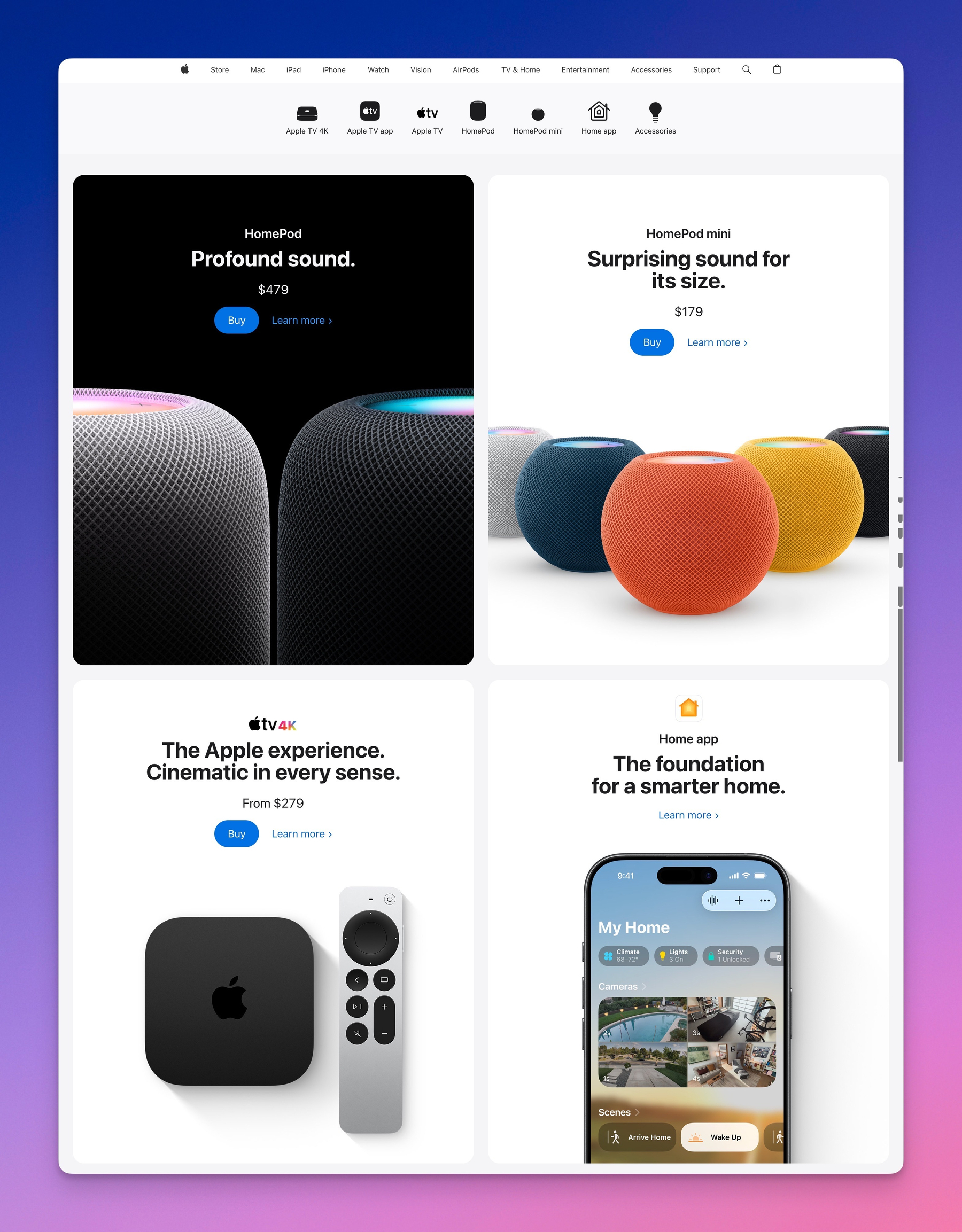
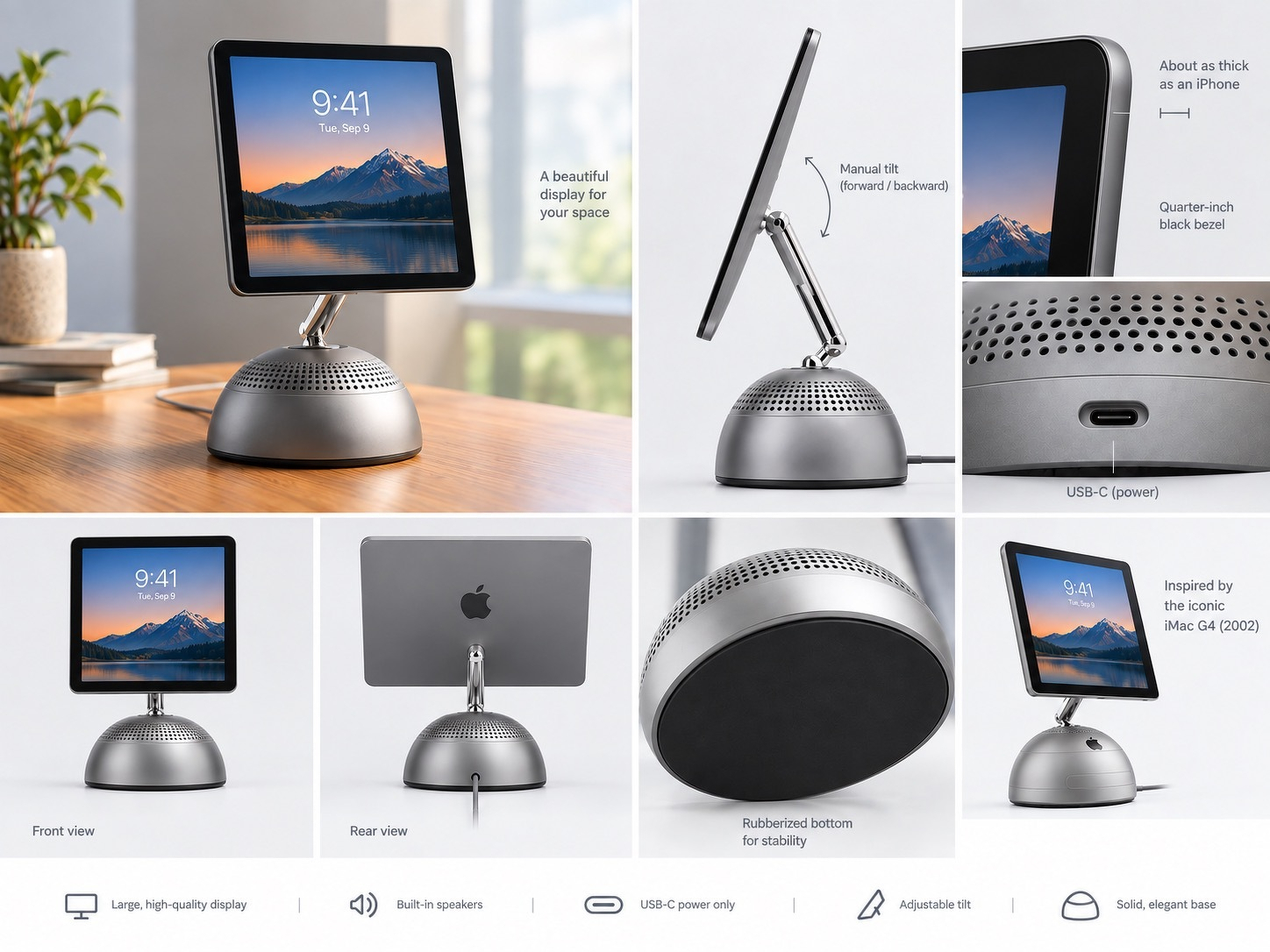
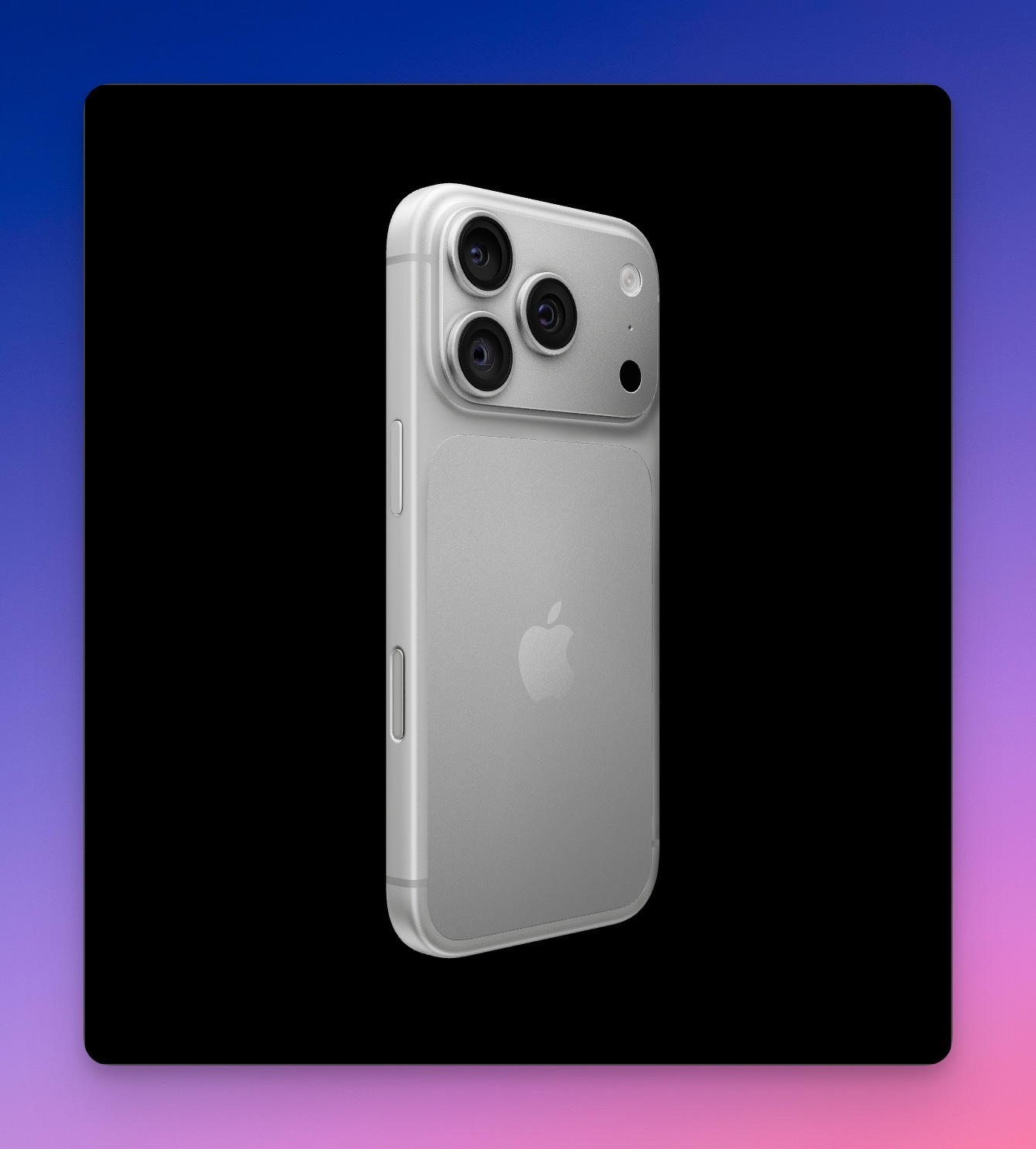
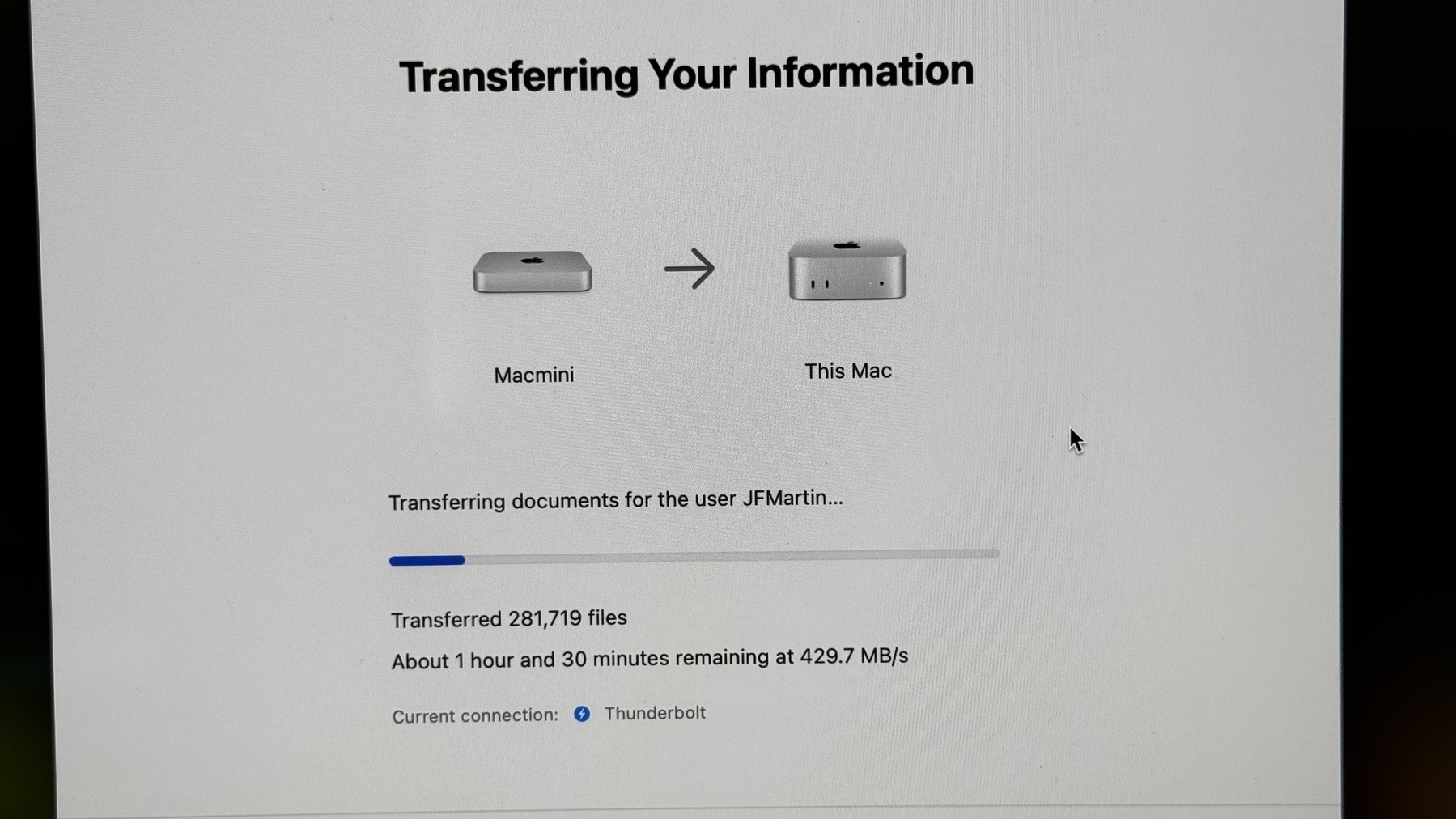
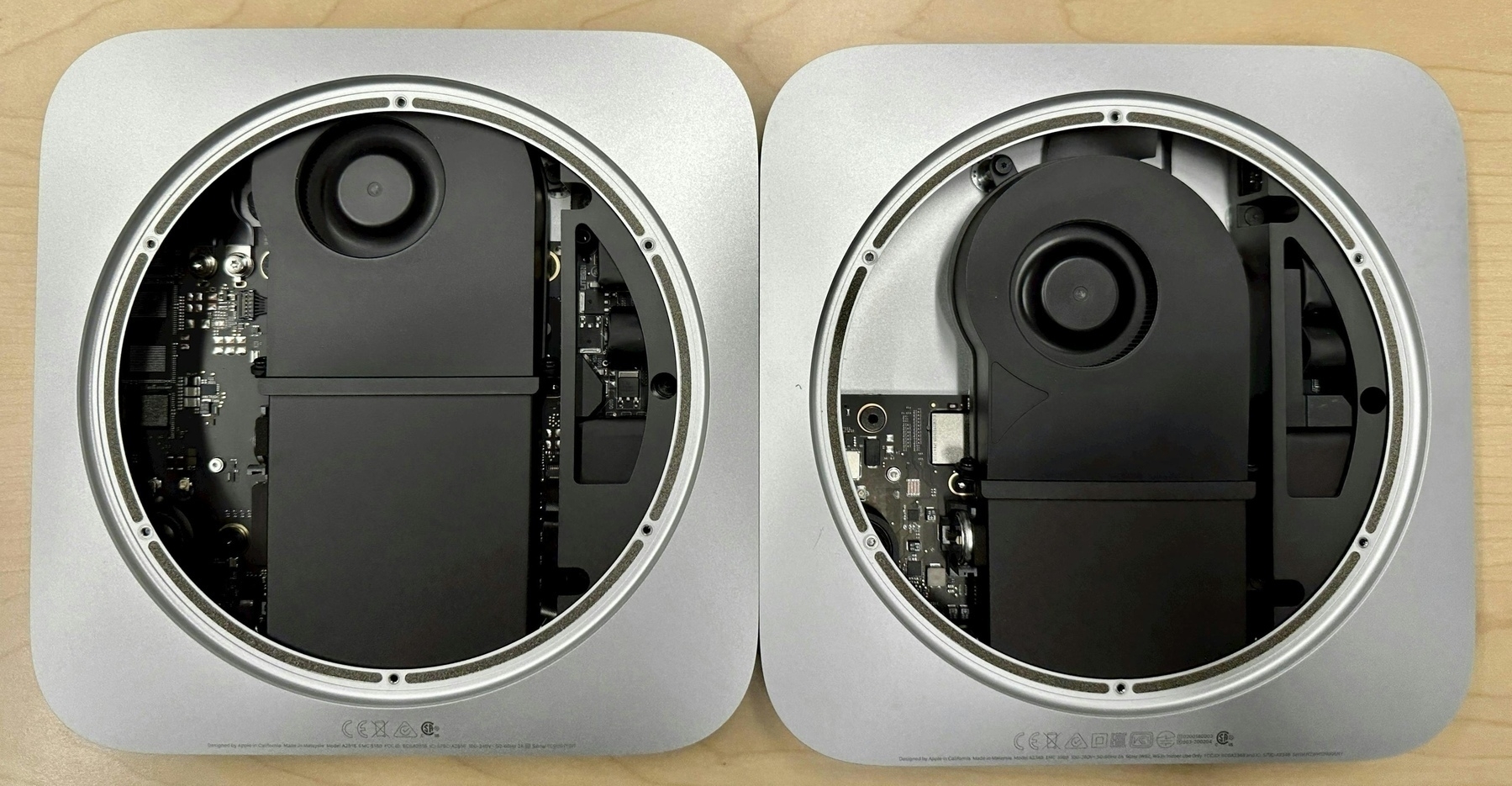
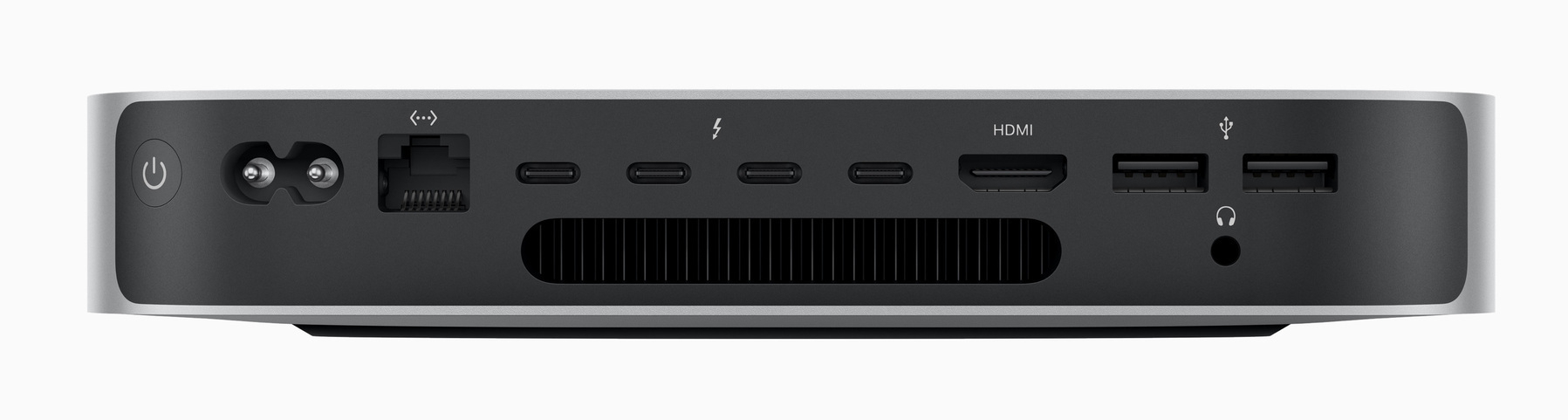
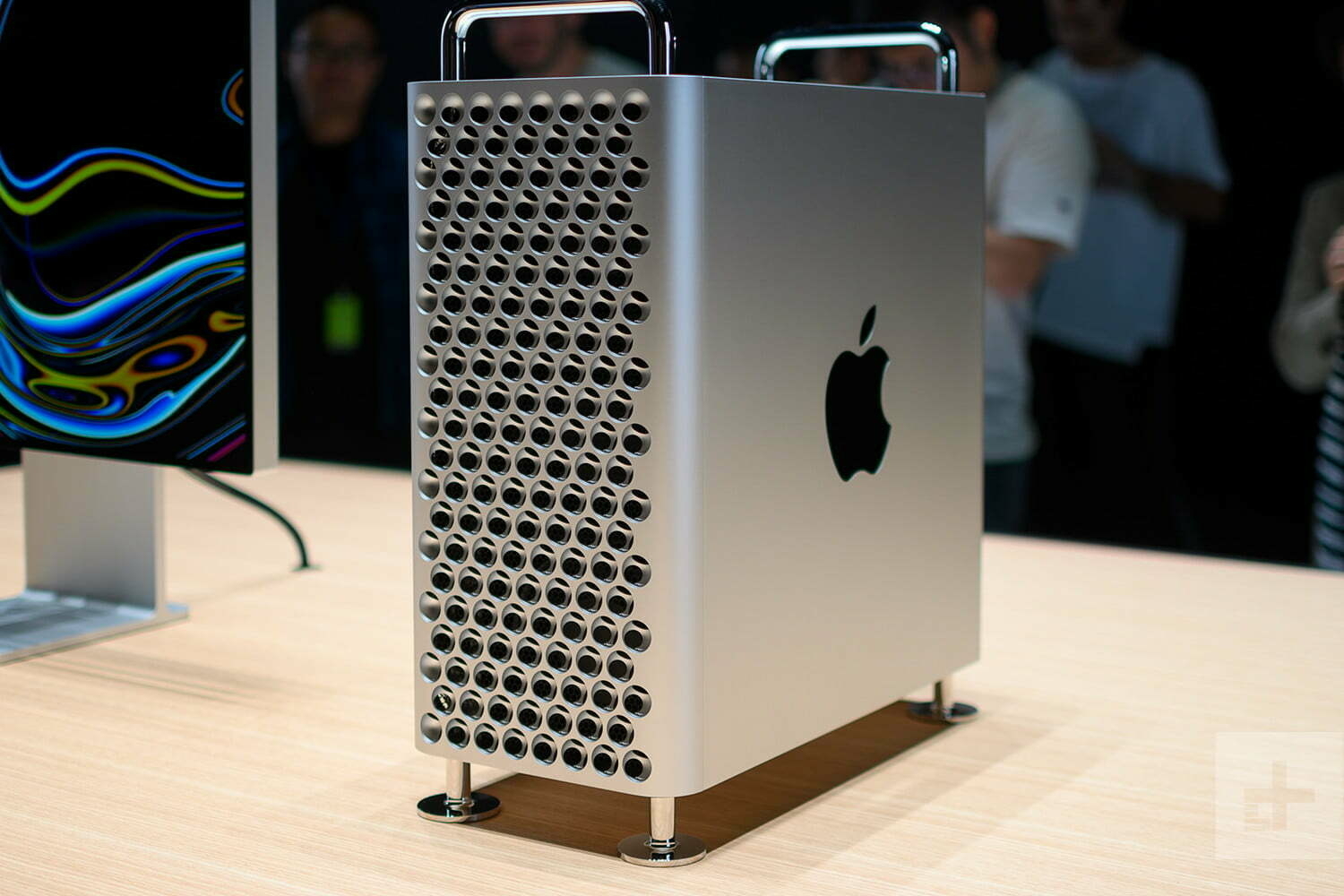
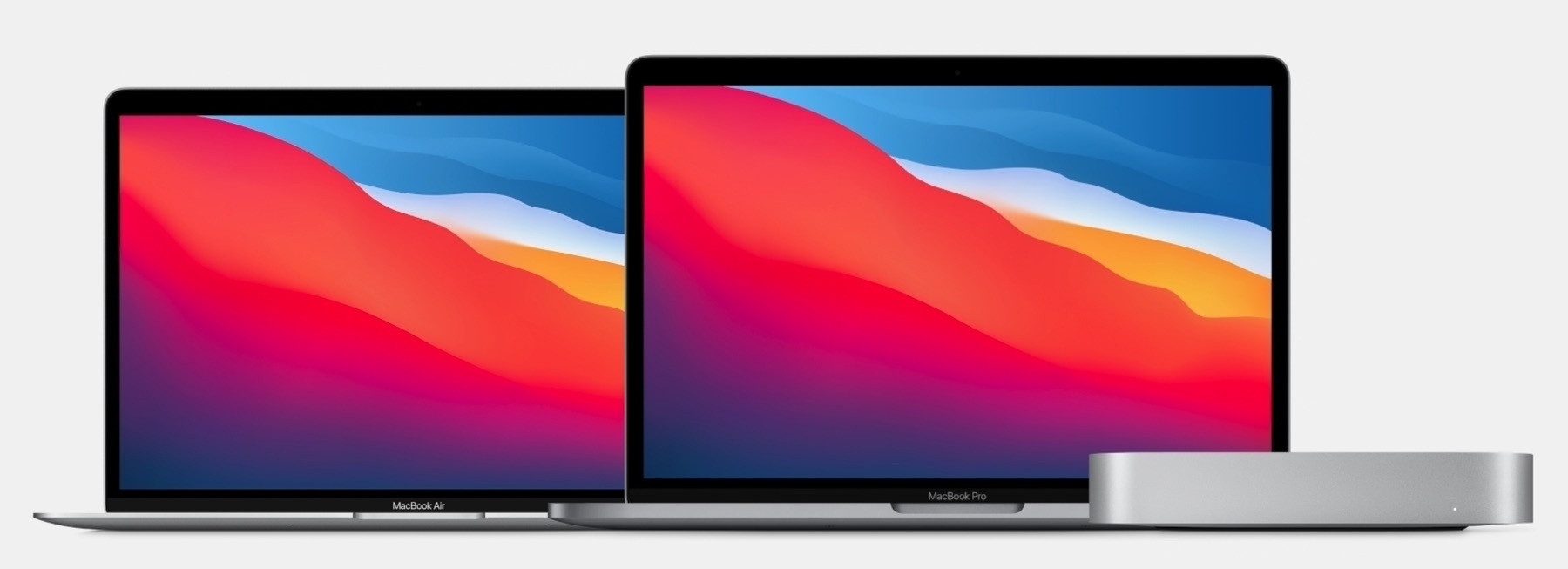
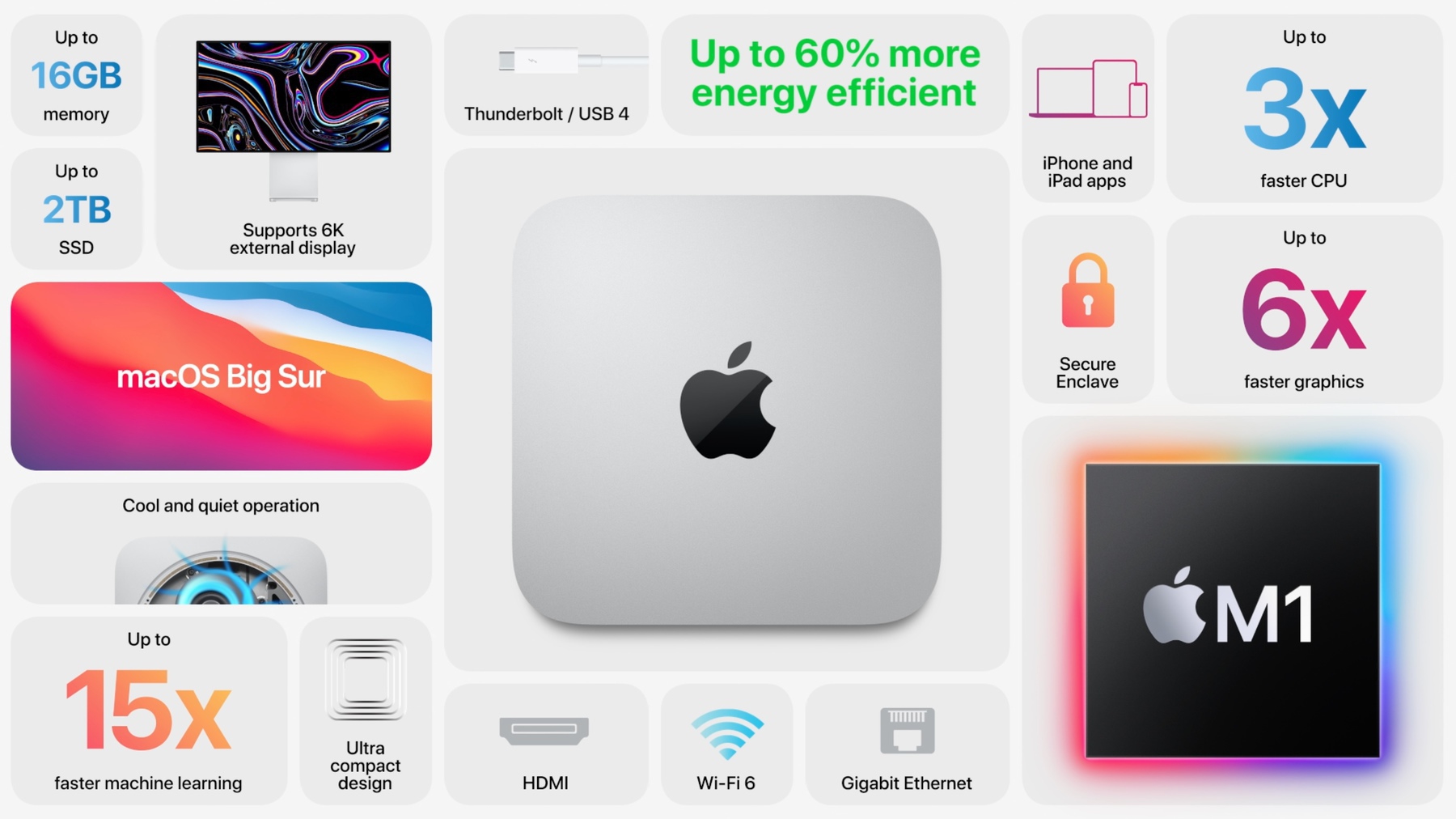
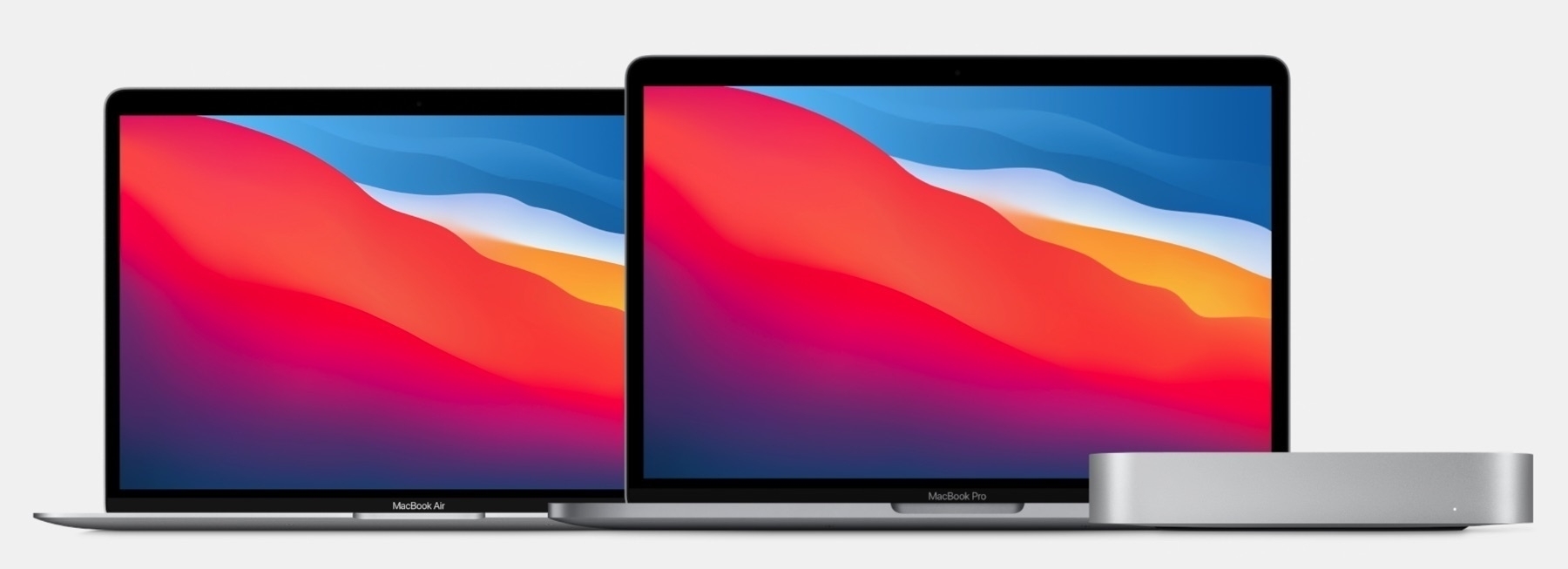
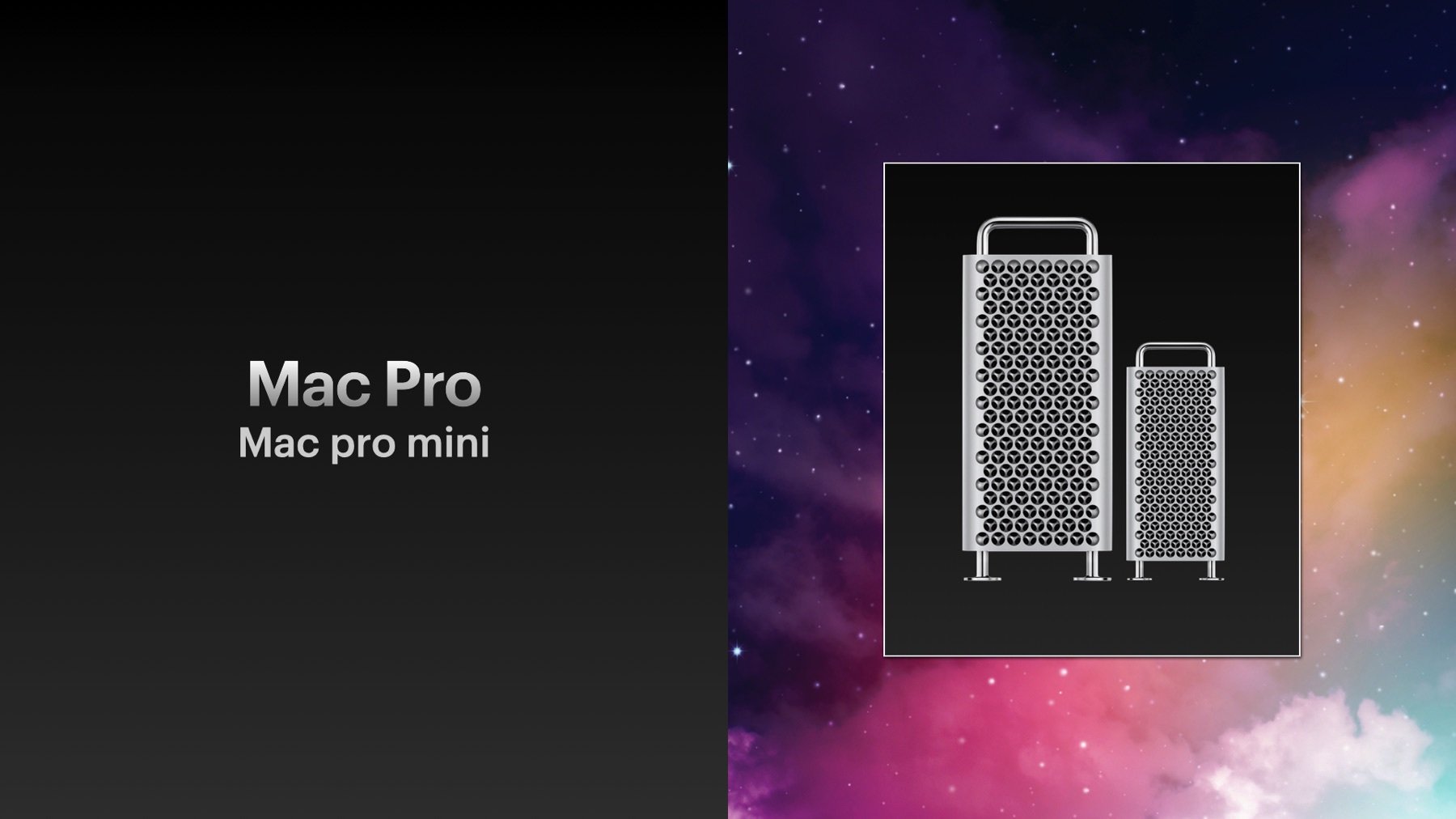
Powerful Macs introduced today by Apple. But expensive, too. Apple should now introduce a Mac Neo, a smaller and cheaper version of the newly introduced M6 Mac mini desktop, in the style of the Apple TV. It’s the only way to get back to the sub-$500 mark. 😱
2026-08-25 ∞I would love to find a viable alternative to the ARC Browser, the digital zombie, and again, Dia isn’t one. Why is this browser so slow compared to the former?
2026-08-26 ∞Our AI Stance - No AI, Ever: Cork
2026-08-26 ∞“Funny how when I ask AI about something I know, it’s completely wrong, But when I ask it about something I don’t know, it gives a great answer.”
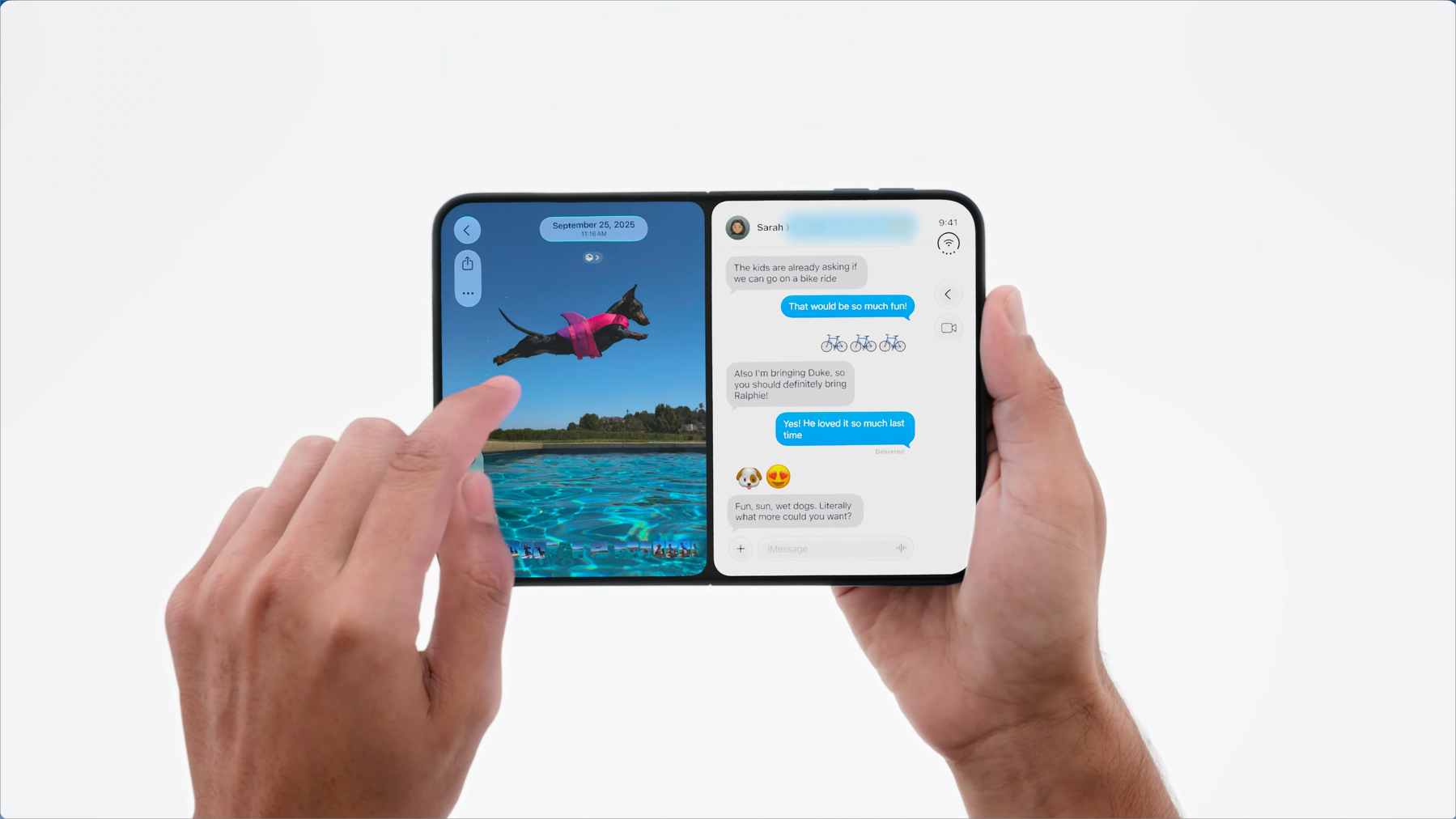
MacRumors’s article “Concept Video Imagines Apple’s Foldable iPhone Ultra Reveal”:
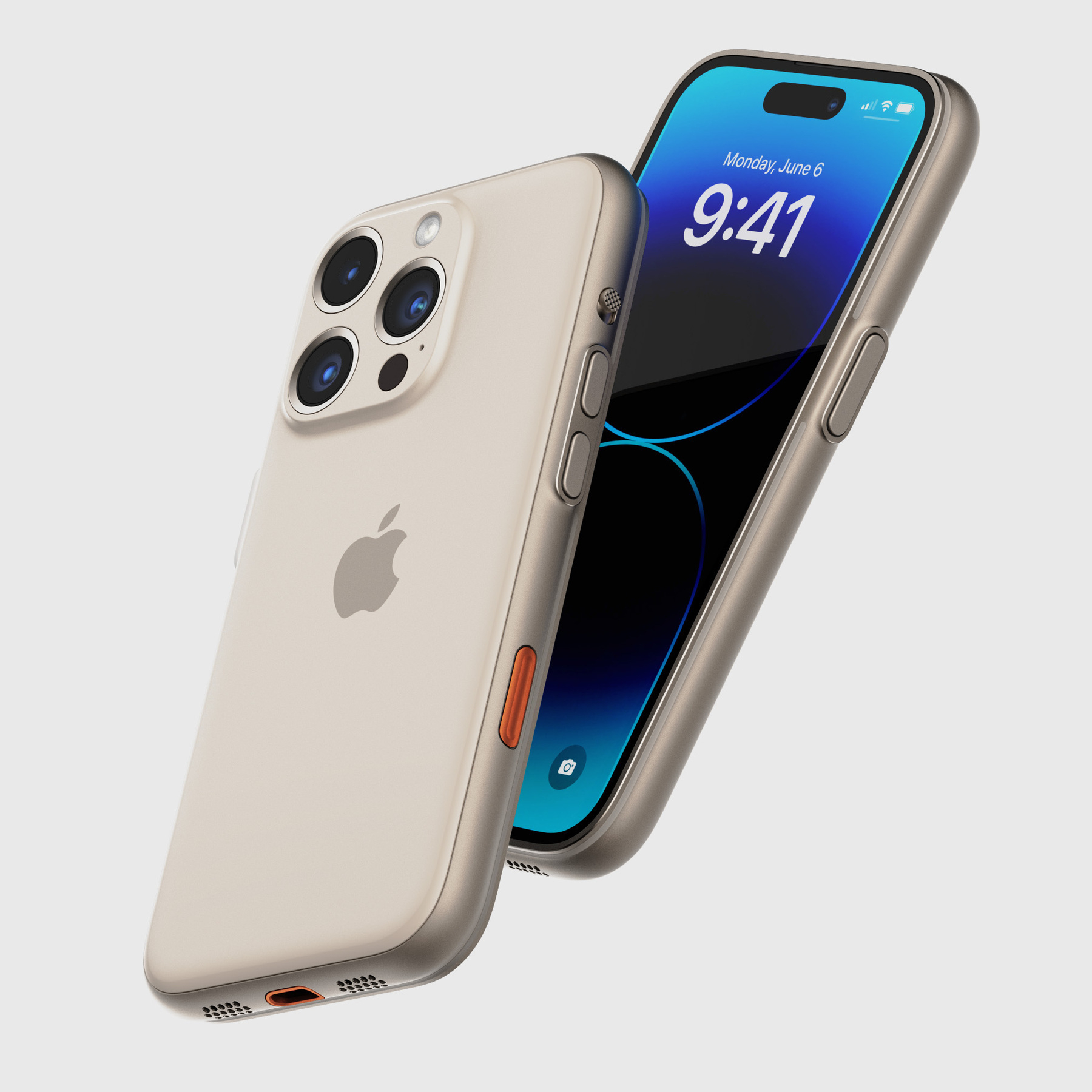
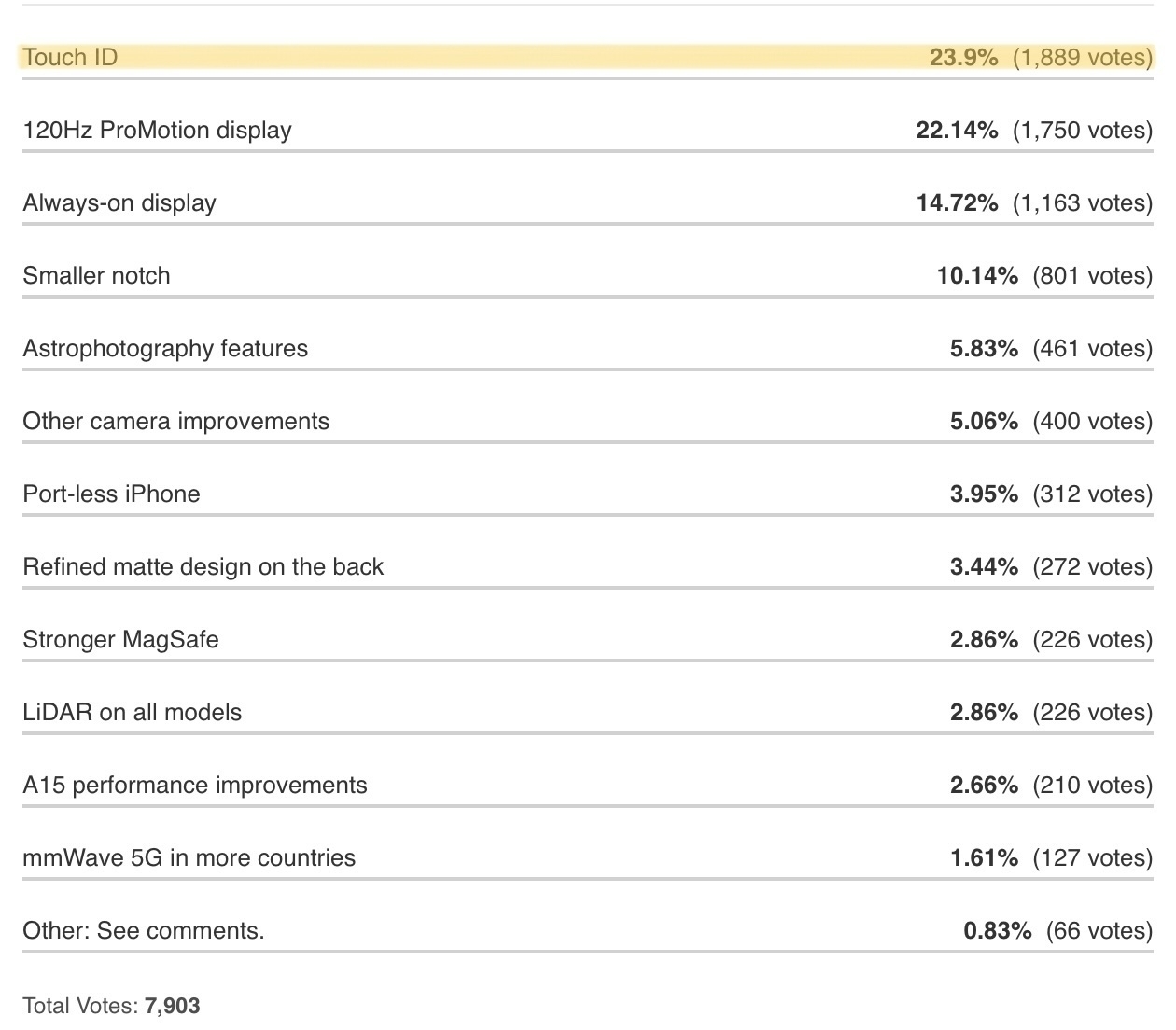
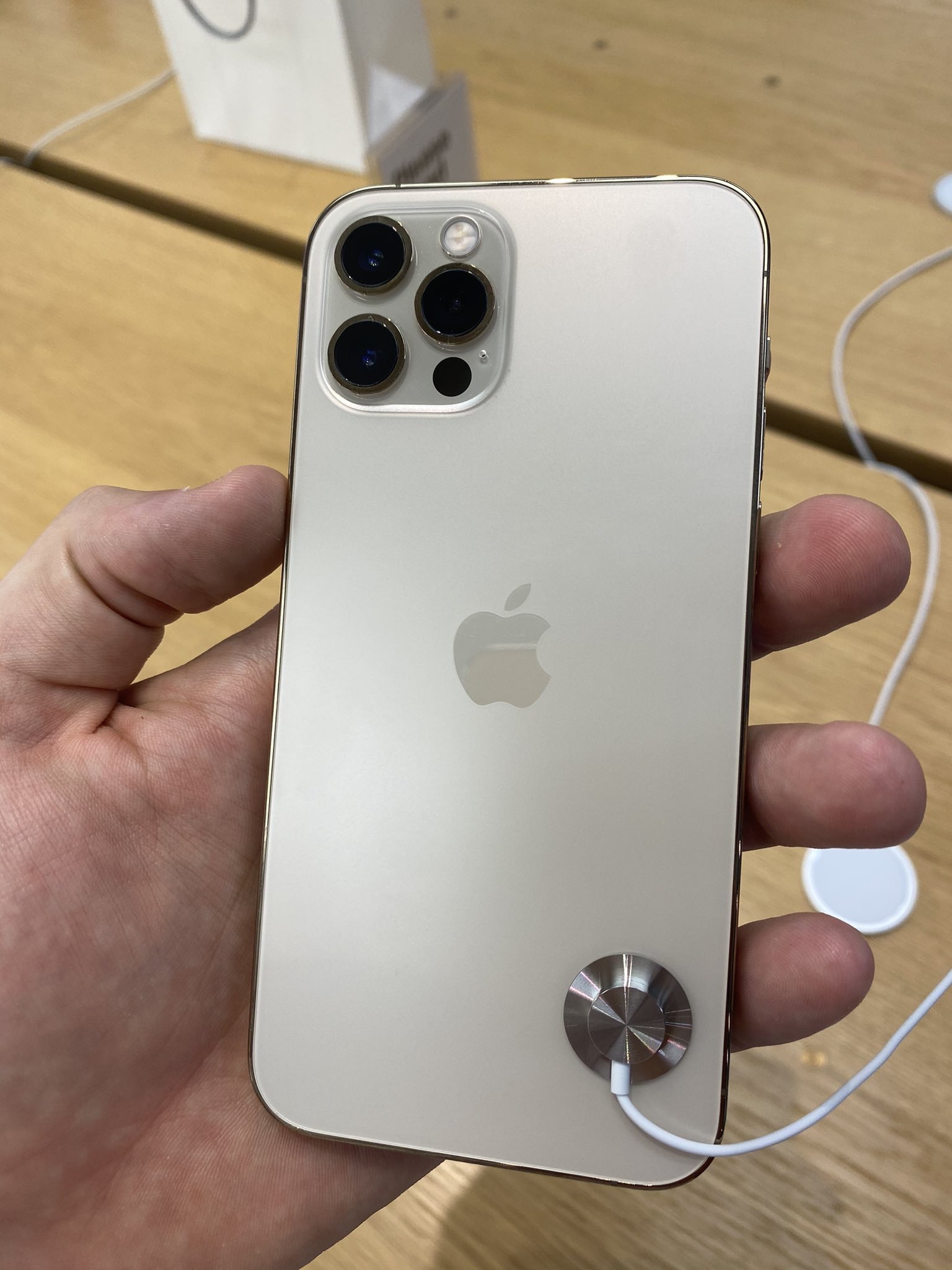
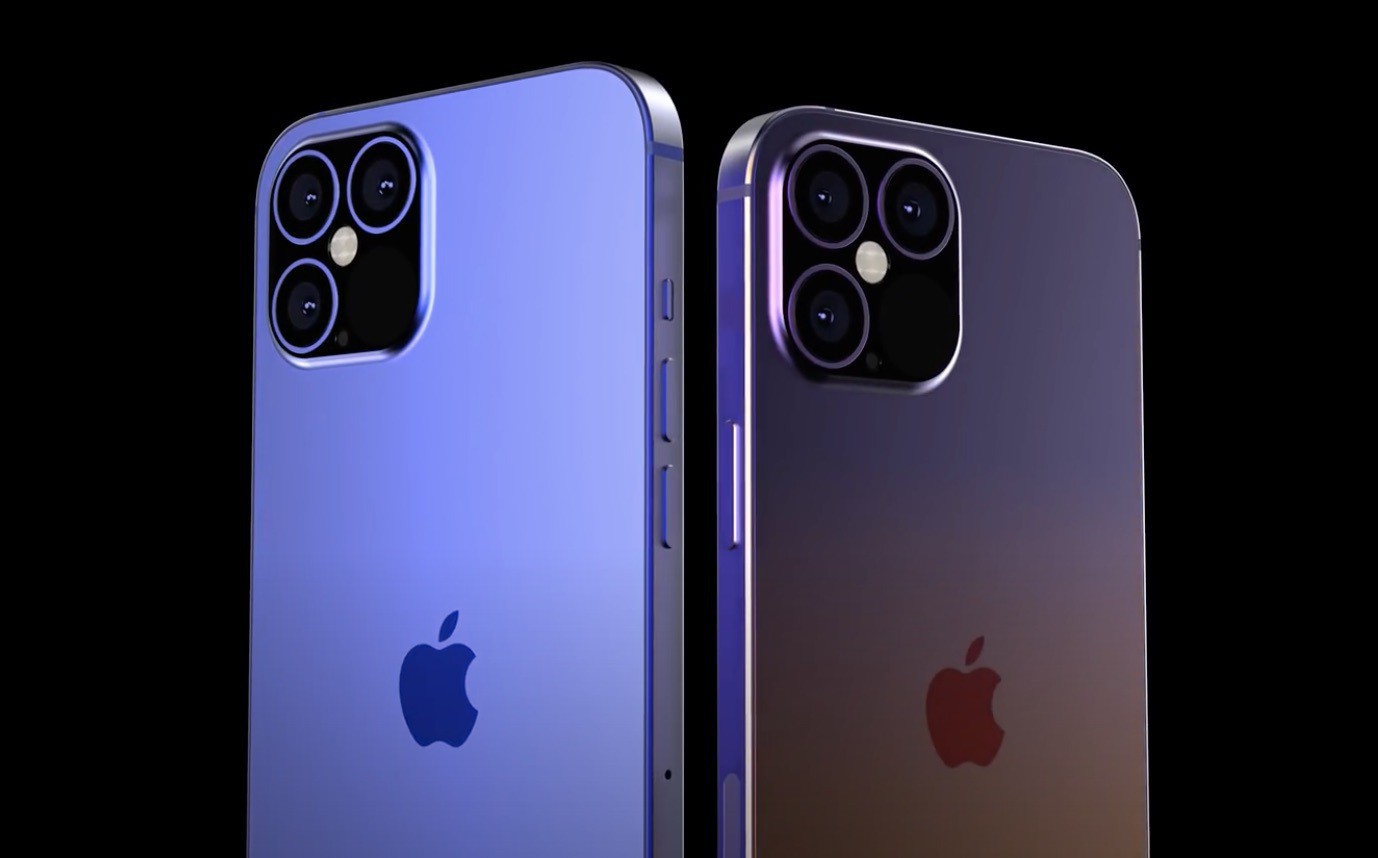
A fan-made concept video depicts Apple’s upcoming foldable “iPhone Ultra” with rumored features including a 7.8-inch display, Touch ID, mechanical hinge, and A20 chip.
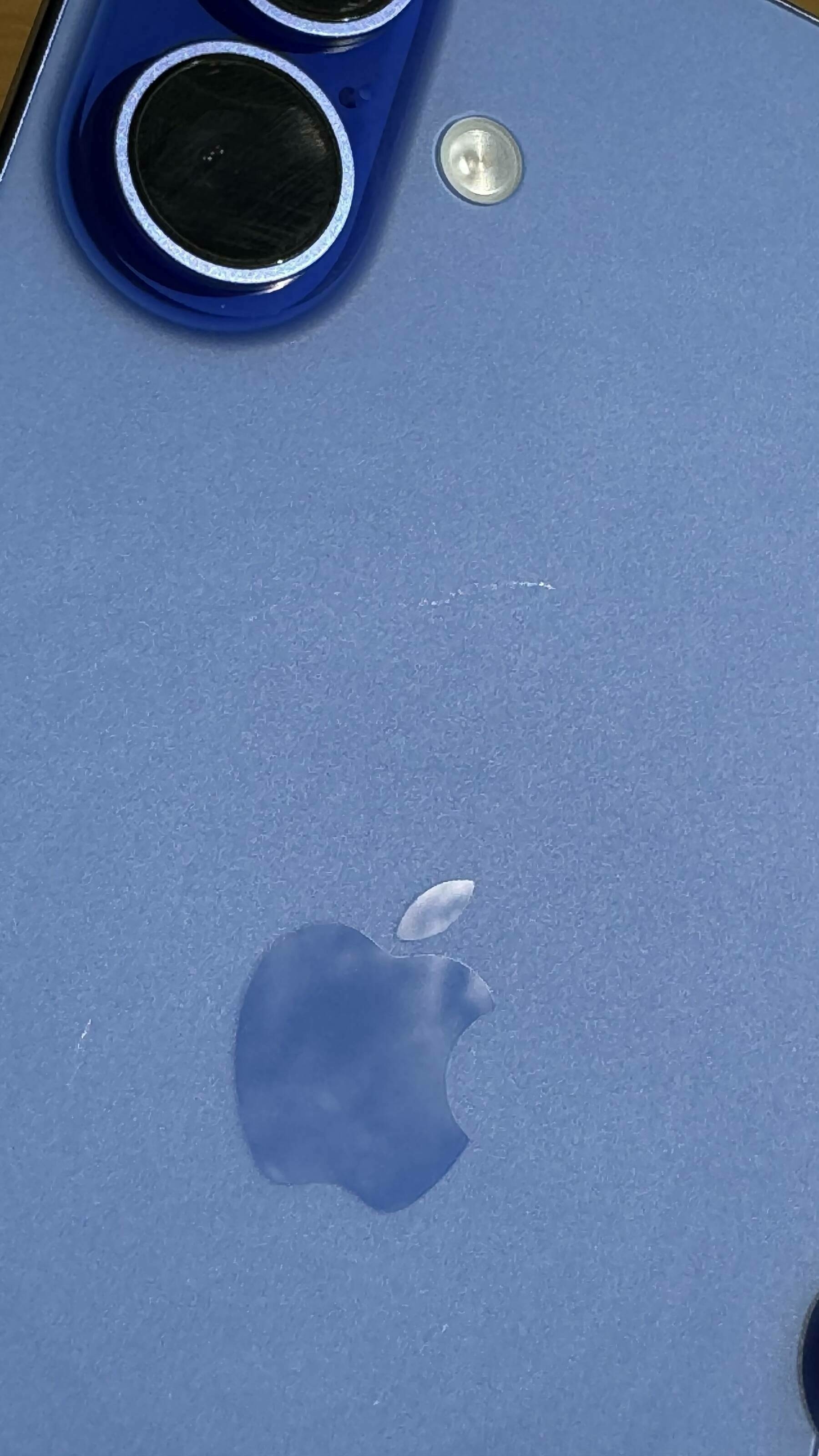
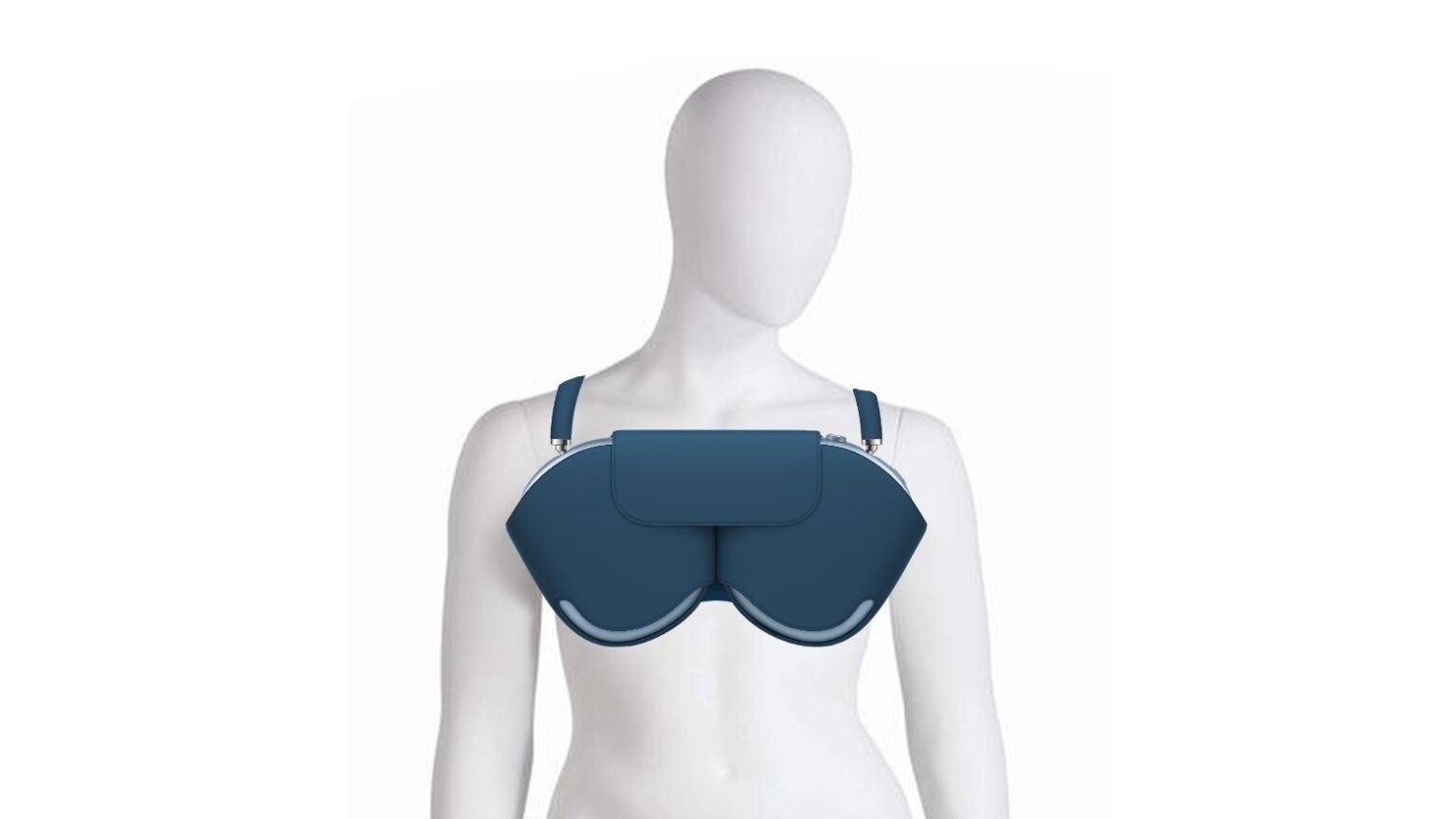
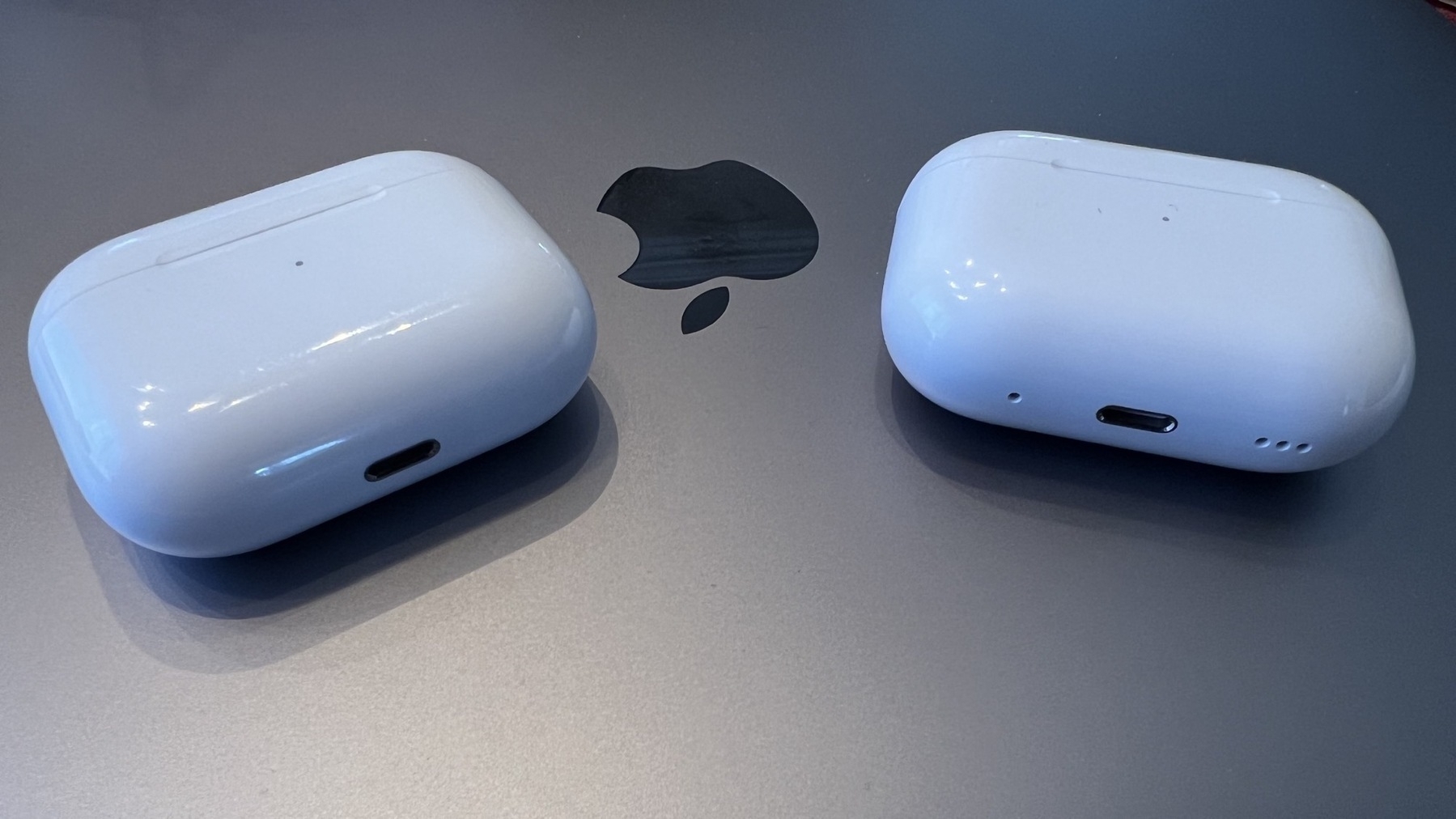
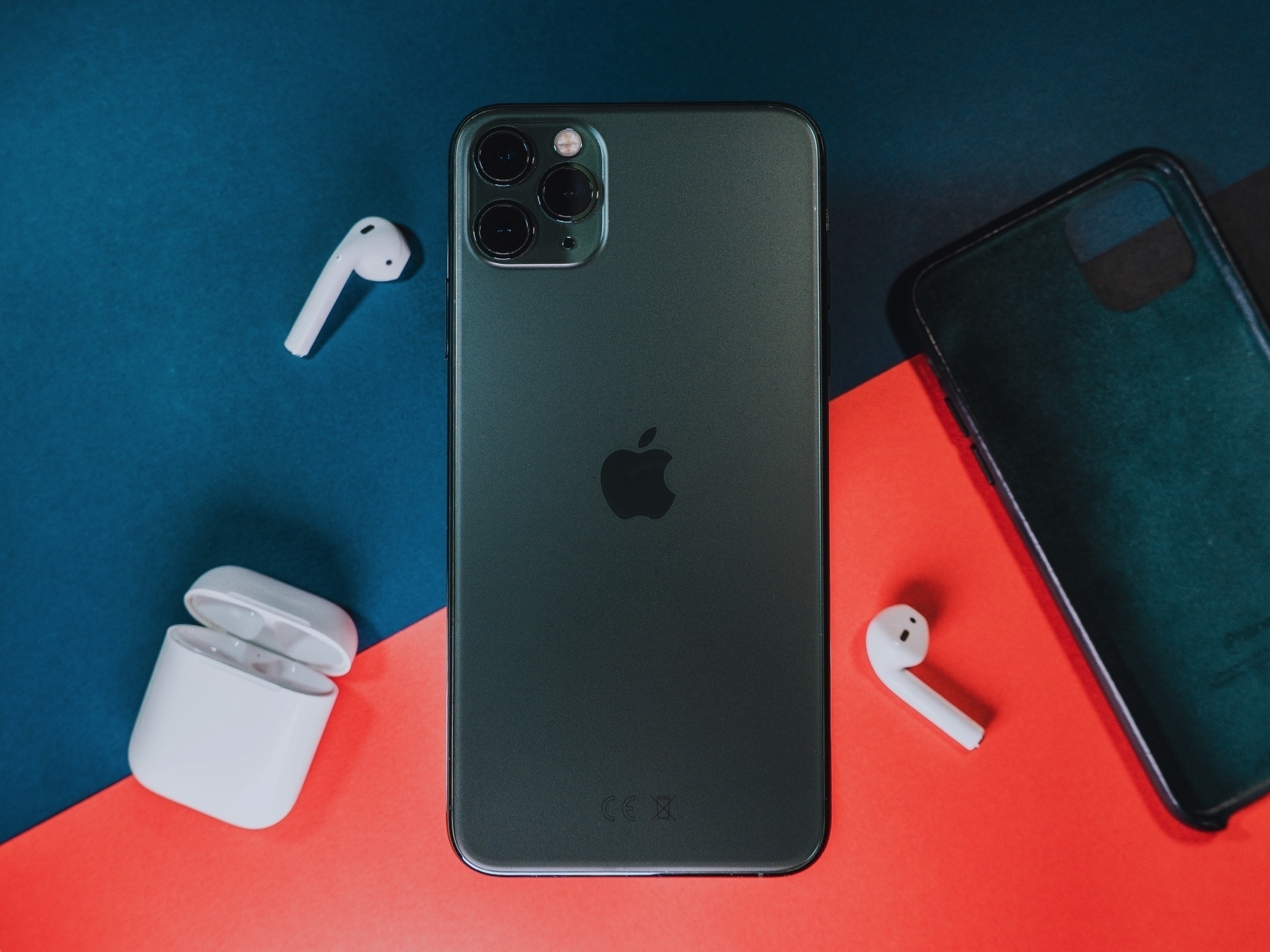
I hope it produces a satisfying ‘click’ when the phone is folded, just like the AirPods case.
2026-08-26 ∞Vibe coding and desktop publishing
Since Claude Code exists, I have noticed a surprising phenomenon: more and more new applications are appearing on the App Store or coming to life as web applications accessible only to their creator-promoter. The process is called vibe coding. When I see people creating new applications with the help of artificial intelligence, I can’t help but think back to the era of the introduction of PageMaker, the LaserWriter laser printer, and the Macintosh. These three elements enabled the democratization of what became known as ‘Desktop Publishing.’ Many people who knew nothing about printing, layout, and design started creating posters, newsletters, etc. The results were not always of very high quality. Fast forward to today: artificial intelligence and tools like Claude Code are bringing us back into a similar context of high-velocity creation. It’s fascinating. The more things change…
2026-08-28 ∞Aiming to discover and read more the web
Recently, I discovered two digital spaces for exploring the web: bubbles.town and Standard Reader. They are two entirely different but complementary approaches. Standard Reader is very focused on discovering publications. Bubbles.town relies on reader participation by letting users vote for an article, similar to Digg. I have set a goal to visit these two spaces every day over the next few weeks.
2026-08-29 ∞“I think the act of writing code manually and having other humans review it to create useful, working software is headed for extinction.”
Agree?
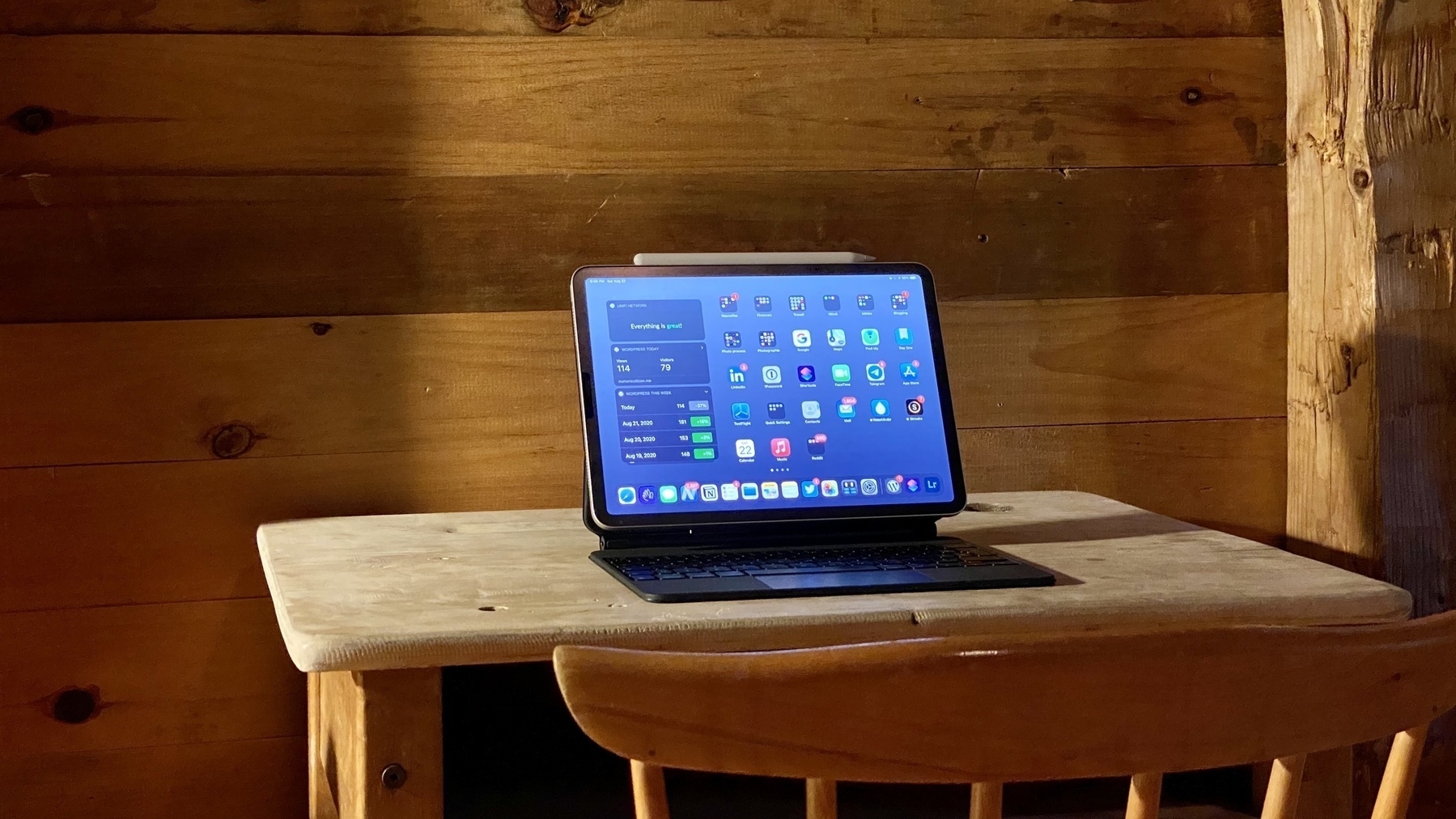
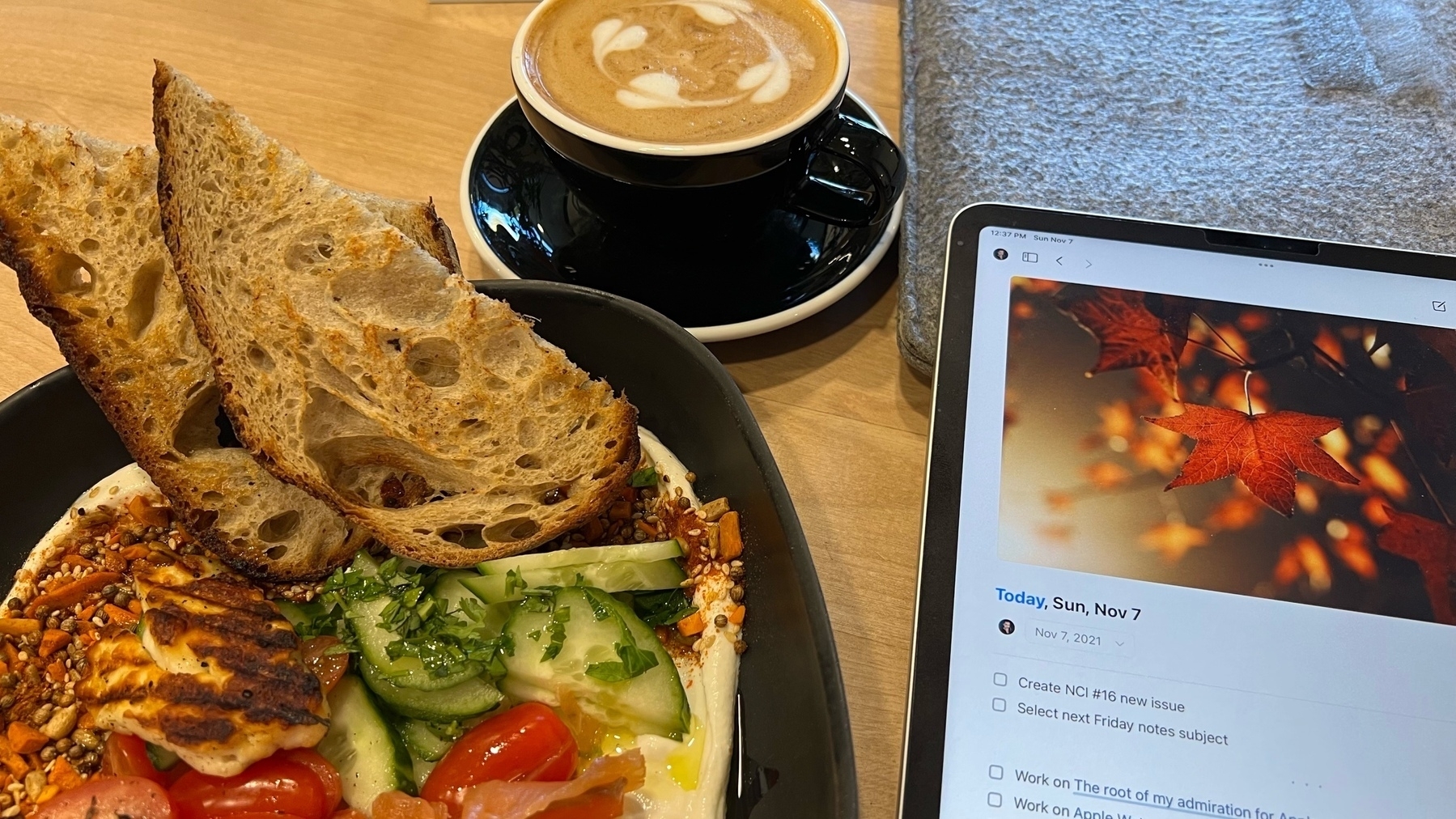
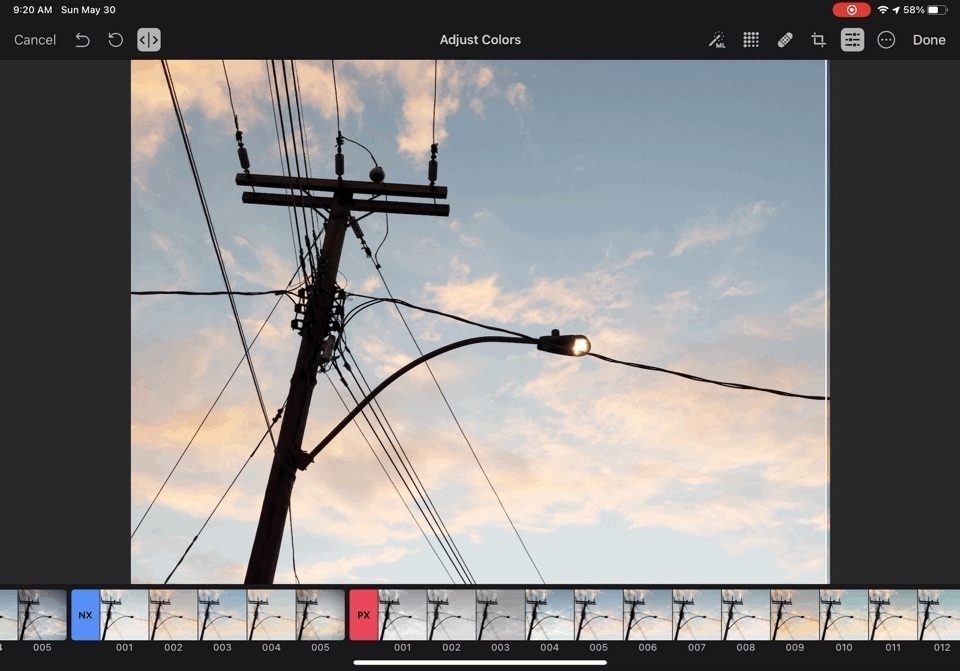
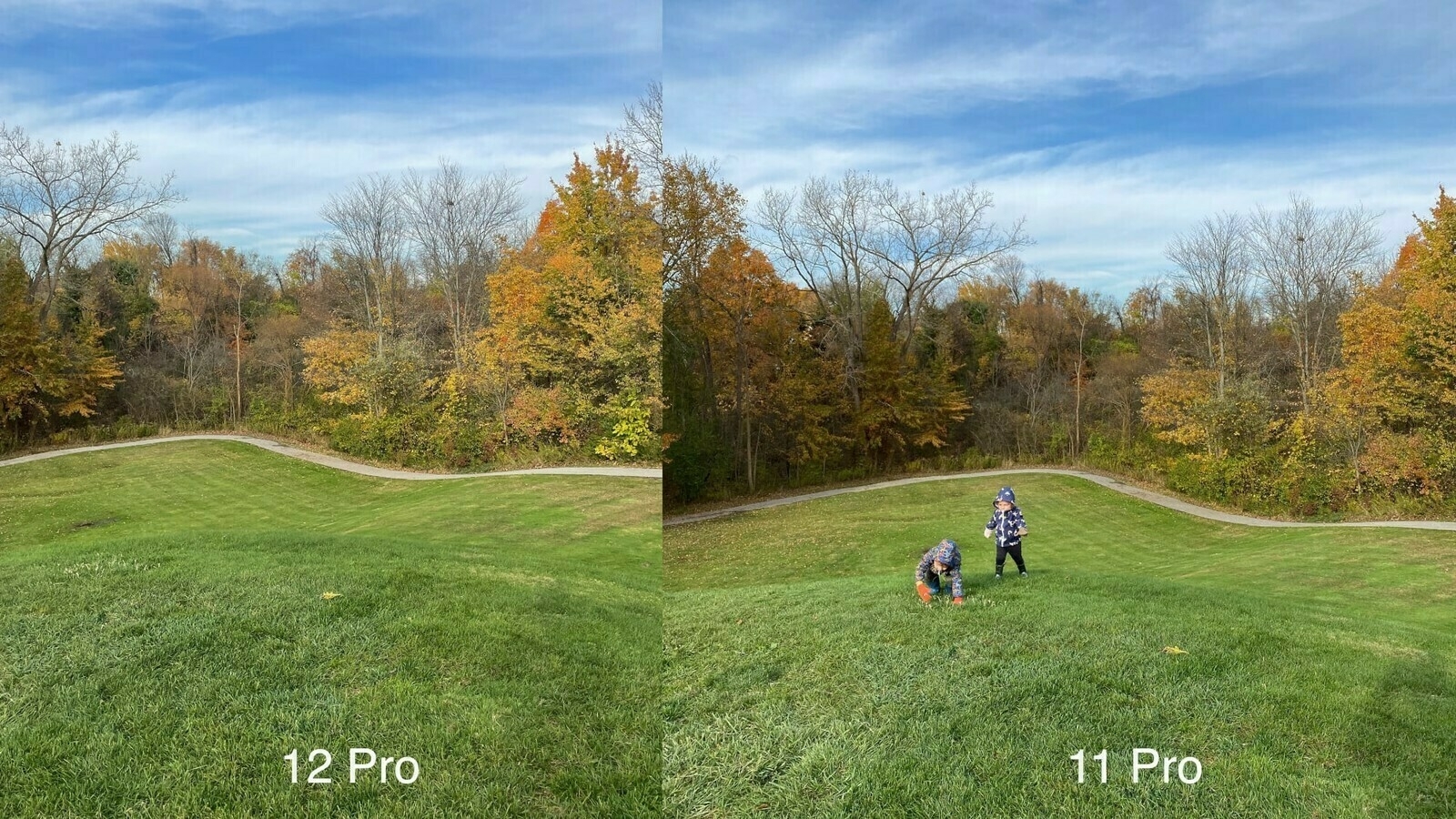
2026-08-29 ∞This photo series is coming to an end, just like summer.
Next up? Fall colors?
2026-08-29 ∞What is my fuckin problem? One moment… please. 👀 I’m so fuckin impulsive. 😱🤦🏻♂️
2026-08-30 ∞Apple at another inflection point?
My interest in Apple’s new leadership, John Ternus in particular, is heating back up. I’m utterly excited to see how Apple under Ternus will be remodelled and transformed. Today’s Bloomberg1 article leaves no doubt that many challenges await Apple. That said, I don’t expect much change, starting with the impending iPhone launch, the last under Cook as CEO while the iPhone 18 line was under development. We have to look further.
-
I’m sorry, I won’t link to a Bloomberg paywalled article, but it’s free to read, under a murky article sharing scam. ↩
Birchfeed might be perfect for me...
Well, what a day… both at work and for my digital hobbies. I saw a teaser from @mattbirchler late last week, which made me think that he might be onto something with RSS feeds… Today I found my answer with the official release of birchfeed.app. There is quite a lot to unpack there.
First, from my experience with Birchfeed after a few hours using it (on the free tier), I came out impressed. It is another case of “build the best tool for myself”. Matt is an RSS feed junky just like me. I also built an RSS reader, but the end result is quite different. It’s not a sync service like Birchfeed, but an RSS reader for a blogroll (i.e. a very limited list of RSS sources).
Second, my RSS reader maintains its own data persistence. It’s not connected with my current RSS sync service: Inoreader. I’d like to have a single source of truth. Birchfeed seems to fit the bill, thanks to its APIs, and it would allow that for a fraction of the cost of using Inoreader APIs. After a quick investigation using Claude AI on my codebase, I could make the switch rather easily, and eventually drop Inoreader when my subscription expires next year. So I’m not in a rush, and Birchfeed will keep improving until then.
But, because I’m a nice guy who likes to support cool guys, I’m might subscribe to Birchfeed right before my free trial ends…
2026-08-31 ∞