The New Apple Finally Begins to Emerge — Parker Ortolani

Molly Anderson’s already proven herself to be an incredibly talented industrial designer, and if the latest iPhones and the MacBook Neo are the first real fruits of her leadership, that bodes incredibly well for the future.

New product design at Apple takes a long time. How much of influence those two new figures had on the MacBook Neo?

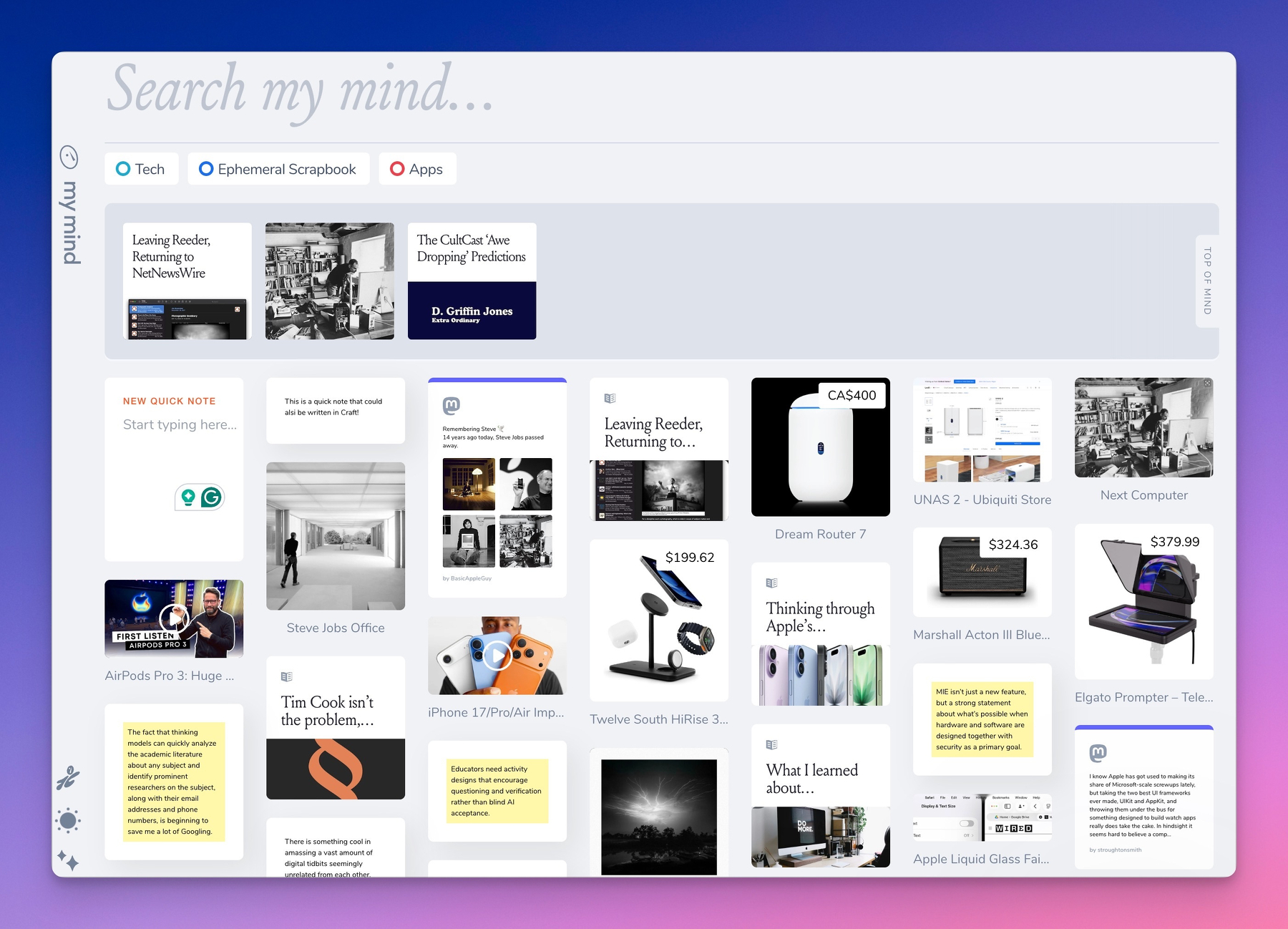
Working on my future bookmarks manager webapp. I’m still refining the specs document. I decided to add the possibility to save text quotes in addition to bookmarks. Quotes might be linked to a bookmark. My specs document is quite long and detailed. I wonder how good Claude Code will be to digest all this from the start.

Neon Signs — Take

Let’s leave the software malaise aside for a moment, hard as that might be; the Neo is a scrappy assemblage of parts, that is trying to find a new route to what Apple considers acceptable, and that is a sign of health.

‘The Window Chrome of Our Discontent’:

This entire idea that application window chrome should disappear is madness. Some people — at Apple, quite obviously — think it looks better, in the abstract, but I can’t see how it makes actually using these apps more productive. Artists don’t want to use invisible tools.

Well, if window chrome is absent, what’s left for Apple to differentiate itself from others than UI elements inside a window? Buttons!

A UI should step back and let user content come forward. But Apple often treats the UI itself as a key part of its identity and differentiation. That creates a tension: the more the UI disappears, the harder it becomes for Apple to stand apart from Microsoft or Google.

I’m really tempted by the MacBook Neo, but really, it makes no sense as an owner of an M4 iPad Pro with a Magic Keyboard: it’s a powerhouse in a compact design. The only problem: iPadOS. It’s THE biggest issue in this story.

Good Job Apple, Now Back to Software?

Ok, Apple did a great job this week. A lot has already been said about Apple’s announcements. The MacBook Neo is a killer, even as an entry device. My wife is getting one. It’s the original Mac mini in a laptop shape. Apple did a great balancing act with the Neo. The only two quibbles: only 8 GB of RAM (I wanted 12 GB) and the lack of a MagSafe port.

Now, I hope Apple can do as good a job on the software as it did on the hardware. There is so much to fix.

One vendor doesn’t mind high RAM prices: VMware — The Register

The high price of memory and solid-state storage has almost everyone worried – but not VMware, because the most innovative new feature in the Cloud Foundation 9 (VCF 9) private cloud suite it launched last year is memory tiering tech that allows offload of data from RAM to NVMe drives.

VMware has always promoted VCF 9 memory tiering as offering the chance to reduce infrastructure costs by reducing the amount of RAM needed in new servers, and by creating the opportunity to upgrade the NVMe drives in old boxes and effectively increase their memory capacity.

Well, yeah, memory tiering certainly helps reduce the cost of servers, but even NVMe drives, which are built on electronic chips too, are impacted by price increases. And, servers must be compatible with this feature. No magic bullet here.

People’s reactions to Apple hardware announcements so far have been quite positive, if not enthusiastic, much more so than any software announcements in recent years. The difference is stark.